
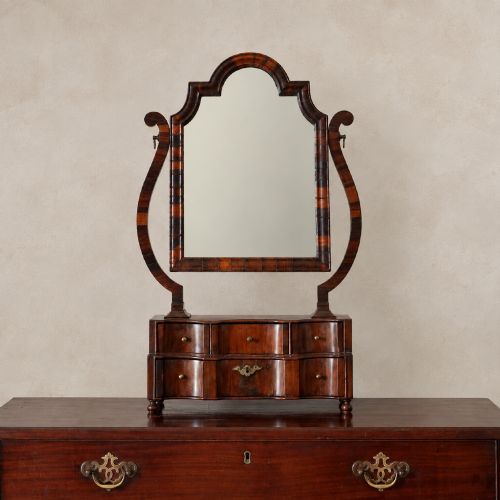
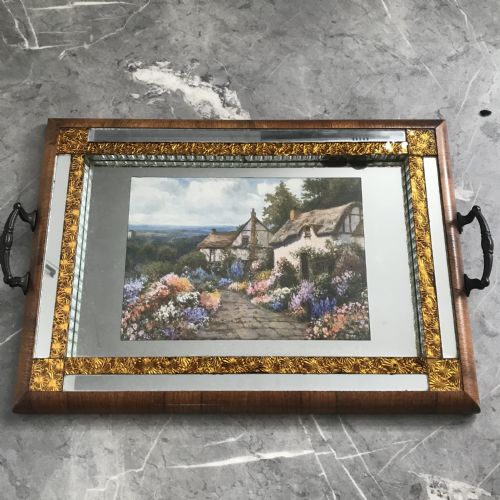


Walnut Veneer Mirror
These walnut veneer mirror pieces offer figured grain and deep warmth, bringing centuries of cabinet-making skill straight to your wall.
Walnut Veneer Mirror
A walnut veneer mirror brings together figured wood and reflective glass, spanning periods from the seventeenth century through to the art deco era. When you search for a walnut veneer mirror, you encounter forms ranging from small cushion-framed dressing pieces to large overmantels designed for the parlour.
The selection here draws heavily on seventeenth-century styles with oyster-cut patterns, alongside eighteenth-century Queen Anne and Georgian wall mirrors. You also meet nineteenth-century Victorian overmantels and twentieth-century interpretations, showing how makers adapted the timber across successive generations.
Materials and construction
Makers laid thin slices of figured walnut or laburnum timber over a secondary wood base, creating symmetrical patterns and complex geometric displays. Oyster veneer involved cross-cutting small branches to reveal circular rings, which workers arranged closely across the entire frame.
Makers incorporated brass hardware, mirror glass plates, and parcel gilding to complement the rich brown tones of the timber. Frames often utilised construction methods that allowed wood to expand and contract naturally without splitting the delicate surface layer.
Listings feature walnut, laburnum, and brass across periods spanning the seventeenth century to the art deco era.
Assessing quality and craftsmanship
Quality rests in the selection of the timber and the precision of the grain matching across the frame. Finer examples display carefully aligned oyster cuts or rich burr walnut patterns that wrap seamlessly around the corners and moulding profiles.
The integrity of the surface finish and the retention of original mirror plates dictate the standing of a piece. Better workshops achieved smooth, even polishes that enhanced the natural figures of the wood without masking the grain beneath.
Jean Faure
The Walnut Veneer Mirror Glossary
- Veneer
- A thin layer of figured wood applied to a structural base timber. This technique allowed cabinet-makers to utilise striking grain patterns while ensuring structural stability.
- Oyster veneer
- Circular slices cut transversely from small branches or roots. These sections form repeating patterns resembling oyster shells across the surface of the frame.
- Cushion frame
- A moulded frame profile with a rounded, convex sweep resembling a cushion. This style was particularly popular during the seventeenth century.
- Parcel gilt
- Partially gilded with thin gold leaf applied to specific carved details. It highlights architectural elements against the dark walnut background.
- Overmantel mirror
- A large mirror designed to hang directly above a fireplace mantelpiece. These pieces often feature proportions scaled to balance the hearth below.
Walnut Veneer Mirror: Frequently Asked Questions
How do I clean my mirror?
Dust the wooden frame gently with a dry, soft cloth to prevent accumulation. Avoid commercial sprays or harsh solvents that might damage the historic polish.
Clean the glass plate using a cloth lightly dampened with water or mild glass cleaner. Keep moisture away from the edges where the glass meets the wooden frame and backing.
Where should I hang it?
Choose a wall away from direct sunlight and damp conditions to protect the delicate timber veneer and historical finish. Stable indoor temperatures prevent the wood and backing materials from warping.
Ensure the wall fixings match the weight of the frame and securely engage the wall studs or masonry. Proper hanging hardware distributes the weight evenly and prevents strain on antique joints.
Are the mirror plates original?
Older mirrors often display slight foxing, minor pitting, or soft distortions within the glass. These subtle irregularities reflect age and confirm the traditional manufacturing process.
Replacement glass appears clearer and lacks the characteristic surface variations found in historic plates. Examining the edges and the backing boards often reveals whether the plate has remained undisturbed.
How do I date the style?
Examine the moulding profiles, the construction of the backing boards, and the pattern of the wood veneer. Seventeenth-century examples often feature cushion frames and oyster cuts, whilst Georgian pieces lean towards fretwork and gilt accents.
Check for hand-cut screws, peg joints, and the type of secondary wood used in the carcass. These hidden construction details provide clear clues regarding the period of manufacture.