
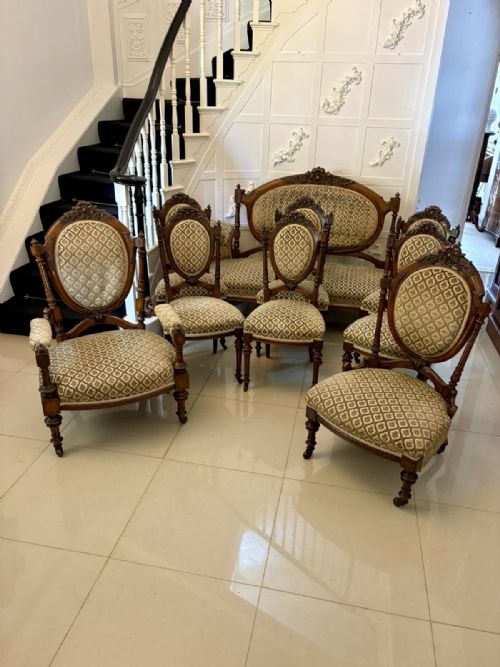
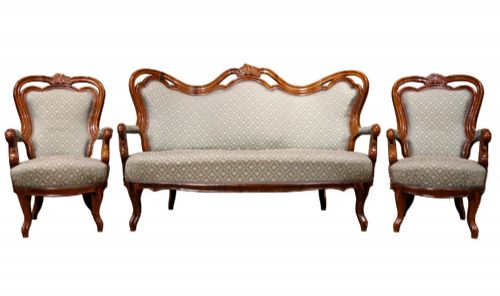


Walnut Sofa and Armchairs
These walnut sofa and armchairs sets bring matched warmth and period character to a room through coordinated timber frames and upholstery.
Walnut Sofa and Armchairs
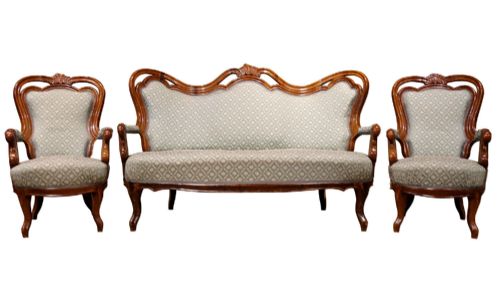
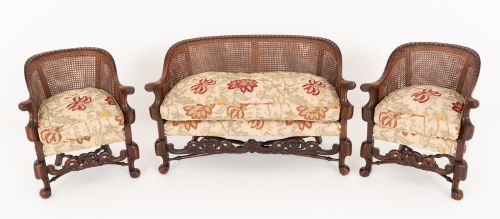
A walnut sofa and armchairs grouping offers a matched set of seating, typically comprising a settee or sofa alongside a pair of armchairs designed in a unified style. Buyers encounter everything from compact three-piece arrangements to large multi-piece drawing room suites spanning multiple seats.
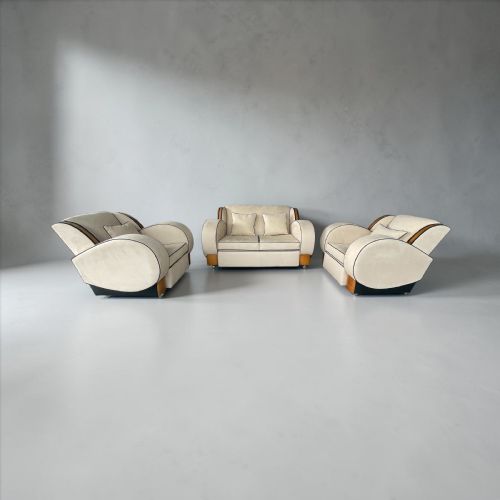
The selections range across distinct historical periods, featuring 19th-century Victorian carvings alongside early 20th-century Art Deco forms. Pieces span continental European salons, English drawing rooms, and specific revival aesthetics like the Carolean and Louis XV styles.
Forms include traditional salon suites, lounge suites, and parlour sets, with occasional miniature apprentice pieces appearing among the full-scale seating. Many sets retain their original character through period upholstery in fabric, leather, velvet, or damask.
How the walnut sofa and armchairs were made
Frames are constructed predominantly from walnut and burr walnut hardwoods, chosen for their rich grain patterns and durable structural qualities. Skilled makers shaped these timbers into elaborate carved flourishes or smooth, sweeping Art Deco curves.
Upholstery techniques integrate traditional textiles such as damask, velvet, leather, and woven fabrics, often secured over supportive sprung or padded interiors. Brass detailing and marquetry inlay occasionally provide additional decorative accents to the timber frames.
Listings feature walnut timber alongside diverse upholstery materials including leather, damask, velvet, and standard textiles.
What varies in quality
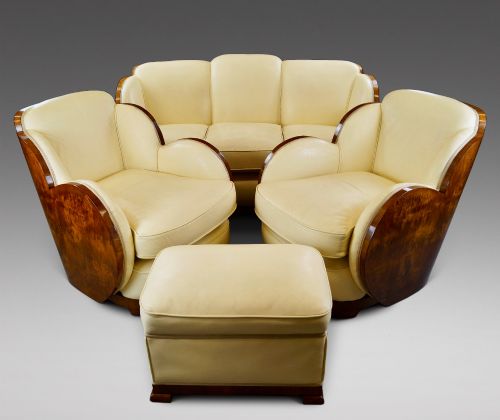
The refinement of the timber carving and the complexity of the wood grain set individual suites apart, with exhibition-quality pieces displaying deep, intricate relief work. Smooth, figured burr walnut veneers require precise execution to maintain visual harmony across a multi-piece suite.
Cohesion within the set dictates overall merit, as matching frames, proportional scale between the sofa and armchairs, and sympathetic upholstery retain the maker's original vision. Suites that preserve their matching suite components intact demonstrate superior provenance compared to assembled groupings.
Howard and Sons·Epstein
The Walnut Sofa and Armchairs Glossary
- Salon suite
- A coordinated set of seating furniture designed for formal reception rooms, usually comprising a settee and matching armchairs.
- Bergere
- An enclosed upholstered armchair with wooden framing exposed around the sides and back, frequently featuring cane panels.
- Marquetry
- Decorative patterns formed by fitting together thin veneers of wood onto a structural surface.
- Carolean style
- A revival aesthetic emulating the ornate carved wood designs characteristic of the English Restoration period.
- Cloud suite
- An influential 20th-century seating design defined by rounded, voluminous upholstered shapes reminiscent of cumulus clouds.
Walnut Sofa and Armchairs: Frequently Asked Questions
How do I clean walnut frames?
Dust the timber surfaces regularly with a soft, dry cloth to prevent the accumulation of grit in carved crevices.
Apply a microcrystalline wax periodically to nourish the walnut and maintain a protective sheen without building up heavy residues.
Can I reupholster these suites?
Professional reupholstery preserves the structural integrity of antique frames while allowing the fabric to match modern interior requirements.
Select textiles that respect the historical period of the suite, whether choosing damask for Victorian pieces or leather for Art Deco designs.
What defines an Art Deco suite?
Art Deco seating relies on streamlined geometric forms, smooth walnut surfaces, and cloud-like padded contours rather than heavy carving.
These suites reflect 1930s modernist design principles, prioritizing clean silhouettes and functional comfort over traditional ornamentation.
How do I date a set?
Examine the framing styles, joinery methods, and upholstery materials to align the pieces with documented Victorian, Edwardian, or 1930s manufacturing trends.
Victorian pieces often feature ornate carved walnut and damask, whereas later 20th-century examples display simplified silhouettes or characteristic cloud shapes.