
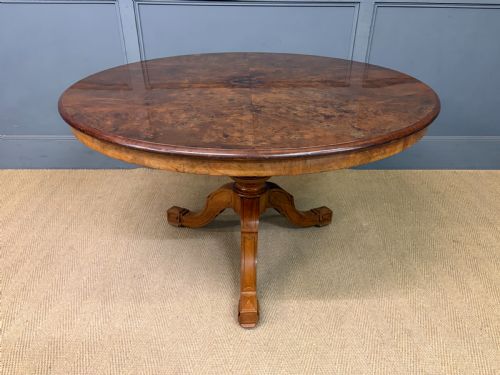

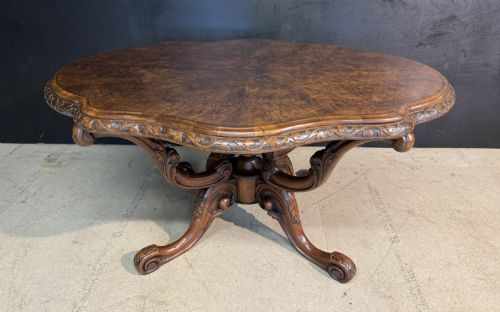
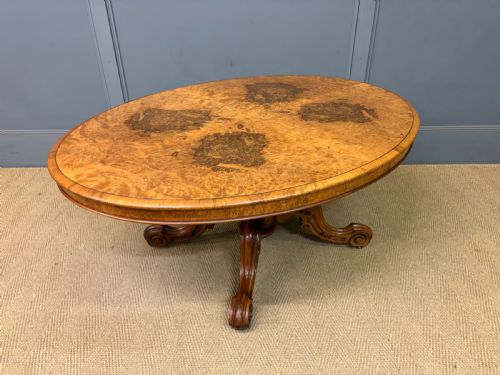
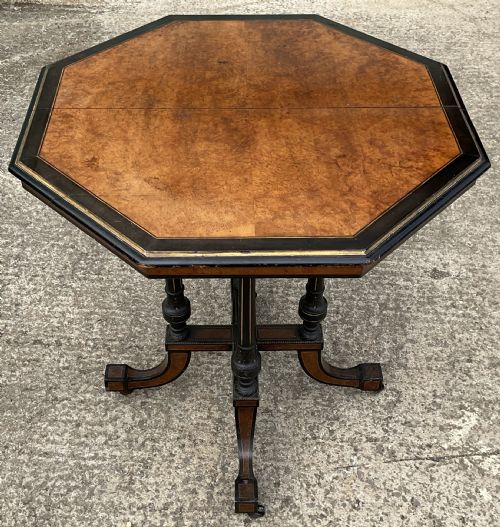
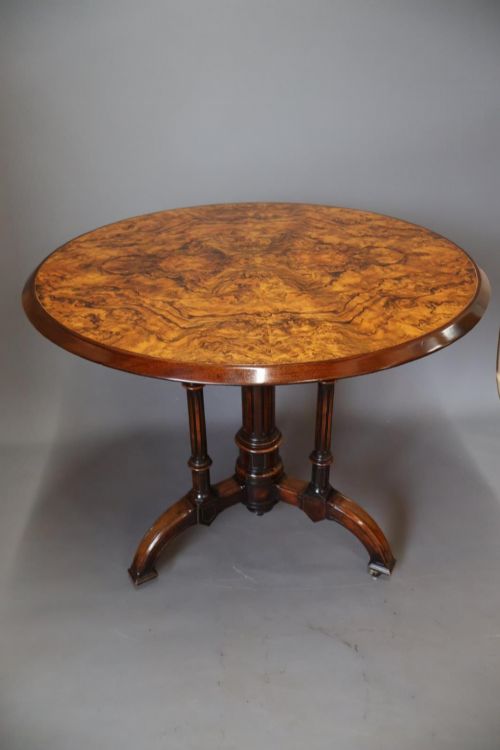


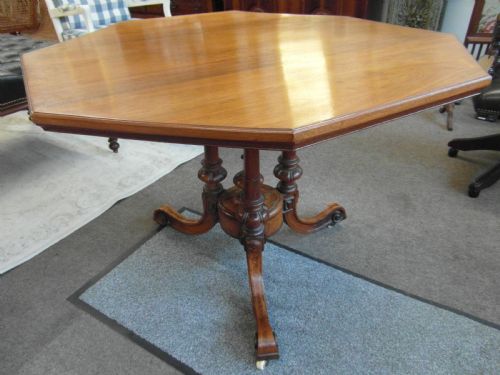
Walnut Quadruped Table
These walnut quadruped table pieces are sturdy four-footed designs in rich timbers, built to anchor a Victorian or Edwardian room.
Walnut Quadruped Table
When you search for a walnut quadruped table, you are looking at substantial Victorian and Edwardian timber furniture designed for central room placement or occasional use. The selection spans the nineteenth century up to the Edwardian period, encompassing forms intended for varied domestic utility.
The version you are most likely to meet on this page is the Victorian centre table or occasional table, frequently rendered in burr walnut with oval or octagonal top shapes. These pieces often feature pedestal bases supported by four feet, alongside specialised card, games, and loo tables.
Makers and workshops of the era utilised rich veneers and varied geometric formats to create functional surfaces for the parlour or drawing room. Examples range from compact window tables to large coffee tables adapted from earlier formats.
How they were made
Cabinet makers constructed these tables using solid timber frames overlaid with figured veneers, principally burr walnut, chosen for its swirling grain patterns. Secondary decorative elements frequently incorporate boxwood inlay, amboyna mounts, and ebonised hardwood details.
Surface ornamentation relied heavily on floral marquetry and hand-carved pedestal bases, sometimes supported by brass fittings or castors beneath the four-footed mounts. Joinery techniques ensured stability across wide oval, octagonal, and rectangular table tops.
Listings span the Victorian and Edwardian periods, featuring burr walnut, amboyna, boxwood inlay, and ebonised hardwood across centre and occasional table forms.
What varies in quality
Quality in these tables rests on the selection of the timber veneers and the crispness of the marquetry and boxwood inlay. Burr walnut with dense, highly figured grain patterns distinguishes the finer examples from plain timber surfaces.
The execution of the hand-carved base and the complexity of the form - such as an octagonal shape or amboyna mounting - demonstrate the maker's skill. Structural integrity in the four-footed support and the preservation of the original polished finish further separate the tiers of craftsmanship.
Gillows
The Walnut Quadruped Table Glossary
- Burr walnut
- A prized timber veneer taken from the warted growths of the walnut tree, showing intricate, swirling grain patterns. It was widely utilised on Victorian table tops to create decorative visual impact.
- Quadruped
- A table base supported by four feet or a four-way branch from a central pedestal. This configuration provides balanced weight distribution for large centre and card tables.
- Marquetry
- The art of applying decorative pieces of veneer to a structure to form intricate floral or geometric designs. It appears frequently on the top surfaces of Victorian games and card tables.
- Amboyna
- An exotic, highly figured timber used for contrasting mounts and banding on superior nineteenth-century furniture. Its warm, spotted grain complements darker walnut veneers.
- Loo table
- A large round or oval Victorian table originally intended for the card game loo. These pieces typically feature a tilt-top mechanism supported on a heavy pedestal base.
Walnut Quadruped Table: Frequently Asked Questions
What is a walnut quadruped table?
A walnut quadruped table is a nineteenth-century or Edwardian piece featuring a walnut or burr walnut surface supported by a four-footed base. These items were built primarily as centre, card, or occasional tables for Victorian parlours.
The quadruped design offers structural stability and balance, accommodating the weight of heavy timber tops while allowing decorative carving on the pedestal and feet.
How do I date a walnut table?
Dating relies on examining the timber, construction methods, and stylistic cues such as marquetry inlay or ebonised details. Most pieces on this page originate from the Victorian era between 1860 and 1880, with occasional Edwardian examples.
Cabinet makers of the nineteenth century favoured specific veneers like burr walnut and amboyna, alongside brass hardware and hand-carved motifs that align with the Aesthetic Movement and Victorian design periods.
Were these tables used for dining?
Most of these tables were designed for display, conversation, or parlour games rather than formal dining. Centre tables and occasional tables held lamps and decorative objects, while card and games tables featured fold-over tops.
Specific variants like loo tables served multiple functions in the drawing room, shifting from card playing to general social use as domestic habits evolved through the nineteenth century.
How do I care for burr walnut?
Burr walnut requires stable indoor humidity and protection from direct sunlight to prevent the delicate veneers from drying or fading. Regular dusting with a soft, dry cloth preserves the polished surface.
Avoid placing these tables near direct heat sources, and treat the wood periodically with appropriate furniture wax to maintain the depth and grain of the antique timber.