
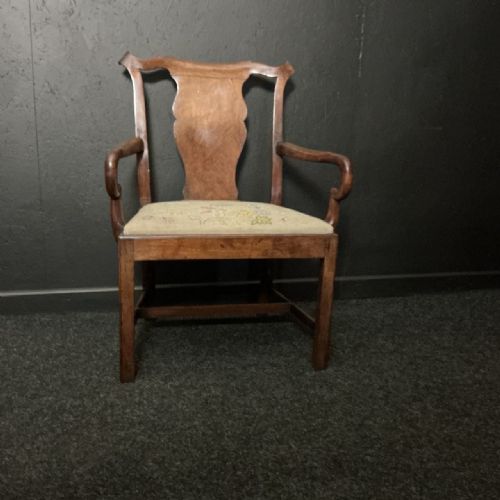


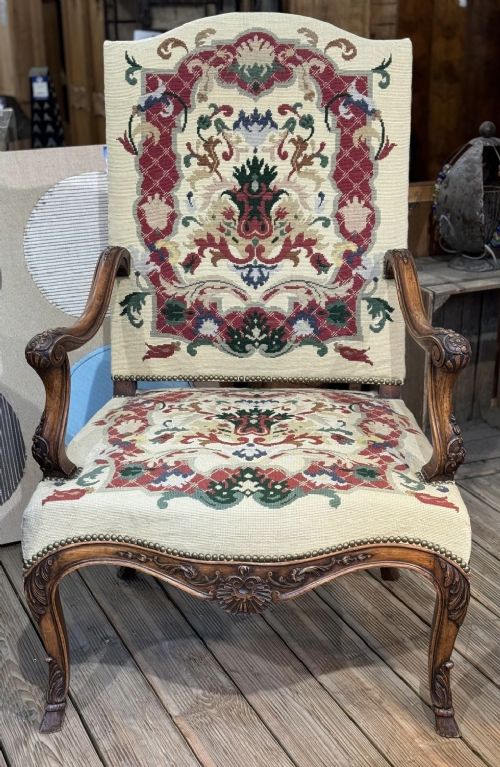

Walnut Needlepoint Armchair
A walnut needlepoint armchair brings rich timber frames and hand-stitched upholstery together for daily sitting.
Walnut Needlepoint Armchair
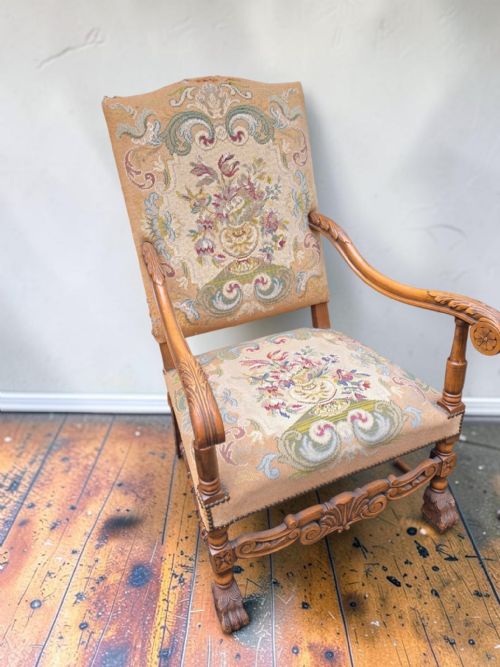
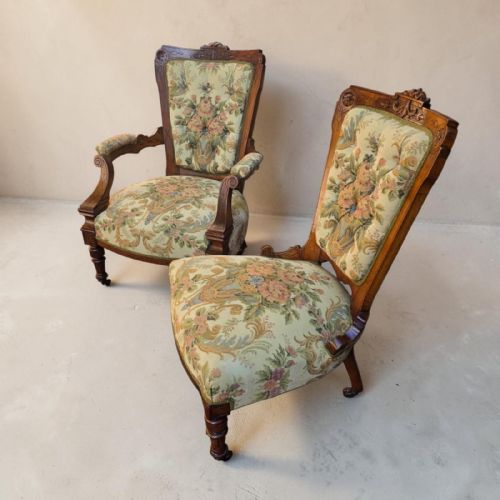
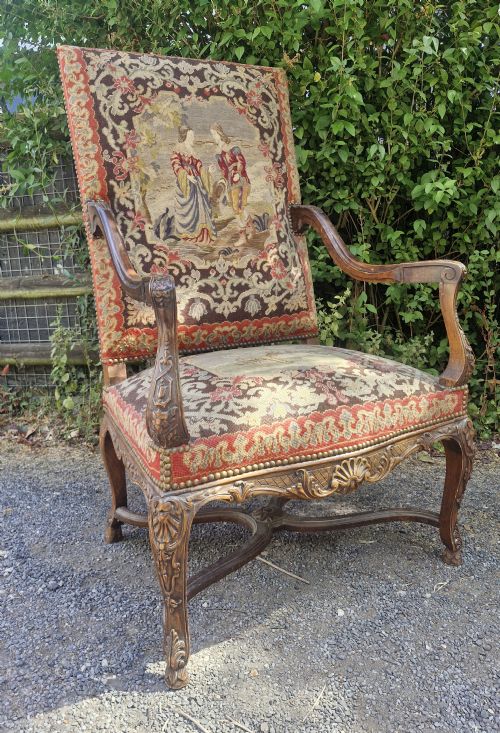
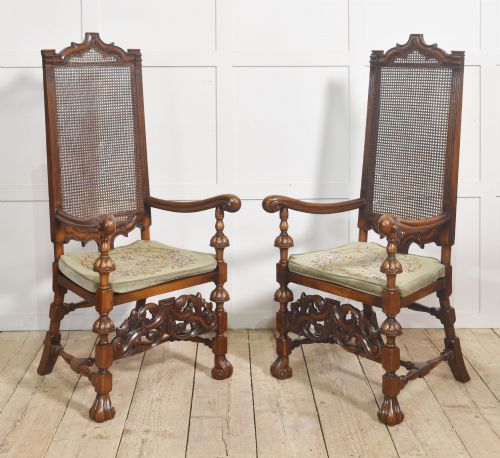
A walnut needlepoint armchair combines a timber frame with hand-worked wool tapestry upholstery, spanning periods from the eighteenth century through to the early twentieth century. Buyers seeking a walnut needlepoint armchair will find frequent examples originating in Victorian England and continental France, taking forms such as open armchairs, nursing chairs, and salon chairs.
The domestic seating found here ranges from large nineteenth-century library and reading chairs to smaller occasional and children's variants. English country house pieces and French revival designs dominate the selection, offering varied frame carvings and seat proportions.
How they were made
Frames are constructed from solid walnut, frequently shaped with hand-carved details, scroll backs, or curved arms reflecting styles from Louis XV revival to Victorian rococo. Joinery relies on traditional methods to support the substantial weight of the timber and the stresses of daily use.
Upholstery consists of wool needlepoint, tapestry fabric, or petit point stitched by hand, often secured to the frame with brass tacks. Textile panels display floral or figurative motifs, stretched tightly over internal stuffing and webbing.
The inventory records children's armchairs alongside full-scale open armchairs, nursing chairs, and occasional seating.
What varies in quality
The refinement of the walnut framing separates standard production from exceptional pieces, visible in the depth of hand-carving and the crispness of moulded scrollwork. Timber selection also matters, with richly figured grain commanding greater regard than plain stock.
Needlepoint quality is defined by the density of the stitch work and the complexity of the tapestry design. Fine petit point execution and intact historical textiles elevate a chair above standard replacement upholstery.
The Walnut Needlepoint Armchair Glossary
- Needlepoint
- A type of embroidery stitched on a stiff open-weave canvas ground. It forms the primary decorative textile surface on these chair backs and seats.
- Petit point
- A fine form of needlepoint executed with smaller stitches on a finer mesh. This technique allows for greater detail in figurative and floral tapestry panels.
- Fauteuil
- An open-armed upholstered armchair with exposed wooden sides. French examples from the nineteenth century frequently utilise this form.
- Spoonback
- An upholstered chair back curved in the vertical plane to resemble the bowl of a spoon. This shape appears frequently on mid-nineteenth-century Victorian walnut pieces.
- Carolean revival
- A decorative style imitating late seventeenth-century English furnishings. Frames feature characteristic scrolls, carved cresting rails, and turned supports.
Walnut Needlepoint Armchair: Frequently Asked Questions
How do I clean needlepoint upholstery?
Needlepoint requires gentle surface cleaning with a soft brush to remove dust from the wool fibres. Avoid heavy moisture or chemical solvents that might damage the historical threads and internal stuffing.
Professional textile conservation is recommended for older tapestries showing deep staining or structural weakness. Regular gentle vacuuming through a mesh screen protects the delicate wool stitches.
Are these chairs suitable for daily seating?
Most nineteenth and twentieth-century examples function well for regular sitting when the frame joints and internal webbing are sound. Heavier library and open armchairs offer robust support for everyday use.
Smaller nursing chairs and delicate French salon pieces suit lighter seating duties. Check that the walnut frame remains rigid before placing the chair into daily service.
How can I tell a French chair from an English one?
French chairs often display carved Louis XV revival or chateau styling with flowing cabriole legs and exposed walnut frames around upholstered panels. English pieces more commonly follow George I, Georgian, or Victorian stylistic conventions.
Proportions and carving motifs also separate the regions, with French frames favouring asymmetrical floral sweeps. English designs tend toward structured scroll backs and bolder timber turnings.
What is the difference between a nursing chair and a salon chair?
Nursing chairs feature lower seats designed for comfort during domestic tasks, often paired with an upholstered scroll or spoon back. Salon chairs stand higher and were built for formal entertaining in reception rooms.
Occasional and reading chairs offer broader proportions for relaxation. Each form serves a distinct function within period domestic interiors.