

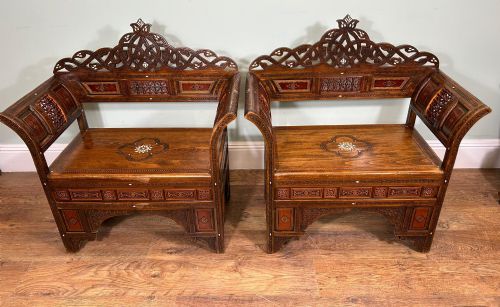


Walnut Marquetry Chair
These walnut marquetry chair pieces bring layered floral and geometric veneers into a room, offering sturdy seventeenth and eighteenth-century seating forms.
Walnut Marquetry Chair
A walnut marquetry chair search reveals seating from the eighteenth and nineteenth centuries, alongside Edwardian and later examples. The core of this inventory is formed by Dutch high-back dining chairs, side chairs, and elbow carvers featuring elaborate floral and bird veneers.
Beyond the standard dining and side forms, the evidence shows armchairs, library chairs, salon suites, hall benches, and occasional musical chairs. Many carry distinct regional influences such as Swiss, Moorish, and Syrian workshops.
Buyers frequently encounter pairs and larger sets, particularly from eighteenth-century Dutch production and nineteenth-century revivals. These pieces function well as single accent items or matched groups around a dining table.
How they were made
Cabinetmakers used solid walnut for structural framing, legs, and stretchers, while applying contrasting veneers to the backrests and seats. Fruitwood inlay, bone, and lighter woods were precisely cut and set into the walnut ground to build pictorial floral and scroll designs.
Inlaid sections were hand-fitted into prepared recesses in the veneer surface before scraping and polishing. Frame joints relied on traditional pegged mortise and tenon construction to withstand daily use.
The inventory includes dining chairs, hall benches, musical chairs, and complete salon suites.
What varies in quality
The refinement of the marquetry cutting determines the tier of a piece, with tight junctions between the inlay and the surrounding walnut separating master work from simpler production. Crispness in the carving of splats, cabriole legs, and crest rails also indicates a higher standard of manufacture.
Survival of original surfaces and matching veneer tones across a set dictate desirability among collectors. Sets that retain their original timber depth and balanced inlay patterns command greater attention than mismatched or heavily restored groups.
James Moore·Shoolbred
The Walnut Marquetry Chair Glossary
- Marquetry
- Decorative veneer work forming pictures or patterns by fitting together small pieces of wood, bone, or fruitwood into a ground material. This technique covers the backrests and seats of many formal chairs.
- Carver
- An armchair, typically designed with arms to match a set of smaller side chairs for use at the head of a table. These pieces provide a wider seat and more substantial arm supports.
- Cabriole leg
- A furniture leg that bends outward in a convex curve and tapers inward in a concave curve below, ending in a pad or foot. This form appears frequently on eighteenth-century seating.
- Splat
- The central vertical strip of wood in the back of a chair. Marquetry examples often use this flat surface to display intricate floral inlay.
- Stretcher
- A horizontal wooden brace connecting the legs of a chair to provide structural stability. Earlier periods often feature shaped or turned stretchers.
Walnut Marquetry Chair: Frequently Asked Questions
How do I date a walnut marquetry chair?
Dating relies on combining the chair's structural form, leg shape, and the style of the veneer work. Eighteenth-century examples often feature high backs and cabriole legs, while nineteenth-century revivals borrow earlier motifs with different timber patination.
Examining the underside and joinery reveals construction methods typical of specific eras. Machine-cut elements or secondary woods point to later nineteenth or twentieth-century production.
Are these chairs suitable for daily dining?
Many of these pieces served as dining furniture originally and remain structurally sound for regular use. Solid walnut frames provide the necessary strength when joints are secure.
Consideration should be given to the upholstered drop-in seats or delicate inlay surfaces. Placing them around a table requires care to protect the outer veneer edges from bumps.
How do I clean marquetry veneer?
Dusting with a dry, soft cloth prevents particulate buildup in the microscopic crevices of the inlay. Avoid modern chemical sprays that can lift old polishes and loosen small fruitwood or bone inserts.
Periodic application of traditional beeswax feeds the walnut and maintains the surface sheen. Professional wax application preserves the contrast between the dark walnut ground and the lighter inlay.
What is the difference between Dutch and English styles?
Dutch examples in this group typically display dense, exuberant floral and bird marquetry covering the entire backrest and seat rail. They often feature tall, slender proportions and shaped crest rails.
English pieces from similar periods tend to use marquetry more sparingly, often framed within reserve panels on walnut backgrounds. The overall silhouette follows prevailing English furniture fashions of the reign.