
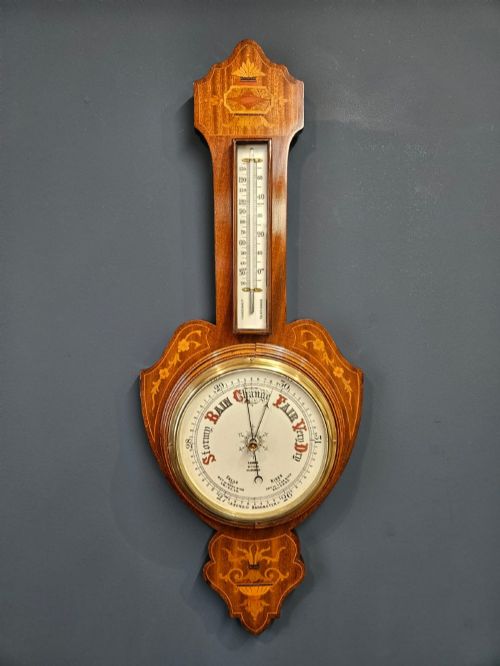
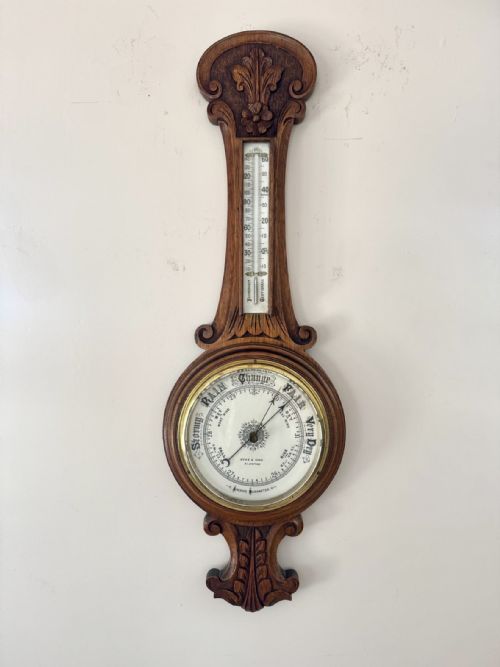
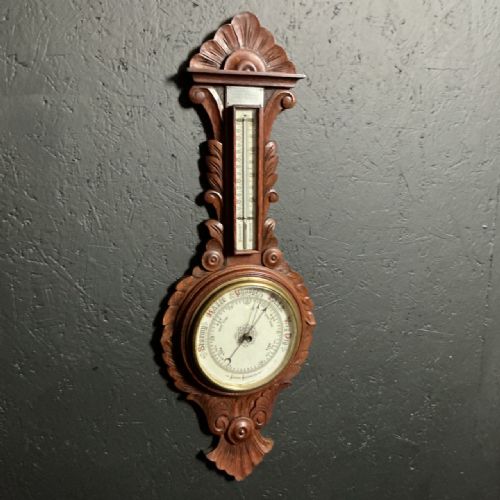

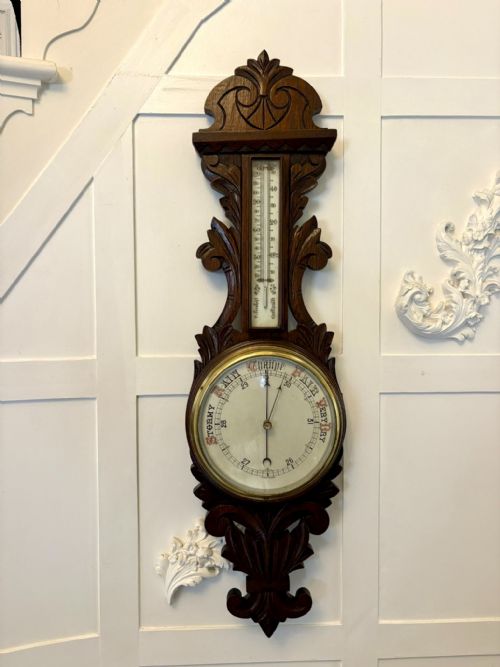


Wall Hanging Thermometer Barometer
A wall hanging thermometer barometer brings atmospheric measurement and domestic utility together on the wall, combining functional science with period craftsmanship.
Wall Hanging Thermometer Barometer
When you search for a wall hanging thermometer barometer, you examine combined domestic instruments designed to display temperature alongside atmospheric pressure. The pieces available span the Victorian and Edwardian eras, stretching back through the nineteenth century.
How they were made
Cabinetmakers utilised solid timbers such as oak and mahogany to construct the structural surrounds, often shaping them into banjo or wheel profiles. Carpenters frequently embellished these surrounds through detailed carving and decorative veneers.
Inlayers applied contrasting woods like satinwood and materials such as bone or mother-of-pearl to create geometric and floral motifs across the timber face. Instrument makers then fitted brass bezels, glass dials, and mercury or aneroid movements into the carved housings.
Some wall barometers doubled as combination units incorporating unexpected items like wall clocks and thermometers into a single wooden board.
What varies in quality
The standard of a wall hanging thermometer barometer depends on the precision of the cabinetwork and the refinement of the carved wooden details. Crisp execution in oak or rich figuring in mahogany distinguish superior examples from plain utility models.
The reputation of the instrument maker inscribed on the dial or scale plate elevates a piece significantly. Master makers employed higher grades of brass work and more intricate inlay compared to unbranded workshop production.
Hyde & Sons Sleaford·Maple & Co·Negretti & Zambra·J Groce York·George Dollond of London
The Wall Hanging Thermometer Barometer Glossary
- Aneroid barometer
- An instrument measuring atmospheric pressure without liquid, using a flexible metal box that expands or contracts. This mechanical movement became common during the Victorian period.
- Banjo barometer
- A domestic wall instrument housed in a case shaped like a banjo, featuring a circular dial at the base and a long stem above. This form dominated nineteenth-century hallway decoration.
- Wheel barometer
- A dial barometer utilising a pulley and weight system connected to a glass tube, frequently paired with a thermometer on the upper board. These often feature decorative damp-proof glass faces.
- Bezel
- The metal ring that holds the glass cover in place over the barometer dial. Brass is the most common metal utilised in these mountings.
Wall Hanging Thermometer Barometer: Frequently Asked Questions
What is a banjo barometer?
A banjo barometer is a wall-mounted meteorological instrument housed in a wooden case resembling the stringed musical instrument. It typically displays a large circular dial at the base with a thermometer mounted on the vertical neck.
These pieces served as both scientific instruments and prominent decorative fixtures in nineteenth-century hallways and reception rooms.
How do I hang a wall barometer?
You hang these instruments securely from a sturdy wall fixing using the integrated brass loop or hanging bracket fitted to the rear of the timber case. Ensure the wall plug or screw supports the weight of the solid timber surround.
Once hung, gentle tapping on the glass may be required to settle the mechanical linkage if an aneroid movement is fitted.
Are these barometers still accurate?
Many period barometers retain working movements that respond to changing atmospheric pressure and room temperature. Aneroid movements can often be calibrated against known local pressure readings using a small adjustment screw on the back.
Even when mechanical calibration drifts, the instrument remains a decorative record of historical scientific craftsmanship.
How do I date an oak barometer?
Dating relies on the style of the timber carving, the shape of the case, and the materials used for inlay work. Victorian examples often feature heavy carved oak, while Edwardian pieces may display lighter inlaid satinwood.
Signatures or maker inscriptions engraved on the brass dial provide the most precise indication of the workshop origin.