



Vintage Woodland Oil Painting
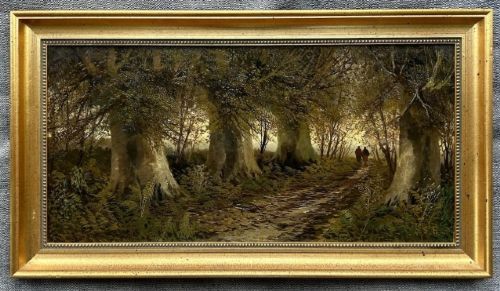
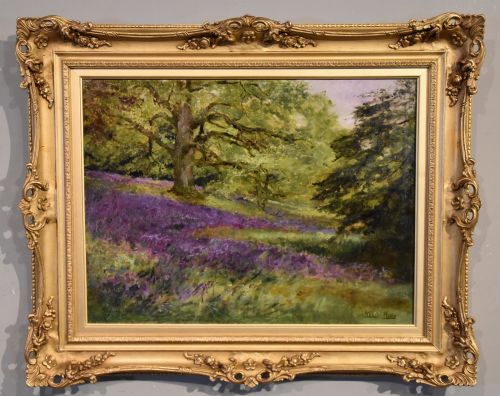
A vintage woodland oil painting brings the quiet atmosphere of trees, streams and dappled light directly into a room.
Vintage Woodland Oil Painting
A vintage woodland oil painting captures natural scenes of trees, forests, and rural pathways created using traditional pigments and supports. These works range from late nineteenth-century Victorian naturalism and British Impressionism to mid-century post-war depictions.
Buyers encounter pieces spanning various decades, including Edwardian compositions and mid-century landscapes. Many feature signed works by named artists depicting specific British, French, or Danish rural locations.
The subjects vary from quiet autumnal glades and winter snow scenes to riverbanks framed by mature timber. Canvases and wooden panels serve as the primary foundations for these atmospheric landscapes.
How They Were Made
Artists painted primarily with oil paint applied to stretched canvas or wooden panels, utilising the slow-drying medium to blend rich tones and build textured brushwork. Many works retain their original wooden frames, frequently accented with gold leaf and gesso mouldings.
The technique relies on layering opaque and translucent pigments to create depth within foliage, tree trunks, and shadowed undergrowth. Brushstrokes range from tight academic precision in the nineteenth-century pieces to looser impressionistic applications in later works.
Red squirrels feature among the branches in the nineteenth-century works, reminding us that woodland wildlife has long charmed artists.
What Varies in Quality
Quality rests upon the artist's ability to handle light, atmosphere, and spatial depth within the woodland setting. Superior execution shows in confident, purposeful brushwork that defines tree bark, foliage, and the fall of light without overworking the surface.
The integration of the painting with its period frame also influences the overall standard of a piece. Original frames matching the era of the canvas demonstrate greater historical integrity than later replacements.
William H Myers·Thomas W Lascelles·Henry Yeen King·Arthur Herbert Rigg·Thomas Bromley Blacklock·Clarence Henry Roe·David Watts·William Mellor·James Proudfoot·Ernest Higgins Rigg·Edward H Holder·J McIntyre·A Wood·Herbert Royle·John Falconar Slater·Hans Kappel Øvre·Frederick Bartman·Charles Edmond Rene His·Kershaw Schofield·Everett W Mellor·George Neil·James Malcolm Stewart·Lewis Creighton·Jack Cross·Brian Richardson
The Vintage Woodland Oil Painting Glossary
- Oil paint
- A slow-drying paint made by combining pigments with a drying oil, typically linseed oil. This medium allows for rich blending and textured impasto applications.
- Canvas
- A closely woven fabric stretched across a wooden frame to serve as a durable painting surface. It remains the most common support found in these works.
- Gesso
- A plaster-like mixture applied to wood or canvas to prepare a smooth surface for painting or to build decorative reliefs on frames. It provides a stable base for gold leaf application.
- Impressionism
- An art movement characterised by relatively small, thin, yet visible brush strokes and an emphasis on accurate depiction of light. British and French variations appear frequently in woodland subjects.
- Panel
- A flat piece of wood used as a rigid support for a painting instead of stretched fabric. Panels offer a stable surface favoured by many artists across different decades.
Vintage Woodland Oil Painting: Frequently Asked Questions
How do I care for an oil painting?
Keep the painting away from direct sunlight and dramatic temperature shifts to protect the canvas and pigments. Dust the surface gently with a dry, soft brush without using liquid cleaners.
Ensure the room maintains stable humidity levels to prevent the wooden stretcher bars or panel from warping. Professional conservators should handle any deeper cleaning or varnish removal.
Are these paintings signed by the artist?
Many of the works feature signatures or monograms applied by the artist, often located in the lower corners of the canvas. Documentation and inscriptions on the reverse can also provide attribution.
Unsigned pieces still appear frequently, identified instead through stylistic traits, framing, or period characteristics. Both signed and unsigned works capture the distinct atmosphere of their respective eras.
What subjects appear in these landscapes?
The compositions focus on trees, woodland paths, rivers, and rural glades observed across different seasons. Scenes include autumn foliage, winter snow, and sunlit summer clearings.
Some works incorporate figures, cottages, timber hauling, or livestock to add narrative depth to the natural setting. The primary focus remains the interplay of light and shadow among mature woods.
How do I date a woodland painting?
Stylistic clues, such as the loose brushwork of impressionism or the tighter realism of Victorian naturalism, help narrow down the period. The type of canvas preparation and framing materials also offer reliable chronological indicators.
Artist biographical details and recorded exhibition dates provide precise confirmation when a signature is present. Examining the reverse of the canvas often reveals old labels or dealer stamps.