
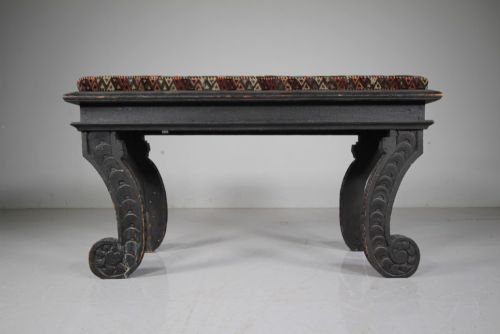


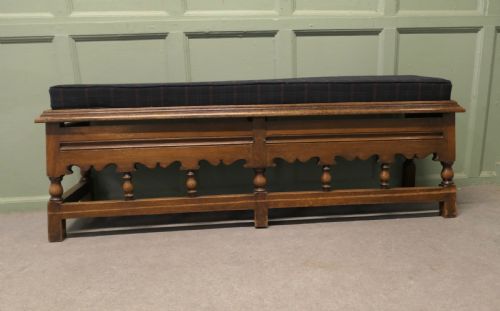
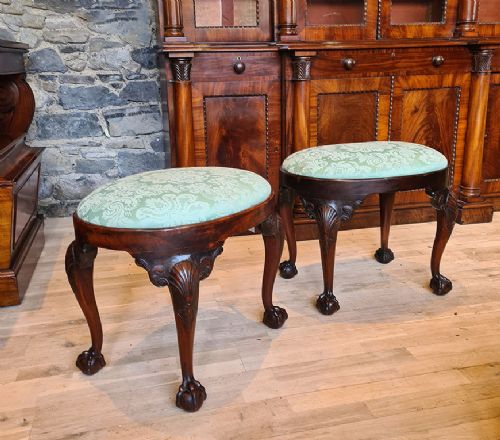


Vintage Upholstered Window Seat
A vintage upholstered window seat brings low, tailored seating to a bay or hallway, marrying timber frames with textile comfort.
Vintage Upholstered Window Seat
A vintage upholstered window seat offers long, narrow seating designed to sit beneath sills or at the foot of a bed. These forms draw from 18th century, Regency, and Victorian traditions, alongside substantial numbers of Edwardian pieces.
The selections span simple painted pine benches, walnut duet stools, and mahogany frames dressed in leather, velvet, or kilim. Many pieces double as piano stools, storage ottomans, or small settees with chair backs.
Edwardian mahogany examples dominate the selection, often featuring inlaid woodwork or slender legs. Alongside these, French provincial stools and country house benches provide lower, decorative profiles.
Materials and construction methods
Makers built the foundational frames using solid hardwoods like mahogany, walnut, and pine, occasionally applying gilt, paint, or ebonisation to the timber surface. Inlaid details and turned legs frequently accent the mahogany and walnut structures.
Upholstery relies on textiles such as velvet, tweed, leather, and tapestry, secured over padding. Brass hardware occasionally appears on feet or hinges, particularly on storage ottomans and duet stools.
Some Edwardian piano stools managed to double as boot stores in busy country hallways.
Assessing quality in frames and upholstery
Quality rests in the rigidity of the timber frame and the depth of the carving or inlay work. Solid mahogany and walnut structures with tight joinery outlast lighter painted pine or softwoods.
The standard of the upholstery finish distinguishes utilitarian seating from refined salon pieces. Hand-worked kilims, supple leather, and tight velvet coverings reflect superior original commissioning.
Hallett & Sons·Morris & Co.
The Vintage Upholstered Window Seat Glossary
- Duet stool
- A wide stool designed for two people to sit side by side, often utilised at a piano or dressing table.
- Curule stool
- An ancient Roman magistrate form featuring intersecting curved legs, revived in Regency and later classical designs.
- Kilim
- A flatwoven textile from the Middle East or Eastern Europe, frequently repurposed as durable upholstery on 19th century frames.
- Ebonisation
- The process of staining timber, usually fruitwood or beech, to imitate solid ebony.
- Ottoman
- A low, upholstered seat or bench, frequently fitted with an internal storage compartment beneath the lid.
Vintage Upholstered Window Seat: Frequently Asked Questions
Where should I place a window seat?
These long benches suit narrow alcoves, deep window recesses, and narrow hallways where deeper sofas fail to fit.
They also serve effectively at the foot of a bed for resting clothes or shoes.
How do I identify an Edwardian window seat?
Edwardian examples typically feature light mahogany frames, sometimes with delicate wood inlay or tapered legs.
They reflect the lighter domestic tastes of the early 20th century compared to heavy Victorian walnut.
Can I use a piano stool as a window seat?
Yes, many Edwardian piano stools share the elongated proportions and upholstered tops of dedicated window benches.
Their compact height makes them ideal for placing beneath lower sills.
What is the difference between a window seat and a day bed?
Window seats are generally shorter and built purely for sitting upright in a recess or hallway.
Day beds include raised ends or backrests intended for reclining during the daytime.