

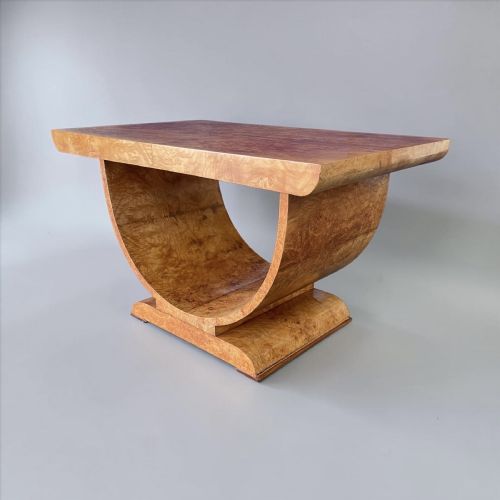


Vintage U Shaped Table
A vintage u shaped table brings distinct curved lines and practical surfaces to a room, spanning Edwardian, Victorian and Art Deco forms.
Vintage U Shaped Table
A vintage u shaped table encompasses curved furniture designs, most frequently appearing in this selection as kidney shaped desks, side tables and occasional tables from the Edwardian period and the nineteenth century. These pieces offer functional surfaces that wrap around the user, combining utility with decorative cabinet work.
The materials span mahogany, walnut, satinwood and burr walnut, often enhanced with marquetry inlay or fitted leather writing surfaces. Alongside desks, the category extends to coffee tables and side tables displaying various revival styles, including Georgian and Louis XV influences.
How they were made
Cabinet makers constructed these curved forms utilising solid timbers and veneers such as mahogany, walnut and satinwood, often shaping the wood over internal frames. Marquetry inlay and decorative brass mounts frequently ornament the exterior surfaces.
Desks and tables commonly incorporate inset leather writing panels tooled with gold leaf, whilst smaller occasional items rely on finely turned legs and shaped tiers joined with traditional cabinet joints.
Heart-shaped silver trinket boxes and menu holders appear alongside the large furniture.
What varies in quality
The standard of timber selection distinguishes finer examples, particularly where figured burr walnut, satinwood or maple veneers are matched symmetrically across the curved top. Superior pieces also feature crisp, detailed marquetry and original tooled leather inserts rather than later replacements.
Construction details such as solid drawer linings, finely cut dovetails and substantial brass hardware separate master workshop production from simpler commercial output.
William Comyns·Sampson Mordan·Wolfe Hollander
The Vintage U Shaped Table Glossary
- Marquetry
- Decorative veneer work arranged in pictorial or geometric patterns on furniture surfaces. It utilises contrasting timbers to create detailed ornamentation.
- Kidney shaped
- A curved furniture top resembling the bean form, popular for desks and occasional tables. This outline provides an ergonomic wrap-around workspace.
- Burr walnut
- Timber taken from the abnormal growth of a walnut tree, yielding intricate swirling grain patterns. Cabinet makers prized it for high-status surfaces.
- Satinwood
- A durable hardwood with a lustrous yellow sheen, used extensively for fine stringing and veneers. It forms a bright contrast against darker woods.
- Ormolu
- Gilt bronze mounts applied to furniture and decorative objects. This technique enhances the decorative richness of period pieces.
Vintage U Shaped Table: Frequently Asked Questions
What periods do these curved tables come from?
The pieces span from the nineteenth century through the Edwardian era into the Art Deco period of the nineteen-thirties. Victorian and Edwardian examples predominate in this selection.
Cabinet makers of these eras favoured serpentine and kidney outlines for desks and occasional furniture, drawing on earlier Georgian and French revival styles.
How were these tables used originally?
Curved desks and writing tables served for correspondence and administration, allowing the user to sit within the embrace of the desktop. Smaller occasional and coffee tables functioned as display surfaces in period reception rooms.
Their distinctive shapes were designed to fit specific domestic layouts while offering accessible surface area close to seating.
How do I care for a leather top desk?
Leather surfaces require gentle cleaning with a slightly damp cloth, avoiding harsh chemical sprays or excessive moisture. Periodic application of specialist leather wax helps preserve the suppleness and gold tooling.
Keeping the timber surround polished with traditional beeswax protects the polished grain from drying out over time.
Are these tables suitable for modern rooms?
The compact proportions of kidney desks and occasional tables allow them to function effectively as dressing tables or workspace accents in contemporary interiors. Their curved profiles soften straight architectural lines.
Different wood tones, from rich mahogany to pale satinwood, enable these pieces to complement various interior colour schemes.