
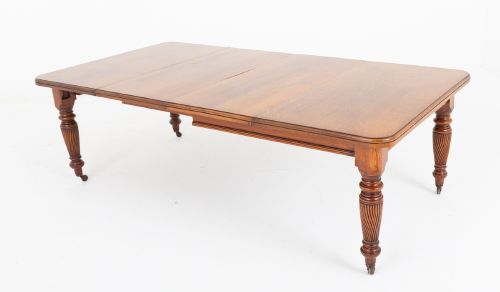
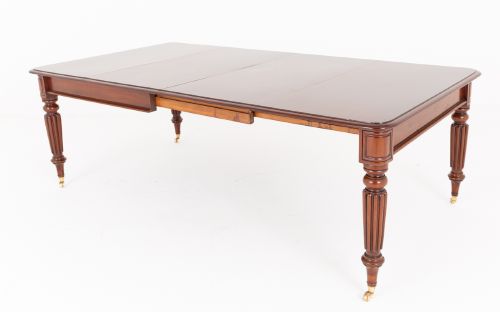
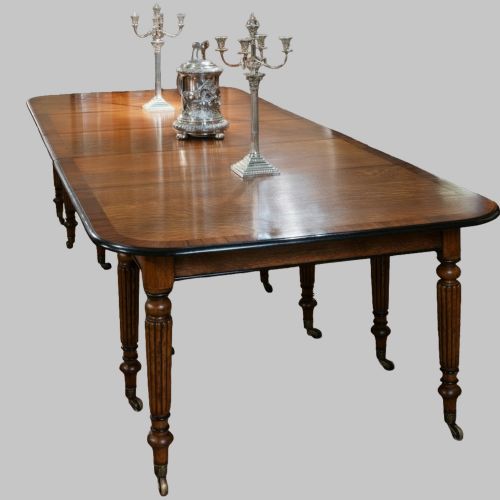


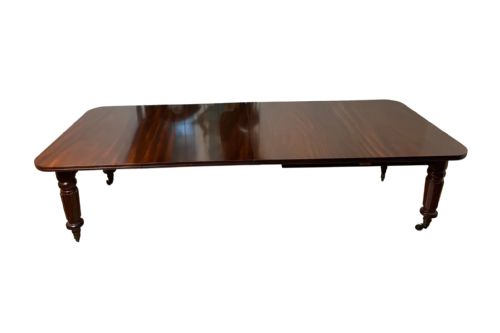


Vintage Telescopic Dining Table
A vintage telescopic dining table brings mechanical ingenuity to the dining room, offering flexible seating through clever extension mechanisms.
Vintage Telescopic Dining Table
A vintage telescopic dining table provides adaptable dining space using integrated extension actions found in nineteenth-century designs. Buyers searching this phrase encounter examples from the Regency, William IV, and Victorian periods.
The most common form on this page is the mahogany extending dining table equipped with leaves. These pieces accommodate gatherings of various sizes by expanding along internal wooden or metal runners.
Origins span the Georgian era through to the mid-nineteenth century, showing distinct stylistic shifts from classical Regency lines to heavier William IV proportions. Oak and mahogany serve as the primary timbers across these listings.
Materials and construction methods
Cabinet makers utilised dense hardwoods such as mahogany and oak to build these frames, ensuring structural stability for the extending mechanism. Timber selection determined both the weight of the table and the richness of the grain visible on the top.
Mechanical function relies on sliding wooden bearers or metal telescopic channels concealed beneath the leaves. These components allowed domestic staff to lengthen or shorten the surface smoothly without jamming.
Listings span the nineteenth century, including Regency, William IV, and Victorian periods, constructed primarily in mahogany and oak.
Distinctions in quality
Quality rests in the precision of the extension mechanism and the smoothness of the operational hardware. Superior examples maintain stability across the entire span even when fully loaded with leaves.
Timber selection and cabinet making proficiency differentiate standard workshop pieces from branded outputs. Finer tables exhibit careful grain matching across added leaves and robust underframes that resist sagging.
Gillows·Thomas Treherne
The Vintage Telescopic Dining Table Glossary
- Telescopic
- An extending mechanism that slides outward on nested channels or runners to accommodate additional leaves. This engineering allows a compact surface to lengthen significantly for dining.
- Leaf
- A removable section of timber inserted into the table surface to increase its length. Leaves are stored separately when the table is closed down to its smallest footprint.
- Mahogany
- A durable tropical hardwood prized for its reddish-brown colour and stable grain. It became the dominant timber for formal dining furniture throughout the nineteenth century.
- William IV
- A British design style spanning the 1830s characterised by robust classical proportions and scrolling foliage carving. Furniture from this period often employs heavy pedestals or reeded legs.
Vintage Telescopic Dining Table: Frequently Asked Questions
How do these extension mechanisms work?
The framework utilises sliding timber runners or metal tracks that pull apart from the centre. Additional leaves drop into the resulting gap to extend the surface.
Once fully expanded, internal latches or brass clips secure the sections together to prevent movement during use.
How many people can these seat?
Capacity depends entirely on the number of leaves inserted and the overall length of the frame. Smaller setups comfortably seat four to six guests.
Larger configurations listed can extend to accommodate up to ten or twelve diners when fully expanded.
What timbers were used?
Mahogany is the dominant wood seen across these nineteenth-century examples, valued for its strength and deep colour. Oak also appears in specific regional or earlier pieces.
These dense hardwoods provided the structural integrity required to support extending leaves without warping.
How do I identify a William IV table?
William IV pieces typically date from the 1830s and display heavier, sturdier proportions than earlier Regency designs. They frequently feature carved pedestal bases or substantial reeded legs.
The timber grain on these tables tends to be dark and pronounced, reflecting the cabinet-making fashions of that decade.