


Vintage Slate Shelf Clock
These vintage slate shelf clock examples are substantial Victorian timepieces in slate and marble, bringing heavy architectural presence to a room.
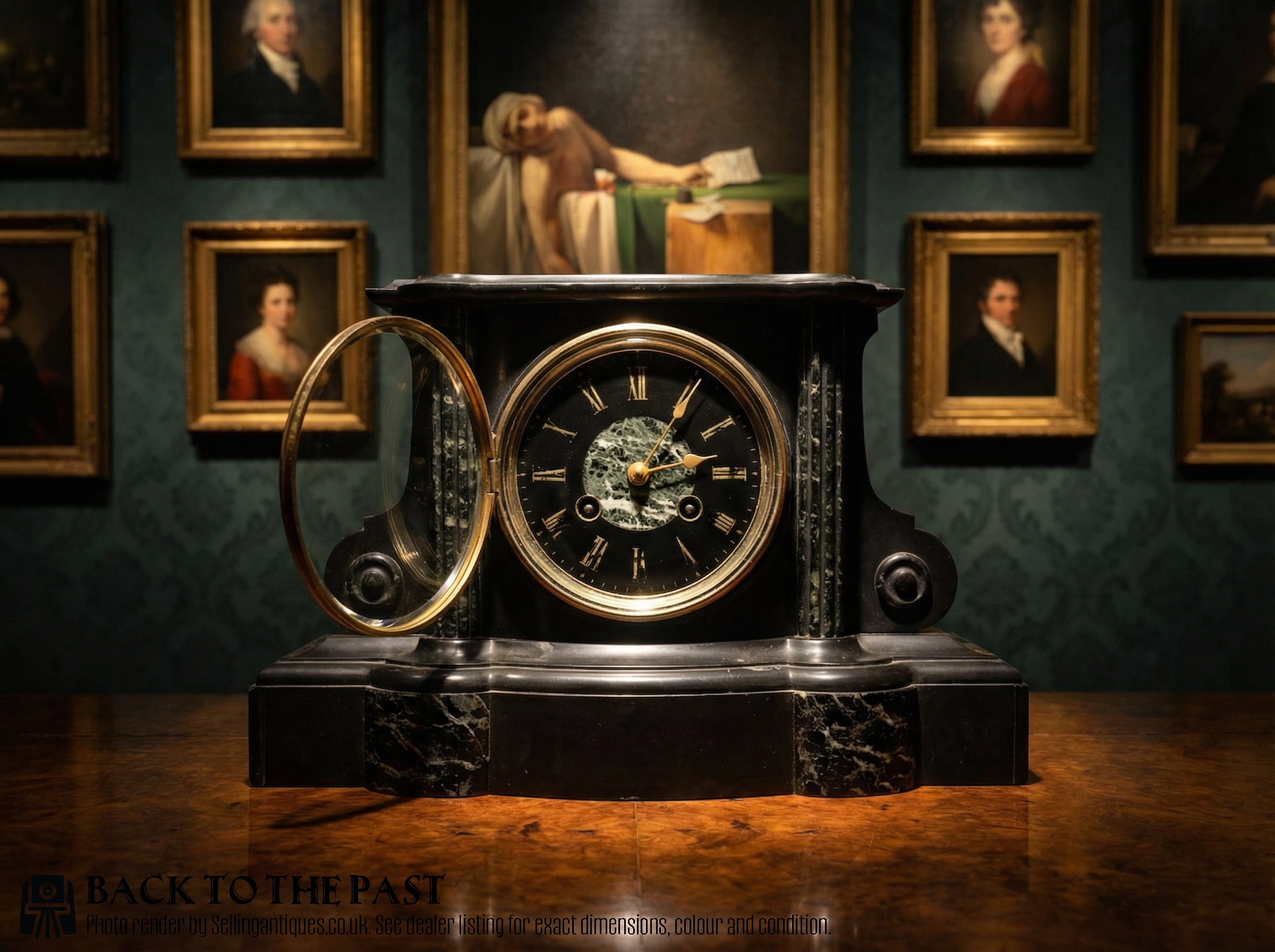
Vintage Slate Shelf Clock
When you search for a vintage slate shelf clock, you encounter nineteenth-century mantel timepieces primarily dated across the decades from eighteen sixty to eighteen ninety. These heavy shelf clocks often incorporate marble alongside slate, displaying classic Victorian architectural forms.
The objects listed here appear as large mantel clocks, frequently housing eight day movements within substantial stone cases. These pieces dominate a mantelpiece through their sheer weight and classical proportions.
How they were made
The makers of these Victorian clocks utilised heavy slate and marble for the structural cases, often combining coloured stone varieties to create architectural facades. Brass components and glass bezels protect the enamel dials housing the mechanical movements.
Cases also integrate ebonised wood details alongside the polished stone surfaces, reflecting the Victorian Classical Revival style. The physical construction relies on dense stone blocks shaped into pediments and columns.
Every listed piece belongs to the Victorian period, spanning dates from eighteen sixty to eighteen ninety.
What varies in quality
Quality across these nineteenth-century shelf clocks rests in the ambition of the architectural stone carving and the integration of contrasting marble elements. Simpler cases contrast with those demonstrating elaborate Classical Revival detailing.
The presence of a complete clock set or higher grade eight day movements elevates specific examples. Faux marble finishes also represent a distinct variation in the materials utilised for the cases.
The Vintage Slate Shelf Clock Glossary
- Slate
- A fine-grained metamorphic rock utilised for heavy Victorian clock cases. It provides a smooth dark surface that mimics or houses polished marble sections.
- Marble
- A crystalline limestone used in contrasting colours for Victorian architectural clock cases. It often frames the dial and adds visual weight to the shelf piece.
- Eight day
- A mechanical movement description indicating the clock runs for eight days before requiring winding. This phrase denotes a more substantial functional capability.
- Ebonised wood
- Timber treated to resemble ebony, providing dark contrasting trim on Victorian clock cases. This material works alongside slate and marble to build architectural depth.
Vintage Slate Shelf Clock: Frequently Asked Questions
Where should I place a heavy slate clock?
These dense stone pieces require a deeply stable shelf or a low mantelpiece capable of supporting significant weight.
Position them away from heavy footfall that might cause vibrations affecting the mechanical movement.
How do I date a Victorian marble clock?
Examine the architectural style and materials recorded across the Victorian period between eighteen sixty and eighteen ninety.
Look for Classical Revival elements and the specific combination of slate, marble, and ebonised wood components.
What is an eight day movement?
An eight day movement refers to a mechanical clockwork system that operates for over a week on a single wind.
This specification is common among larger Victorian shelf clocks listed from this era.
Are these clocks strictly slate or marble?
Many examples combine dense slate with contrasting coloured marble sections and ebonised wood trim.
Some listings specifically identify faux marble finishes applied to the structural stone cases.