


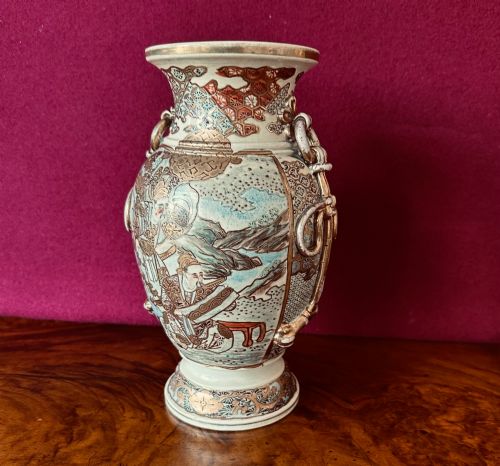




Vintage Satsuma Urns
These vintage satsuma urns deliver intricate hand-painted detail and heavy gilding that elevate any traditional interior.
Vintage Satsuma Urns
Vintage satsuma urns and their closely related vase counterparts are earthenware vessels originating from Japan, frequently arriving on the market from the Meiji period through the early twentieth century. Buyers seeking these items encounter both individual display pieces and converted table lamps decorated with detailed figural processions and garden scenes.
The selections span miniature cabinet pieces to large decorative pairs, often featuring hexagonal bodies or traditional lidded urn forms. Most examples reflect export production intended for Western interiors, carrying intricate enamel work alongside traditional Japanese motifs.
How they were made
Potters shaped these vessels from earthenware, applying a characteristic ivory-coloured crackle glaze that formed the canvas for subsequent decoration. Artisans then built up the surface using rich enamels and raised gold leaf to delineate complex narrative scenes and floral patterns.
Makers finished many pieces with detailed brushwork requiring steady precision, particularly on miniature vessels and large exhibition-grade vases. Some later examples from the twentieth century were mounted onto wooden or brass bases for utility as electric table lamps.
Vintage Satsuma Urns Retail Price Guide 2026
Typical asking prices for vintage satsuma urns among the pieces listed under this phrase on Sellingantiques today, from the lower quarter to the upper quarter. They describe what is for sale here now, not the wider market.
Even the smallest miniature vase managed to pack an entire imperial procession onto a surface no larger than an acorn.
What varies in quality
The crispness of the underlying crackle glaze and the balance of the enamel palette determine the visual harmony of each piece. Larger vases often display greater ambition in their composition, whereas miniatures demonstrate the miniaturist skill of the Kyoto or Meiji workshops.
Chosei·Hakusan·Kinkozan·Hattori
The Vintage Satsuma Urns Glossary
- Satsuma
- A type of Japanese earthenware traditionally characterised by a finely cracked ivory glaze and elaborate polychrome and gilt decoration. It originated in Satsuma Province before production spread to major urban centres like Kyoto.
- Meiji Period
- The period of Japanese history spanning from 1868 to 1912, corresponding with the reign of Emperor Meiji. Pieces from this era often show high technical skill tailored for Western export markets.
- Gilt
- A thin layer of gold applied to the surface of the ceramic to accent patterns and figures. It catches the light and frames the painted enamel scenes.
- Enamel
- Opaque or translucent glass-like material fused to the ceramic surface during decoration. It provides the vibrant colours found across floral and figural panels.
- Kutani
- A style of Japanese coloured porcelain and pottery produced in Ishikawa Prefecture. It shares export markets with Satsuma but typically relies on distinct green, blue, and red palettes.
Vintage Satsuma Urns: Frequently Asked Questions
How do I identify a Meiji period piece?
Meiji period items typically display dense, meticulous hand-painting, refined crackle glazes, and distinct artisan signatures on the base. They reflect the rapid artistic output directed at international exhibitions during the late nineteenth and early twentieth centuries.
Examine the weight of the earthenware and the precision of the gilt work, as later twentieth-century reproductions often feature flatter, mechanically applied patterns without the depth of nineteenth-century export pieces.
Can these urns be used as lamps?
Many surviving pieces were converted into table lamps during the early twentieth century to suit Western domestic lighting trends. These conversions often integrate wooden or brass hardware alongside the original ceramic body.
Buyers should inspect the wiring for safety while recognising that period mounts add functional versatility to decorative display rooms and libraries.
What is the difference between Satsuma and Kutani?
Satsuma ware relies on a characteristic cream-coloured earthenware body covered in a fine network of crackled glaze, decorated primarily with enamels and raised gold. Kutani pieces typically utilise a different palette of strong greens, blues, and reds on porcelain or denser ceramic bodies.
Both styles emerged strongly during the Meiji period for the export market, yet their tactile surfaces and underlying clay bodies remain distinct upon close inspection.
How should I clean my Satsuma vase?
Dust these delicate earthenware pieces gently with a dry, soft brush to protect the aged enamel and gold leaf decorations. Avoid chemical cleaning agents or excessive moisture, which can penetrate the historical crackle glaze and discolour the fabric.
Display them away from direct sunlight to preserve the richness of the original enamels and prevent thermal stress to the ceramic.