


Vintage Piano Bench Storage
These vintage piano bench storage pieces combine practical seating with concealed compartments, offering a clever way to keep sheet music tidy.
Vintage Piano Bench Storage
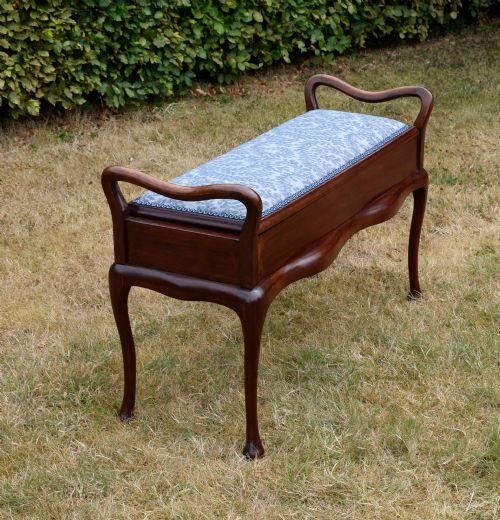
Vintage piano bench storage pieces provide dual functionality as both a seat at the keyboard and a compartment for organising music sheets and books. Buyers searching for vintage piano bench storage will encounter a range of forms, most commonly single and duet stools designed to accommodate one or two players.
The selections span multiple eras, with Edwardian and Victorian examples appearing frequently alongside later Art Deco designs. Pieces often feature lift-up seats or fall-front mechanisms to access the internal storage space efficiently.
Origins represented in the inventory point primarily to English cabinet-making traditions from the late nineteenth century through to the interwar decades. The fundamental purpose remains consistent across these periods: discreet containment paired with sturdy domestic seating.
Materials and construction methods
Makers relied heavily on solid hardwoods like mahogany and walnut to build the primary frames, ensuring the furniture could withstand the daily rigour of the music room. Boxwood inlay frequently appears as a decorative flourish on Edwardian specimens, adding fine linear detail to the wood surfaces.
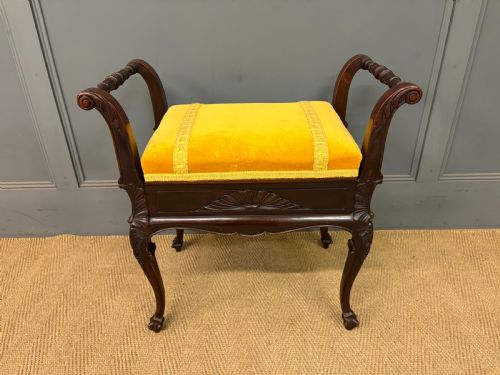
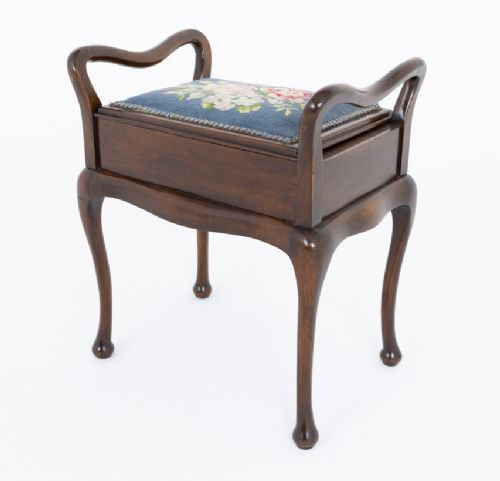
Upholstery forms a vital component of the construction, utilising fabrics such as velvet and tapestry to top the hinged seats. Brass hardware commonly secures the internal mechanisms and provides functional hinges or pulls for the storage compartments.
Many of these Victorian and Edwardian benches still harbour faint pencil markings from music teachers tucked inside their storage wells.
Distinguishing quality across the range
The refinement of the cabinet-making separates standard utilitarian seating from superior examples. Finely turned legs, crisp boxwood inlay work, and robust joinery indicate a higher standard of original craftsmanship.
The integrity of the internal storage mechanism also defines the tier of a piece. Smoothly operating lift-up seats and well-fitted fall-front compartments demonstrate superior execution compared to simpler, coarser builds.
The Vintage Piano Bench Storage Glossary
- Duet Piano Stool
- A wider seat designed to accommodate two players simultaneously during piano practice or performance. These longer benches often feature extended storage compartments beneath the cushion.
- Fall-Front
- A hinged door that drops downward to reveal internal shelving or storage space. This mechanism is frequently utilised in Victorian walnut designs.
- Boxwood Inlay
- Contrasting light wood inserted into recesses of a darker wood surface to create decorative patterns. It is a hallmark of Edwardian Sheraton Revival styling.
- Edwardian Sheraton Revival
- A style popular in the early twentieth century characterised by neoclassical motifs, light mahogany timbers, and delicate inlaid lines. These pieces favour elegance and symmetry.
- Upholstery
- The padded and covered top of the bench, finished in materials such as velvet, tapestry, or plain fabric. It provides comfort for the seated musician.
Vintage Piano Bench Storage: Frequently Asked Questions
How do I identify an Edwardian piano stool?
Edwardian piano stools typically feature lighter mahogany timbers, tapered legs, and subtle decorative elements such as boxwood inlay. They date from the reign of King Edward VII and lean towards refined, neoclassical aesthetics.
Look for slender proportions and Sheraton Revival styling cues that distinguish them from heavier Victorian counterparts.
What is a duet piano stool?
A duet piano stool is an extra-wide bench built to seat two people side by side. They are commonly used for piano duets or teaching sessions.
Because of their larger footprint, they generally provide a more substantial storage capacity beneath the dual-seating lid.
How were fall-front piano stools used?
Fall-front piano stools allowed players to access stored sheet music from the front of the bench rather than lifting the seat. The front panel drops open on hinges to reveal internal compartments or slots.
This mechanism proved particularly convenient when sheet music needed to be retrieved without disturbing someone sitting on top.
What woods were used for vintage piano benches?
Cabinet-makers predominantly used mahogany and walnut for these benches, valuing their durability and rich grain patterns. Oak also appears in specific revival styles from the early twentieth century.
Inlays utilised contrasting light woods like boxwood to add delicate geometric or floral patterns to the primary timber.