


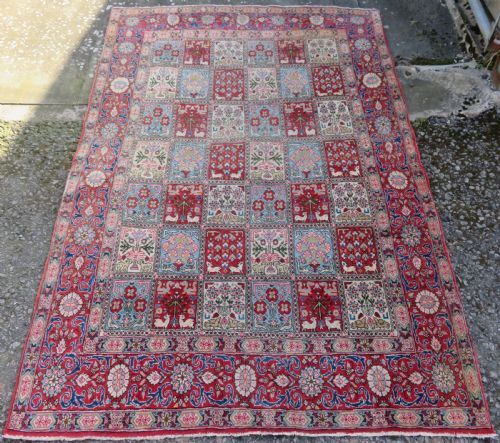

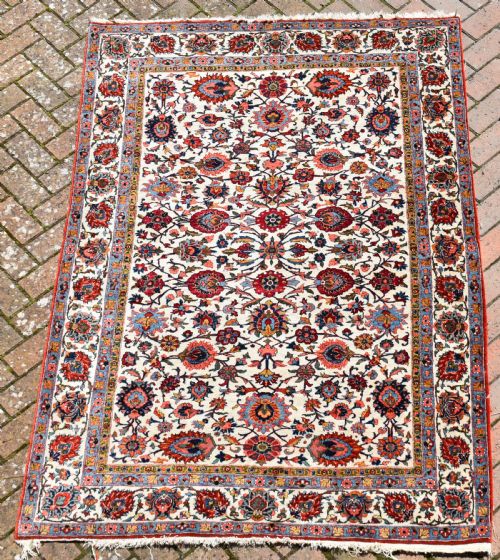

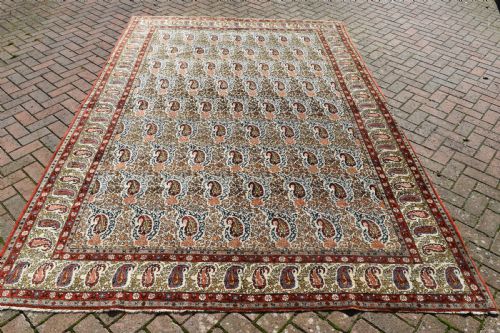
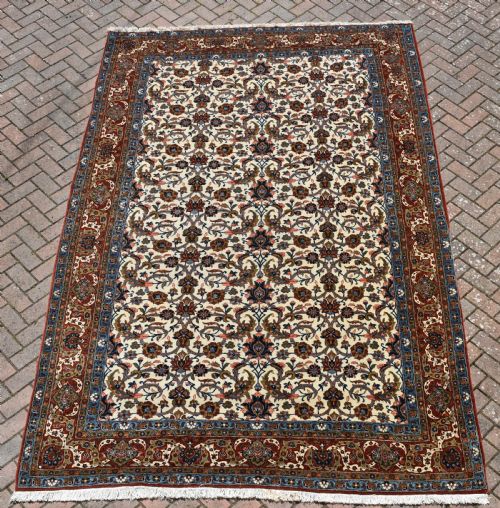


Vintage Persian Qum Carpet
These vintage persian qum carpets bring intricate central Persian artistry into a room, offering the fine knotting and traditional patterns collectors value.
Vintage Persian Qum Carpet
A vintage persian qum carpet represents fine central Persian weaving traditions, originating from the city of Qum. These pieces emerge in roomsize formats as well as smaller rugs, featuring traditional Persian patterns and occasionally distinct tile motifs.
Buyers encountering this selection will find floor coverings dating from the early decades of the twentieth century, specifically spanning the 1910s to the 1940s. These older examples demonstrate the established methods of Qum workshops from that era.
Materials and construction
Weavers constructed these carpets using cotton foundations alongside wool and silk surface materials. The careful combination of these fibres allowed workshops to produce both durable roomsize carpets and finer, delicate rugs.
The physical structure relies on traditional Persian weaving techniques, executed to achieve dense piles and precise patterning. Artisans utilised these established methods to shape specific formats, from compact area rugs to large carpets exceeding four metres in length.
The listings show pieces dated across four distinct decades, spanning from 1910 to 1940.
Evaluating quality and execution
Quality in these carpets rests on the fineness of the weave and the handling of the materials. Silk and wool combinations achieve varying levels of textural definition, distinguishing standard production from finer examples.
The scale and complexity of the design also separate pieces across the range. Larger roomsize formats require sustained precision in pattern execution compared to smaller rugs.
The Vintage Persian Qum Carpet Glossary
- Qum
- A city in central Persia known for producing finely knotted carpets and rugs. It represents a significant centre of twentieth-century Persian weaving.
- Roomsize
- A designation for floor coverings large enough to anchor a primary living space. These pieces typically measure over three metres in length.
- Pile
- The upright yarn forming the soft surface of the carpet. In these pieces, it is composed of wool or silk.
- Foundation
- The underlying structure of warp and weft threads that supports the pile. Cotton is commonly utilised for this purpose in these Persian pieces.
Vintage Persian Qum Carpet: Frequently Asked Questions
How do I date a Qum carpet?
Dating relies on recorded production periods spanning the early twentieth century, specifically between 1910 and 1940. Stylistic elements and material usage help place these pieces within that timeframe.
Examining the structural wear and the specific characteristics of the wool or silk provides further context for the period of manufacture.
Are these carpets suitable for daily use?
Many examples function well as floor coverings in moderate traffic areas. Their wool and cotton construction provides durability for roomsize formats.
Lighter silk examples benefit from placement in lower-traffic zones to preserve the integrity of the finer fibres over time.
What sizes are available in these carpets?
The selection includes smaller formats starting around two metres in length, suitable for compact spaces. Larger roomsize variations extend past four metres.
Dimensions vary significantly between individual pieces, accommodating both specific floor spaces and broader room layouts.
Where were these carpets made?
These pieces originate from Qum, located in central Persia. The region established a distinct reputation for traditional Persian weaving.
Workshops in this area utilised local materials and traditional patterns to create both rugs and larger carpets.