
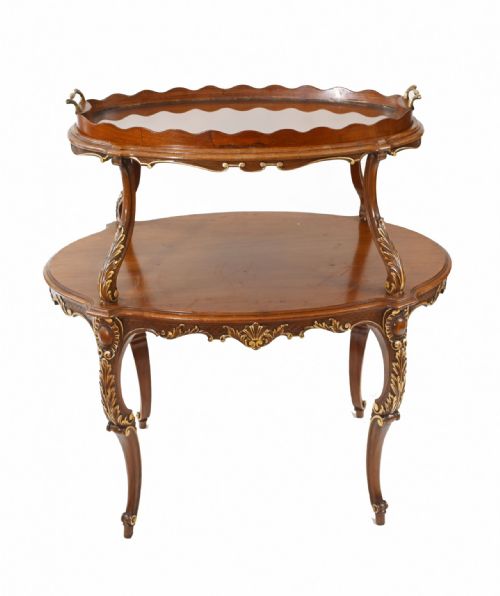
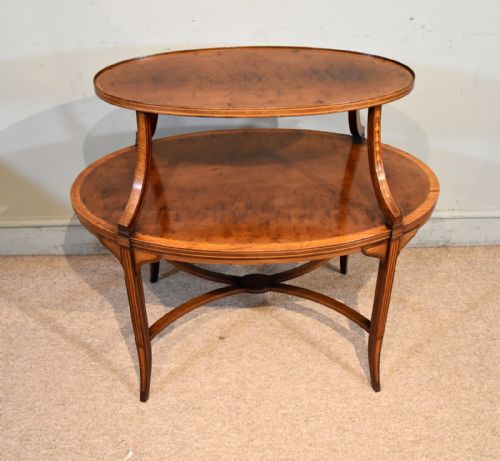


Vintage Oval Etagere Table
A vintage oval etagere table brings tiered display and surface space to a room, spanning Edwardian elegance and nineteenth-century craftsmanship.
Vintage Oval Etagere Table
A vintage oval etagere table functions as a tiered display piece or occasional surface, frequently seen in forms from the Edwardian era and the nineteenth century. These tables provide multiple tiers for organisation while maintaining a slender footprint in a room.
The versions most commonly met on this page span Edwardian Sheraton Revival designs and nineteenth-century mahogany or satinwood pieces. They appear as tiered tables, occasional tables, and side tables with distinct oval surfaces.
Origins stretch from English workshops to Italian makers and French-influenced styles, encompassing French Louis XV and Neoclassical revivals alongside campaign furniture.
How they were made
Construction relies heavily on timbers such as mahogany, walnut, and satinwood, frequently enhanced by satinwood inlay and marquetry work. Cabinetmakers shaped these woods to form curved oval tiers supported by uprights.
Metal mounts in brass and gilt brass appear alongside glass and ebonised finishes, particularly in campaign pieces and French-influenced designs. These materials require precise joinery to support multiple tiers securely.
Some tables double as travelling washstands, proving that nineteenth-century travellers still insisted on tiered elegance.
What varies in quality
Quality separates pieces through the crispness of inlay and marquetry, alongside the selection of timber veneers on the oval top. Finer examples display meticulous attention to detail in the satinwood banding and the joinery connecting the tiers.
The integration of brass mounts and the stability of the tiered structure dictate the grade of the piece. Superior construction ensures that multiple platforms remain balanced and aligned without heavy reinforcement.
The Vintage Oval Etagere Table Glossary
- Etagere
- A piece of furniture consisting of a set of open shelves or tiers for displaying small objects. This form provides vertical display space across multiple levels.
- Marquetry
- Decorative woodwork in which pieces of fine timber are fitted into a veneer to form geometric or pictorial designs. It appears frequently on the tiers of finer tables.
- Campaign washstand
- Portable furniture designed for travel, featuring brass mounts and folding or modular construction. These pieces prioritise robust utility alongside refined materials.
- Sheraton Revival
- A late nineteenth and early twentieth-century style inspired by the light, neoclassical furniture designs of Thomas Sheraton. It is characterised by satinwood inlay and tapered supports.
Vintage Oval Etagere Table: Frequently Asked Questions
What is an etagere table used for?
An etagere table serves primarily as a display surface for decorative objects, small lamps, and books across its multiple tiers.
In period interiors, these tables functioned in reception rooms and parlours where space permitted decorative arrangement without blocking foot traffic.
How do I date an Edwardian etagere?
Dating relies on identifying characteristic Edwardian revival styles, such as Sheraton Revival motifs and lighter mahogany frames with satinwood inlay.
Construction methods and timber selection from the early twentieth century further distinguish these pieces from earlier nineteenth-century examples.
Are these tables sturdy enough for daily use?
The tiered construction provides stable surfaces for general decorative placement, provided the joints between tiers and uprights remain secure.
Heavier items are best placed on the main lower tier to maintain overall balance.
What is the difference between a tiered table and an etagere?
While both offer multiple levels, an etagere specifically emphasises open shelving for display rather than enclosed storage.
Oval etagere tables combine this tiered format with a curved perimeter, softening the profile in a room.