


Vintage Opal Drop Pendant
A vintage opal drop pendant offers a play of spectral fire, capturing the shifting hues of natural gemstones in historic settings.
Vintage Opal Drop Pendant
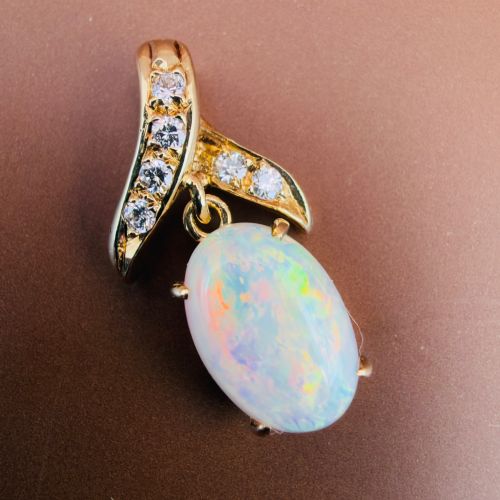
A vintage opal drop pendant draws the eye with its suspended gemstone, swinging gently beneath a delicate chain or mounting. When searching this phrase, a buyer encounters pieces originating from the Edwardian era through to the mid-century decades, reflecting shifting aesthetic movements. The selection leans heavily towards distinct twentieth-century designs, where opals take centre stage in various drop configurations.
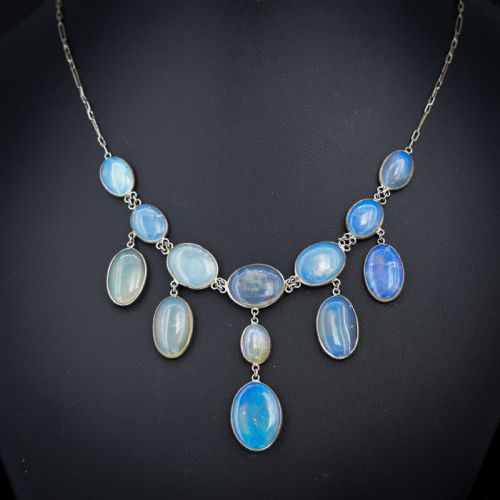
The forms range from single cabochon stones held in simple gold mounts to elaborate clusters surrounded by diamonds and pearls. Edwardian creations often showcase intricate festoon work, whilst later pieces embrace clean lines and geometric arrangements in white and yellow gold. Each pendant carries the characteristic play-of-colour intrinsic to the stone, making every single drop distinct in its visual impact.
Materials and construction
Goldsmiths utilised a range of precious metals to house the stones, moving from higher carat yellow gold in early pieces to 18ct white gold and platinum in later decades. Opals are typically cut as cabochons to maximise their internal fire rather than faceted like traditional gemstones. Master jewellers frequently augmented these centre stones with accent diamonds and natural saltwater pearls to enhance the overall luminance.
The construction relies on fine wirework, bezel settings, and articulated drop joints that allow the pendant to move freely with the wearer. Settings range from traditional claw mounts to intricate pierced galleries characteristic of Edwardian and Art Deco workshops. Brass and silver also appear occasionally in alternative pieces, providing durable structural support for the suspended components.
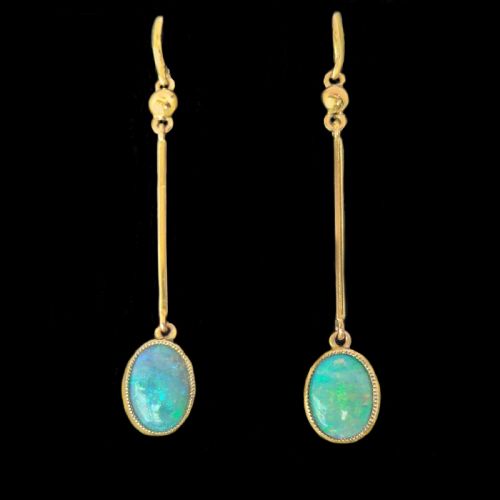
One unexpected Edwardian drop ball earring set proves that even spheres of opal enjoy hanging around.
Judging the quality
The play-of-colour within the opal itself dictates much of the visual merit, with stronger, more vibrant flashes commanding attention. Stones exhibiting a full spectrum of spectral hues against a dark or clear body stone represent the upper echelon of selection. The clarity and cut of any accompanying diamonds further elevate the piece, alongside the precision of the metalwork in the gallery and setting.
Structural integrity and the originality of the mounting play a vital role in establishing the calibre of the piece. Fine millegrain edges, secure bezel settings, and intact original chains or drop mechanisms demonstrate superior craftsmanship. Pieces that retain their original proportions without later alterations or replacement stones maintain higher integrity for the collector.
The Vintage Opal Drop Pendant Glossary
- Cabochon
- A gemstone shaped and polished with a smooth, rounded surface rather than faceted. This style of cutting is essential for displaying the internal play-of-colour in opals.
- Play-of-colour
- The optical phenomenon where a gemstone displays flashing changes of hue when rotated under light. It forms the primary visual appeal of quality opals.
- Festoon
- A necklace or pendant style featuring a curved chain or swag suspended across the chest, often supporting drops. This design was particularly popular during the Edwardian period.
- Millegrain
- A decorative jewellery technique involving a line of tiny raised metal beads along the edges of a setting. It adds a refined texture typical of antique and vintage pieces.
Vintage Opal Drop Pendant: Frequently Asked Questions
What periods do these pendants span?
The pieces available span from the early Edwardian era through the 1920s, 1930s, and into the 1950s and 1960s. Each decade brings distinct stylistic shifts in metal choice and mounting design.
Earlier items often feature yellow gold and delicate pearl accents, whilst later mid-century examples utilise white gold and bolder geometric cluster settings.
Are the chains usually original?
Many Edwardian and vintage pieces retain their original matching chains, whilst others are paired with compatible historic chains suited to the period. Inspecting the hallmark and link construction helps determine the age relationship between pendant and chain.
When a chain is a later replacement, it is selected to match the metal purity and style of the drop.
How are opals secured in settings?
Opals are most commonly held securely in custom bezel settings or delicate claw mounts designed to protect the vulnerable edges of the cabochon. Master makers ensured the stone could expand slightly without sustaining pressure fractures.
Open-backed settings are also found, allowing light to pass through the stone and enhance the internal fire.