


Vintage Oak Newspaper Holder
A vintage oak newspaper holder keeps your daily journals and periodicals tidy, bringing robust warmth and practical organisation to any room.
Vintage Oak Newspaper Holder
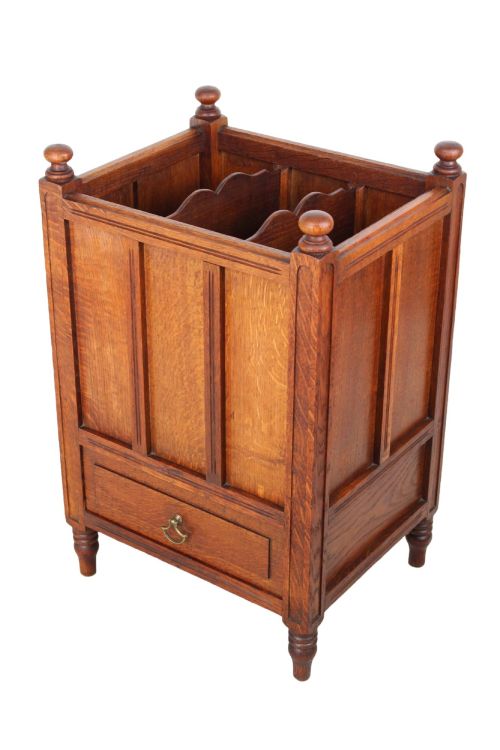
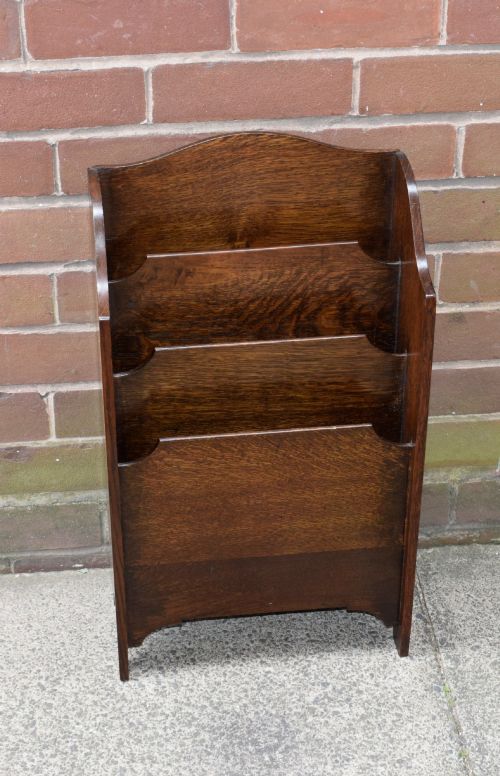
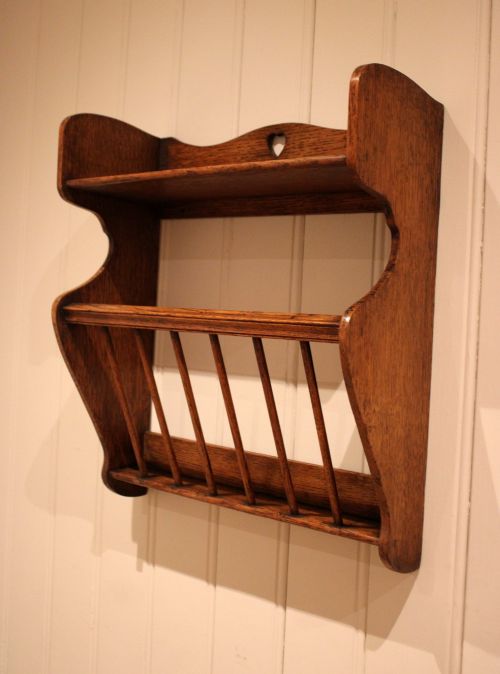
A vintage oak newspaper holder is a functional household piece designed to store periodicals, journals, and newspapers within easy reach. These items typically take the form of magazine racks, floor-standing stands, or combined wall shelves.
The versions you are most likely to meet on this page span from the Victorian and Edwardian eras into the nineteen-twenties and thirties. They frequently incorporate traditional forms such as the Canterbury or the revolving stand.
Makers produced these accessories in styles ranging from plain utilitarian designs to the characteristic craftsmanship of the Arts and Crafts movement. Each piece reflects the domestic habits of its period through sturdy construction and useful compartments.
How they were made
Carpenters built these newspaper holders primarily from solid oak, sometimes accented with contrasting satinwood details for visual interest. The timber was selected for its durability and strong grain pattern, which suited heavy daily domestic use.
Metalwork played a key role in the construction, with brass utilised for handles, rods, and decorative fittings that added a bright contrast to the dark timber. Joinery methods varied from simple fastened panels to more complex metamorphic and revolving mechanisms.
Current listings feature oak newspaper holders from the Victorian, Edwardian, and Arts and Crafts periods, alongside wall shelves and brass-accented stands.
What varies in quality
Quality in these holders is defined by the integrity of the timber joinery and the sophistication of the design, such as metamorphic functions or revolving actions. Superior examples display thoughtful proportions and careful hand-finishing rather than mass-produced simplicity.
The integration of secondary materials like brass fittings distinguishes finer pieces from plain utilitarian items. Well-cast metal hardware and clever internal divisions elevate a standard rack into a distinguished piece of furniture.
The Vintage Oak Newspaper Holder Glossary
- Canterbury
- A low wooden stand fitted with partitions for holding sheet music, books, or newspapers. Originating in the late eighteenth century, the form remained popular through the Victorian and Edwardian periods.
- Metamorphic
- A term applied to furniture designed to transform or fold into different configurations for alternative uses. These ingenious pieces often combine a stand with other domestic functions.
- Revolving rack
- A rotating display stand mounted on a central pivot, allowing easy access to publications from any angle. This mechanism required precise engineering to ensure smooth movement.
- Arts and Crafts
- A design movement advocating traditional craftsmanship and simple forms, often featuring exposed joinery and honest use of materials. It heavily influenced Edwardian cabinetmakers.
Vintage Oak Newspaper Holder: Frequently Asked Questions
What is a Canterbury?
A Canterbury is a traditional stand featuring vertical partitions designed to hold newspapers, magazines, or music sheets. They often include carrying handles or small legs for floor placement.
Cabinetmakers adapted these compartmentalised forms through the Victorian and Edwardian eras to serve as domestic newspaper holders.
How do I use a revolving rack?
A revolving newspaper rack sits on a central pivot base, allowing you to spin the storage compartments freely. This design gives you access to multiple publications from a single stationary seat.
They work well beside armchairs or desks where floor space is limited.
Are these holders wall-mounted?
While most pieces are freestanding floor stands or chairside companions, certain designs combine wall shelves with magazine storage. These dual-purpose units save floor space while keeping periodicals organised.
Check the structure of the back panel for hanging points before mounting any wooden shelf.
How do I date an oak rack?
Dating relies on stylistic clues, construction methods, and materials such as the presence of Arts and Crafts details or Edwardian brass hardware. Victorian examples often show heavier mouldings, while nineteen-thirties pieces tend toward simpler lines.
Comparing the timber finish and joinery style helps place the piece within its historical era.