


Vintage Money Bank
These vintage money bank pieces are tangible pieces of social history designed to secure small savings, offering both charm and a tangible link to past domestic habits.
Vintage Money Bank
A vintage money bank encompasses various domestic savings receptacles produced across the nineteenth and early twentieth centuries in forms ranging from earthenware pots to mechanical contraptions.
Buyers browsing this selection encounter pieces spanning the Victorian and Edwardian eras, utilising materials like cast iron, earthenware, mahogany, oak, and spelter.
Common forms include mechanical banks, barrel money boxes, puzzle book boxes, and folk art carvings representing figures or animals designed to encourage thrift.
Materials and construction
Makers utilised cast iron for robust mechanical banks, employing intricate foundry casting to create moving parts actuated by lever or spring.
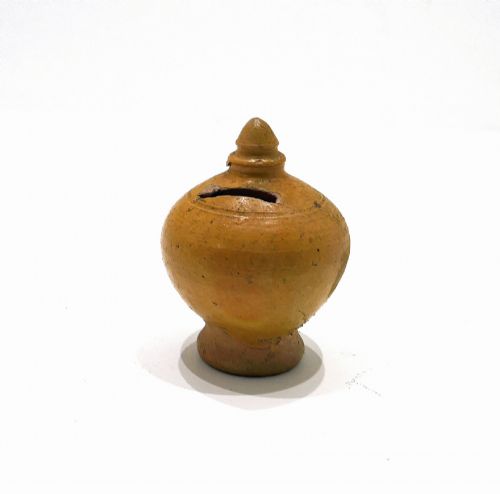
Pottery examples emerge from earthenware traditions such as Verwood or Staffordshire potteries, shaped by hand or mould before being glazed and painted.
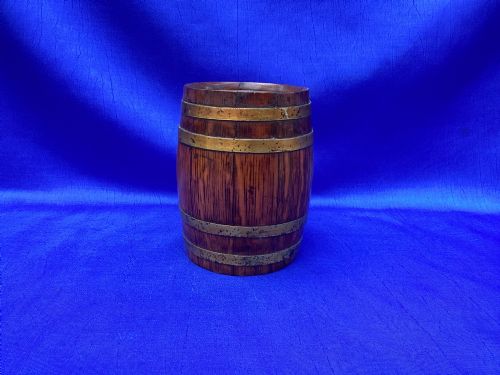
Woodworkers selected mahogany, oak, and hardwood to construct coopered barrels and carved figural boxes using traditional joinery and hand-carving techniques.
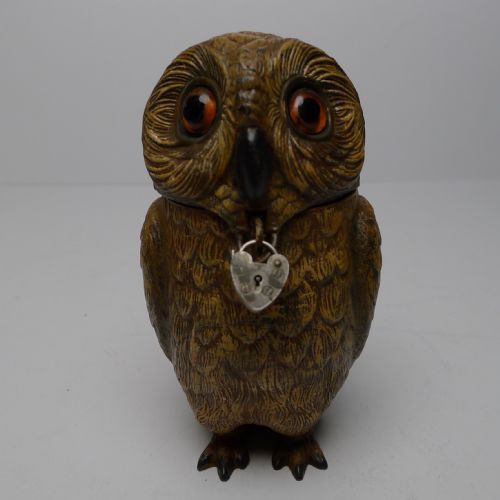
An amusing carved hardwood box portrays a notorious miser guarding his coin slot.
Distinctions in quality
Quality rests upon the crispness of the casting in iron pieces and the retention of original paint surfaces, which often suffer from flaking over decades of handling.
In ceramic and wooden examples, the finesse of the hand-carved detail or the authenticity of the regional pottery glaze dictates the desirability and artistic merit of the piece.
John Harper Co·Verwood Pottery
The Vintage Money Bank Glossary
- Spelter
- A zinc alloy frequently used as a substitute for bronze in decorative castings, often painted to simulate heavier metals.
- Mechanical bank
- A cast iron savings device that performs a physical action when a coin is deposited, popular in the late nineteenth century.
- Verwood pottery
- Earthenware originating from the Verwood potteries in Dorset, known for traditional lead glazing and rustic utilitarian forms.
- Coopered
- Constructed from wooden staves bound together with metal hoops, characteristic of barrel-shaped money boxes.
Vintage Money Bank: Frequently Asked Questions
How do mechanical banks work?
Mechanical banks operate through internal spring or lever mechanisms that activate an animation when a coin is inserted. Pressing a lever causes a figure to kick a football, drop the coin, and store it inside the iron housing.
These devices served as both toys and savings incentives for children in the Victorian period. Their complex iron engineering required careful assembly by foundries.
What materials are common in these banks?
Makers constructed these savings boxes from a diverse range of materials including cast iron, earthenware, oak, mahogany, spelter, and tin. Each material reflects the manufacturing capabilities of its specific decade.
Heavier metals suited mechanical action, whilst regional potteries utilised local clays for simple glazed earthenware money boxes. Woodworkers turned hardwoods into barrels and carved figural boxes.
How can I date an old money box?
Dating relies on identifying stylistic markers, manufacturing techniques, and materials characteristic of specific periods like the Victorian or Edwardian eras. Cast iron mechanical examples often bear patent dates or maker marks from the late nineteenth century.
Pottery pieces offer clues through glaze chemistry, body composition, and regional kiln practices. Documentary evidence on specific makers further narrows the production window.
Were these banks meant for children?
Many examples were manufactured specifically to teach children the habit of saving small coins through engaging mechanical actions or amusing carved figures. Figures like animals or traditional characters held youthful interest.
Other containers served adult domestic spaces as donation boxes, coin trays, or puzzle boxes for secret storage. Their dual function combined utility with parlor entertainment.