


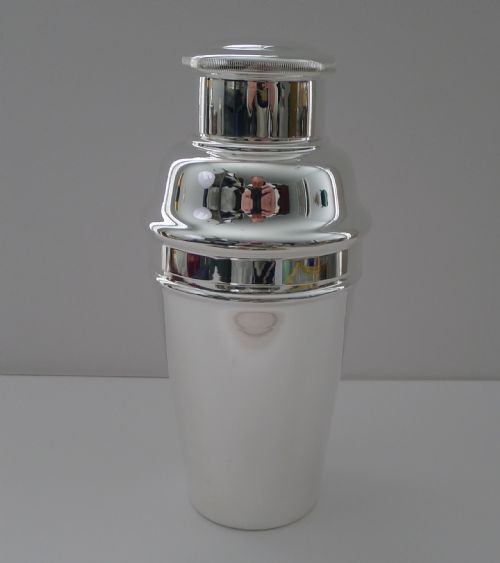


Vintage Martini Shaker
A vintage martini shaker brings modernist geometry and polished shine to the home bar.
Vintage Martini Shaker
A vintage martini shaker is a barware vessel designed for mixing spirits, most frequently encountered in silver plate, electroplated nickel silver, or sterling silver. The selection ranges across the 1920s, 1930s, and 1940s, with later examples extending into the 1950s and 1960s.
The dominant aesthetic is Art Deco, producing clean lines, bottle shapes, and cylindrical bodies. Mid-Century Modern forms also appear, alongside specialised additions such as integral lemon squeezers, built-in reamers, ice breakers, and rolling recipe mechanisms.
How they were made
Silversmiths utilised base metal, copper alloys, and sterling silver, frequently applying a heavy silver plate or electroplated nickel silver finish to achieve a bright metallic lustre. Cut glass and wood also feature in selected designs to provide textural contrast.
Techniques included engine turning, guilloche enamel work, and hammering to ornament the exterior surfaces. Integral functional elements such as strainers, squeezers, and ice breakers were engineered directly into the metal bodies.
Vintage Martini Shaker Retail Price Guide 2026
Typical asking prices for vintage martini shaker among the pieces listed under this phrase on Sellingantiques today, from the lower quarter to the upper quarter. They describe what is for sale here now, not the wider market.
Materials range from basic metal and silver plate to sterling silver, glass, and wood.
What varies in quality
Quality rests in the weight of the metal, the precision of the maker's mark, and the complexity of the integrated mechanisms such as internal strainers, lemon reamers, and rolling recipe bands. Substantial gauge silver plate and solid sterling silver demonstrate superior manufacturing standards.
Artistic execution distinguishes standard production from exceptional pieces, particularly where specialised ornamentation like engine turning, guilloche enamel, or distinct forms by named designers are present.
Hukin & Heath·J. B. Chatterley & Sons·Christofle·William Suckling·Adie Brothers·Gaskell & Chambers·Maison Barra·William Hutton·Mappin & Webb·St. Medard Paris·Kingsway Silver Plate·Tuttle·David Andersen·Lutz & Weiss
The Vintage Martini Shaker Glossary
- Electroplated Nickel Silver
- A base metal alloy of copper, nickel, and zinc coated with a layer of pure silver. This material provided a durable, lustrous surface for barware at a lower cost than solid silver.
- Engine Turned
- A mechanical decoration technique that etches intricate geometric patterns into metal surfaces. This method creates precise linear textures across the body of the vessel.
- Guilloche Enamel
- A decorative technique where transparent enamel is layered over engine-turned metal. It produces a repeating geometric design beneath a colourful glossy finish.
- EPNS
- An abbreviation for electroplated nickel silver, commonly stamped as a mark on silver-plated metal objects. It indicates the underlying metal composition of the piece.
- Sterling Silver
- A precious metal alloy consisting of silver and other metals, usually copper, combined to increase durability. It represents the highest grade of silver used in standard silversmithing.
Vintage Martini Shaker: Frequently Asked Questions
What materials were used for vintage cocktail shakers?
Makers utilised silver plate, electroplated nickel silver, sterling silver, and base metal alloys. Cut glass and wood also appear in specific designs.
Surface decoration often included enamel and engine-turned patterns.
How do I identify an Art Deco shaker?
Art Deco shakers typically display geometric lines, streamlined bottle shapes, and engine-turned or hammered surface textures. These pieces originate predominantly from the 1920s and 1930s.
They frequently incorporate functional additions like built-in lemon squeezers or ice breakers.
Are these shakers safe for mixing drinks today?
Most silver-plated and sterling silver shakers remain suitable for mixing drinks provided the interior is clean and well-maintained. Inspect the lining and mechanical parts before use.
Hand washing preserves the historic silver plating and any delicate enamel work.