

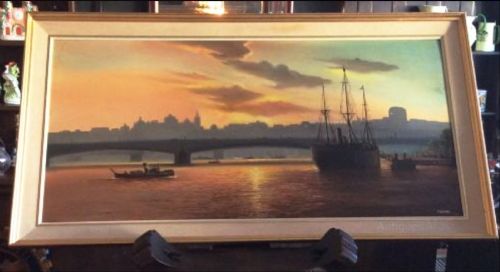


Vintage Marine River Scene
These vintage marine river scene works capture historic waterways and bustling ports through traditional oils and delicate watercolours.
Vintage Marine River Scene
A vintage marine river scene captures the working life of historic waterways, from the Thames in London to continental rivers like the Maas and the Tees. These pieces document busy ports, anchored barges, and panoramic bridges under varying skies and moonlight.
The selections span the nineteenth century through the mid-twentieth century, encompassing Victorian landscapes, Edwardian maritime views, and post-war British interpretations. Common forms include framed oil paintings on canvas or board alongside detailed watercolour paintings on paper.
Makers and artists working in these periods recorded industrial expansion and river trade with distinct regional focus, portraying specific locations such as Waterloo Bridge, Rochester, and the Norfolk broads.
How they were made
Painters applied oil paint to stretched canvas, wooden board, or used watercolour pigment on paper, frequently framing the finished pieces in gilt or giltwood. The physical supports reflect traditional studio practices of the nineteenth and twentieth centuries.
Brushwork ranges from the fluid, transparent washes typical of maritime watercolours to the heavier impasto and layered pigments characteristic of nineteenth-century oil paintings.
The selection includes oil paintings and watercolours spanning the nineteenth century, the Edwardian era, and the mid-twentieth century.
What varies in quality
Quality rests in the precision of draughtsmanship, particularly in the accurate rendering of rigging, hull structures, and architectural perspective along the riverbanks. Stronger works demonstrate a sure command of light reflecting off water and atmospheric depth in the distance.
Condition of the original paper or canvas, stability of the pigments, and the preservation of period frames contribute to the overall integrity of the piece.
Thomas Bush Hardy·Edward Henry Eugene Fletcher·Charles Harmony Harrison·Frank William Scarbrough·William Dommersen
The Vintage Marine River Scene Glossary
- Watercolour pigment
- Finely ground colour mixed with a water-soluble binder, applied in translucent washes on paper. This medium allows for luminous skies and subtle water reflections.
- Oil on canvas
- Pigment bound in an oil medium spread across a woven textile support. It permits rich colour saturation and varied surface texture.
- Giltwood
- Wood carved and coated with gold leaf or gold paint to form decorative picture frames. It was widely utilised during the Victorian and Edwardian eras.
- Impressionism
- An art style focused on the accurate depiction of light and its shifting qualities. British practitioners applied these principles to coastal and river subjects.
Vintage Marine River Scene: Frequently Asked Questions
What subjects appear in these river scenes?
The compositions generally depict working barges, commercial shipping, and bridges along tidal rivers like the Thames, the Medway, and the Tees. Artists recorded busy urban pools alongside quieter rural waterscapes.
Many pieces document specific historic locations, capturing the industrial activity and maritime traffic of past centuries.
How do oils differ from watercolours here?
Oil paintings utilise heavy pigments on canvas or board, offering rich textures and deep tones suitable for moody moonlight or bustling industrial ports. Watercolours employ translucent washes on paper, creating bright, luminous atmospheric effects.
Both mediums were used extensively across the nineteenth and twentieth centuries to record maritime views.
How should I display these paintings at home?
These works suit traditional or transitional interiors, particularly when hung on neutral walls that allow the period gilt frames to stand out. Direct sunlight should be avoided to protect both watercolour pigments and oil varnishes.
Stable room humidity helps preserve the wooden boards, canvas supports, and paper grounds.
How can I tell the period of a piece?
Stylistic clues, framing materials, and artist signatures often indicate the date of execution. Victorian and Edwardian works frequently display specific academic or impressionistic approaches to light and maritime trade.
Inscribed titles on the reverse or front of the work frequently reference the exact waterways and cities portrayed.