


Steamship Thames River Painting
These steamship thames river painting works capture the industrial energy and maritime traffic of the capital across the Victorian and Edwardian eras.
Steamship Thames River Painting
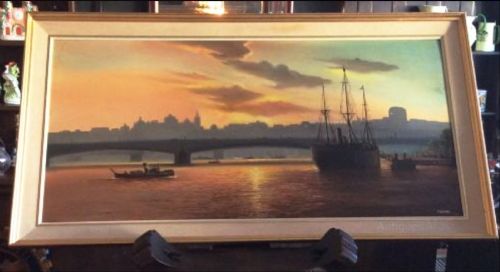
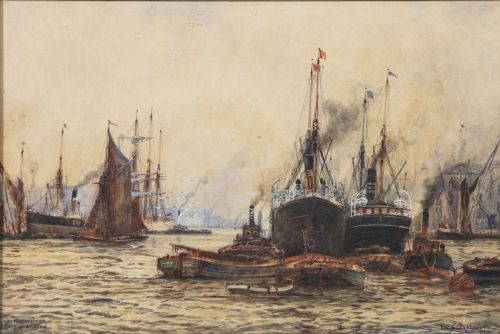
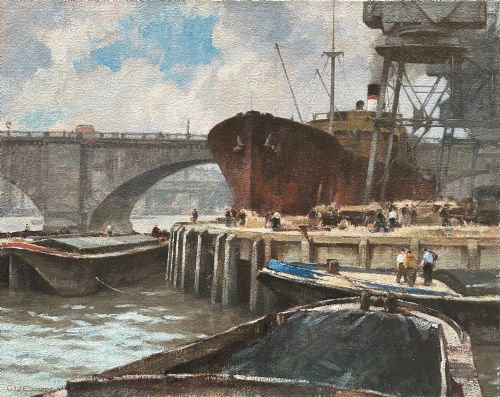
A steamship thames river painting records the bustling commercial waterways of London, focusing on bridges, docks, and maritime traffic along the Thames. Buyers searching for a steamship thames river painting encounter works that range from expansive panoramic views of Waterloo Bridge to atmospheric depictions of the Upper and Lower Pools.
The pieces listed on this page span several decades, notably the nineteenth century, the Edwardian period, and later twentieth-century interpretations. These works capture specific London landmarks such as St Paul’s Cathedral and the Tower of London set against working river craft.
Watercolour and oil on canvas dominate the forms available, executed by named British maritime artists who specialised in coastal and river scenes. Most examples present framed compositions suited to traditional domestic interiors.
Materials and methods
Artists record these river scenes using watercolour paint on paper or oil pigment applied to canvas, mounted within wood frames. Watercolour allows for fluid washes that render the misty, smoky atmosphere of the London pool.
Oil on canvas provides richer textures and heavier impasto, suitable for capturing the dark water and coal smoke of steamships. The framing typically consists of traditional wood moulding which complements the maritime subject matter.
Several artists captured the notorious London smog so effectively that viewers might feel the urge to reach for a coal shovel.
Factors of quality
Quality rests upon the artist's ability to render topographical detail alongside atmospheric light, distinguishing a master hand from a routine topographical record. The best works balance architectural precision with the movement of steam vessels and river craft.
Condition of the paper or canvas also dictates the standing of a piece, with unblemished watercolours and stable oil surfaces commanding greater appreciation. Stronger compositions offer clear focal points, such as named bridges or prominent cathedral backgrounds, rather than generic water stretches.
Frank William Scarbrough·Cyril Walduck Edwards·Charles William Wyllie·Walter Duncan·Edward Fletcher·Frances E Nesbitt
The Steamship Thames River Painting Glossary
- Upper Pool
- The stretch of the River Thames extending downstream from London Bridge to Limehouse. It served as a primary commercial hub for steamships and sailing vessels.
- Watercolour
- A painting method in which the paints are made of pigments suspended in a water-based solution. Paper serves as the primary support for these translucent applications.
- Oil on Canvas
- A medium utilising pigments bound in a drying oil, spread across a stretched canvas fabric. This technique permits deep colour saturation and rich surface texture.
- Edwardian
- Pertaining to the reign of King Edward VII, spanning the early years of the twentieth century. In art, this period often maintained late Victorian illustrative standards.
- Maritime Art
- Works depicting ships, shipping, sea, and shore. This genre encompasses historical naval battles as well as working river scenes.
Steamship Thames River Painting: Frequently Asked Questions
How do I date an older river painting?
Dating relies on recorded artist signatures, exhibition labels, and the architectural landmarks visible in the background, such as specific bridges or wharves.
Changes in vessel design, from sail to steam, also provide a reliable chronological marker for nineteenth and twentieth-century maritime scenes.
Where should I hang a maritime watercolour?
Watercolours are sensitive to direct sunlight and require placement on interior walls away from bright windows to prevent fading.
Pairing them with neutral wall colours helps highlight the delicate brushwork and atmospheric washes typical of early twentieth-century British paper art.
What is the difference between oil and watercolour river scenes?
Oil paintings on canvas offer heavier pigment layers and deep textures that capture the heavy smoke and dark water of the industrial Thames.
Watercolours on paper deliver lighter, more translucent effects well suited to misty morning light and subtle atmospheric haze.
Are these London scenes historically accurate?
Most professional maritime artists of the Victorian and Edwardian periods painted from direct observation of the working port and its shipping traffic.
Landmarks like the Tower of London and St Paul's Cathedral provide dependable anchor points that confirm the specific locations depicted along the river.