
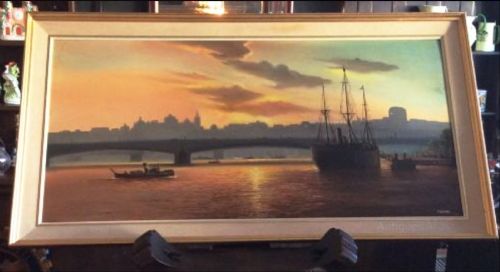


Twentieth Century Maritime Painting
Twentieth century maritime painting captures coastal waters, harbour scenes and naval vessels through the lens of British Impressionism, Post-Impressionism and maritime art.
Twentieth Century Maritime Painting
Twentieth century maritime painting encompasses works produced across several decades, ranging from Edwardian coastal scenes to mid-century harbour views. Buyers encounter subjects such as Thames panoramas, Yorkshire fishing boats, Cornish harbours and naval vessels recorded by regional schools and individual artists.
The form appears in various media, predominantly oil paint on canvas and watercolour on paper, often presented in framed formats. These pieces document coastal life, maritime commerce and naval history through distinct regional movements like the Newlyn school.
Materials and technique
Artists utilised oil paint on canvas and wood panels alongside watercolour and gouache on paper to record coastal subjects. The application ranges from textured impasto in oils to fluid washes in watercolour.
Works are frequently mounted behind glass when executed on paper, whilst canvas paintings are traditionally stretched over wooden frames and housed in decorative wooden surrounds.
Some maritime artists recorded naval seaplane carriers alongside traditional sailing cobles and transatlantic liners.
Evaluating quality
Quality rests upon the artist's handling of light, atmosphere and maritime atmosphere, distinguishing competent topographical records from accomplished artistic interpretations. Stronger examples demonstrate confident brushwork and a secure grasp of marine architecture and coastal topography.
Condition plays a part, particularly the stability of the paint surface on canvas and the absence of fading or foxing on paper works. Original framing and clear provenance further elevate the standing of a piece.
Vincenzo D’Esposito·Donald McIntyre·Frank H. Mason·Dion Pears·Ernest F. Hill·William Lambert Bell·Frank Wood·Owen Bowen·Fred Mayor·Edmund Gouldsmith·Maurice Sijs·Rowland Henry Hill·Richard Hall·Harry John Pearson
The Twentieth Century Maritime Painting Glossary
- British Impressionism
- A painting style developed in Britain during the late nineteenth and early twentieth centuries, characterised by loose brushwork and an interest in natural light. Artists applied these principles to coastal and marine subjects.
- Coble
- A traditional type of open fishing boat native to the north-east coast of England, distinguished by a flat floor and high bow. These vessels frequently appear in regional marine watercolours.
- Gouache
- An opaque water-based paint that dries to a matte finish, often used alongside transparent watercolour to add highlights and solid colour to maritime works.
- Newlyn school
- An art colony based in Cornwall during the late nineteenth and twentieth centuries, known for naturalistic plein-air painting of local fishermen, harbours and coastal life.
- Post-Impressionism
- An art movement extending Impressionism while rejecting its limitations, employing vivid colours and distinct brushstrokes to portray marine scenes and coastal landscapes.
Twentieth Century Maritime Painting: Frequently Asked Questions
What subjects appear in these paintings?
These works depict coastal harbours, open seas, naval vessels, fishing boats and Thames river scenes. Artists recorded daily maritime life, coastal topography and specific historical ships.
Subjects range from Cornish harbours and Yorkshire fishing fleets to French coastal gatherings and naval portraits.
How should I display watercolour works?
Watercolour paintings on paper require protection behind glass to prevent atmospheric damage and fading from direct sunlight. Acid-free mounts help preserve the paper over time.
Position these pieces away from humid environments like kitchens and bathrooms to protect the paper support and pigments.
How do I identify the period of a piece?
Dating relies on recorded artist lifespans, stylistic indicators such as Post-Impressionist brushwork, and the specific maritime vessels or clothing depicted in the scene. Signatures and gallery labels on the reverse also offer clues.
Framing materials and backing boards can provide additional context regarding the age of the presentation.
What is the difference between oil and watercolour?
Oil paint utilises pigment suspended in drying oils applied to canvas or wood, offering rich texture and deeper colour saturation. Watercolour employs water-soluble pigments on paper, creating translucent washes and lighter effects.
Oils are generally more robust and traditionally housed in heavy wooden frames, whereas watercolours require glass protection.