

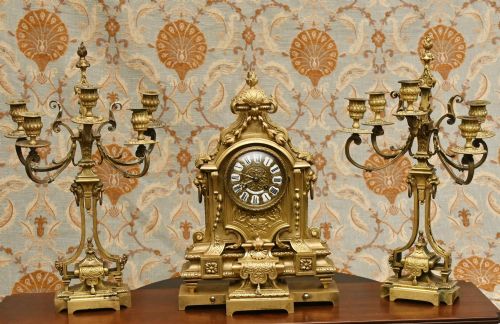


Vintage Mantle Clock Set
A vintage mantle clock set brings architectural presence to a room, combining timekeeping with matching garnitures in marble, brass and onyx.
Vintage Mantle Clock Set
A vintage mantle clock set centres on a main timekeeper accompanied by matching side pieces such as candelabras or urns, forming a unified decorative arrangement. When you search for a vintage mantle clock set, you encounter complete multi-piece ensembles designed to sit together on a fireplace ledge or sideboard.
The pieces on this page span the Victorian era, the nineteenth century, and the Art Deco period of the nineteen-twenties and thirties. French origins feature strongly alongside Victorian Classical Revival designs.
Most examples incorporate a central mantel clock paired with flanking garnitures, though desk clocks and barometer combinations also appear. Materials range from traditional marble and green onyx to spelter, brass, and gilt metal.
How they were made
Makers utilised dense natural stones like marble and green onyx for the substantial bodies of these clock sets, often shaping them into architectural forms. Heavy metals such as brass, spelter, and gilt bronze provide structural mounts, dials, and decorative accents.
Movements within these pieces typically rely on eight-day mechanisms designed to strike the hours and halves. Enamel dials carry the numerals, protected behind glass bezels set into the metal or stone case.
Vintage Mantle Clock Set Retail Price Guide 2026
Typical asking prices for vintage mantle clock set among the pieces listed under this phrase on Sellingantiques today, from the lower quarter to the upper quarter. They describe what is for sale here now, not the wider market.
Listings on this page span the Victorian era, the nineteenth century, and the Art Deco period of the nineteen-twenties and thirties.
What varies in quality
The standard of a vintage mantle clock set depends on the cohesion of the complete garniture and the quality of the materials used in its construction. Heavier marble and onyx cases paired with matching candelabras demonstrate greater ambition than simpler single-piece clocks.
Finishing details such as crisp casting in the brass mounts and well-preserved enamel dials separate ordinary production from finer examples. The integration of the movement with the heavier stone cases also marks the distinction between standard and superior sets.
The Vintage Mantle Clock Set Glossary
- Clock garniture
- A set comprising a central clock accompanied by matching decorative side pieces such as urns or candelabras. These elements are designed to be displayed together on a mantelpiece.
- Spelter
- A zinc alloy commonly utilised as a less costly alternative to bronze for casting decorative figures and mounts, often given a metallic finish. It appears frequently on nineteenth-century clock cases.
- Gilt bronze
- Copper and zinc alloy treated with a gold wash or mercury gilding to impart a bright metallic sheen. It provides durable ornamentation on high-end French clock sets.
- Green onyx
- A banded chalcedony variety valued for its rich translucent green patterning. It forms the solid carved housing for several ornate Victorian clock sets.
- Eight-day movement
- A mechanical clock movement requiring winding roughly once a week. This system was standard in quality nineteenth-century and Art Deco timepieces.
Vintage Mantle Clock Set: Frequently Asked Questions
What is included in a clock garniture?
A clock garniture includes a main mantel clock accompanied by matching side objects like candelabras or urns. These matching elements share materials and stylistic details to create a balanced display.
They were traditionally arranged across a mantelpiece or a large sideboard to anchor the room's decor.
Where were these clock sets made?
Many of these clock sets originate from French workshops active during the nineteenth and early twentieth centuries. French makers produced a significant portion of the marble and brass garnitures seen here.
Victorian British pieces also feature prominently, particularly those utilising heavy green onyx and classical revival styles.
How do I wind an eight-day clock?
An eight-day clock movement is wound using a specific key inserted into winding holes on the dial face. Turning the key tensions the internal springs that power the time and strike trains.
Care should be taken not to overwind the mechanism to ensure the longevity of the vintage movement.
How do I distinguish Victorian from Art Deco sets?
Victorian clock sets are characterised by heavy marble or green onyx bodies, ornate brass mounts, and classical revival motifs. They lean towards symmetry, elaborate casting, and traditional architectural silhouettes.
Art Deco sets, dating from the nineteen-twenties and thirties, utilise streamlined geometric shapes, contrasting marble colours, and simplified metallic accents.