




Vintage Library Telescope
These vintage library telescope pieces are precision instruments designed for study and observation, offering brass and mahogany craftsmanship that brings historic science into the home.
Vintage Library Telescope
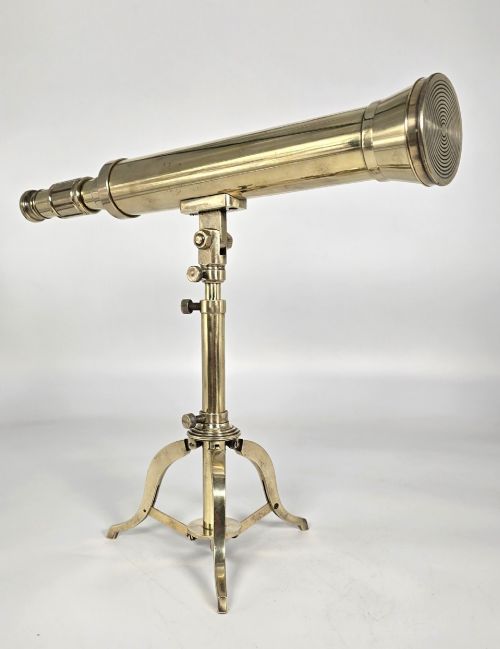
A vintage library telescope is a precision optical instrument intended for terrestrial or astronomical observation, often mounted on a sturdy stand for indoor study. These pieces combine practical science with decorative presence, suiting the desks and studies of collectors.
The examples on this page span the Georgian, Victorian, and Edwardian periods, stretching from the eighteenth century into the early twentieth century. Makers from London and Sheffield dominate the selection, offering multi-draw brass tubes and fitted mahogany cases.
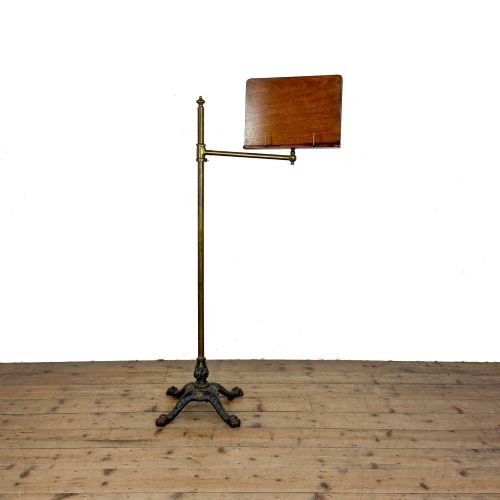
Forms vary from compact table models on folding tripods to larger cased instruments resting on dedicated stands. Alongside these telescopes, the selection includes related items such as adjustable reading stands designed for scholarly study.
Materials and construction
Brass serves as the primary metal for the optical tubes and mountings, polished to a bright finish or patinated with age. Glass lenses provide the magnification, housed within sliding brass draws that extend to focus the image.
Mahogany and other woods appear in the fitted storage cases and support stands, frequently complemented by stitched leather barrel coverings. Cast iron and steel components provide stability for the heavier floor and table stands.
Listings span from the 18th century through the Edwardian period, featuring brass, mahogany, leather, and glass across various scientific instruments.
What separates the best examples
Quality rests in the precision of the optical maker's signature and the mechanical execution of the multi-draw tubes. Signed London and provincial makers command attention through crisp engraving on the brass barrels and refined lens clarity.
The presence of original fitted wooden cases and matching folding stands elevates an instrument. Complete assemblies with original caps and robust mechanical mountings represent the peak of the instrument maker's craft.
Nairne & Blunt of London·W. & T. Gilbert London·Clarkson London·Steward of London·Chadburn Brothers of Sheffield·S & B Solomons·Matthew Berge London·G.adams of london·Broadhurst & Co
The Vintage Library Telescope Glossary
- Terrestrial telescope
- An optical instrument designed for viewing objects on land, providing an erect image rather than an inverted one. These models often feature multiple draws for compact storage.
- Draw
- A sliding tubular section of a telescope barrel that pulls out to adjust the focal length. Telescopes are commonly described by the number of draws they possess, such as four-draw or six-draw.
- Astronomical telescope
- An instrument configured for viewing stars and celestial bodies, typically producing an inverted image. These require sturdy mountings to maintain stability during extended viewing.
- Reading stand
- An adjustable wooden support designed to hold heavy volumes at a comfortable angle for study. They share the library provenance of these optical instruments.
Vintage Library Telescope: Frequently Asked Questions
What is a library telescope?
A library telescope is a mid to large-scale optical instrument traditionally kept in a study or library for terrestrial or celestial viewing.
Mounted on a stand or kept in a fitted case, these instruments combined scientific utility with the refined appearance expected in a gentleman's study.
How do you use a multi-draw telescope?
To use a multi-draw telescope, you gently pull the smaller inner brass tubes outward until the instrument is fully extended. You then adjust the final draw to bring the distant subject into sharp focus.
Care must be taken to support the main barrel while sliding the smaller brass draws to prevent strain on the historical fittings.
Where were these telescopes made?
The instruments recorded here originate primarily from British workshops, with prominent makers working in London and Sheffield. These urban centres were renowned for producing precision scientific instruments during the Georgian and Victorian eras.
Signatures engraved on the brass tubes frequently name the specific optician and city of manufacture.
How do you date an antique telescope?
Dating relies on maker signatures, stylistic details of the brass mountings, and the materials used for the cases and stands. Georgian instruments often display simpler lines, while Victorian examples frequently incorporate multi-draw designs and detailed maker inscriptions.
Comparing the maker's recorded working dates helps narrow the period of manufacture.