
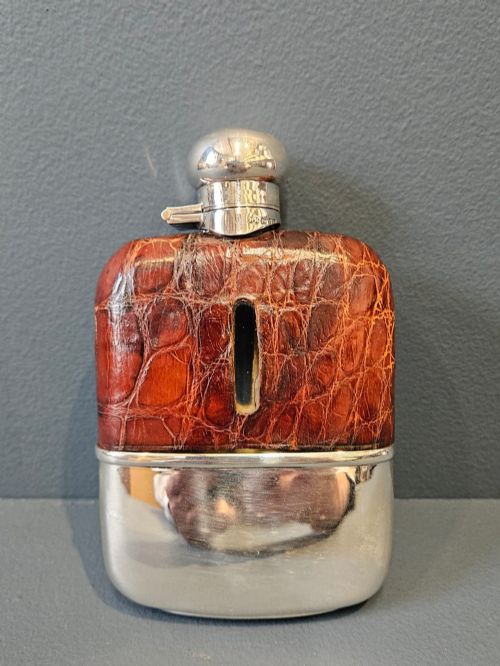


Vintage Leather Pocket Flask
These vintage leather pocket flask examples bring together glass, silver, and hide for a portable spirit container.
Vintage Leather Pocket Flask
A vintage leather pocket flask serves as a portable spirit container encased partially or fully in hide, designed to slip easily into a coat or jacket pocket. These items appear across several decades, spanning the Victorian era through Edwardian designs and into the Art Deco period of the 1930s.
Most examples combine a glass body with metal mounts and a protective leather covering, frequently featuring a captive or removable silver cup at the base. The leather wrap provides a secure grip and cushions the glass against knocks during travel or outdoor pursuits.
How they were made
Maker workshops combined glass bodies with sterling silver or silver plate collars and caps, securing the metalwork with threaded necks and cork seals to prevent leaks. Crocodile skin or standard leather wraps were carefully fitted and stitched around the central section of the glass body.
Many specimens incorporate a silver-plated or solid sterling silver removable cup that slides over the lower portion of the flask. Hallmarks stamped into the metal mounts record the assay office, year, and maker.
What varies in quality
The distinction between standard production and finer work rests on the choice of precious metal and the texture of the hide. Solid sterling silver mounts command greater regard than silver plate, while genuine crocodile skin offers a more intricate natural pattern than plain leather.
The precision of the leather stitching and the snugness of the fitted cup indicate the original standard of manufacture. Complete sets retaining their original hallmarked components demonstrate higher artisanal skill.
Hukin & Heath·James Dixon & Sons
The Vintage Leather Pocket Flask Glossary
- Hip Flask
- A small container for holding liquor, curved to fit against the body in a pocket. These vessels became essential accessories for travel and sporting events during the nineteenth and twentieth centuries.
- Sterling Silver
- An alloy containing silver and other metals to ensure durability for functional items. This material appears frequently in the caps, collars, and cups of these vessels.
- Silver Plate
- A thin layer of silver bonded to a base metal such as copper or brass. This technique offered the appearance of solid silver at a lower cost.
- Captive Top
- A screw cap attached to the flask by a hinged arm so it cannot be misplaced. This mechanism ensures the stopper remains secure during use.
Vintage Leather Pocket Flask: Frequently Asked Questions
What are vintage leather pocket flasks made of?
These vessels combine a glass interior container with an exterior wrap of leather or crocodile skin. The mounts, screw caps, and base cups utilise either sterling silver or silver plate.
The metal components frequently carry hallmarks that verify the metal purity and production year. The glass body holds the liquid securely while the outer hide protects the surface.
How do I date a silver and leather flask?
Dating relies heavily on the hallmarks stamped into the silver collars, caps, or cups. These assay marks indicate the exact year of manufacture and the workshop responsible.
Stylistic shifts also help place a piece, moving from ornate Victorian ornamentation through Edwardian refinement to the cleaner lines of the 1930s Art Deco era.
Are the cups on these flasks removable?
Many examples feature a metal cup that slides off the bottom of the flask to serve as a drinking vessel. This lower section fits snugly over the leather-covered glass body.
Some designs secure the cup with a bayonet mount or simple friction fit, requiring a gentle pull to release it from the base.
Did these flasks use real crocodile skin?
Makers frequently utilised genuine crocodile hide for the exterior wrap, particularly on finer sterling silver models from the late nineteenth and early twentieth centuries. The distinct scale pattern provides a textured grip.
Alternative pieces employ smooth or embossed leather instead of exotic reptile skin, depending on the tier of production.