




Vintage Hanging Clock
These vintage hanging clock pieces bring working timepieces and barometers onto the wall, offering period presence and practical utility for any interior.
Vintage Hanging Clock
A vintage hanging clock gathers wall clocks, barometers, and trade signs spanning the Victorian era through the mid twentieth century. Buyers seeking this phrase encounter wall mounted timepieces and combined weather instruments housed in wooden and metal cases.
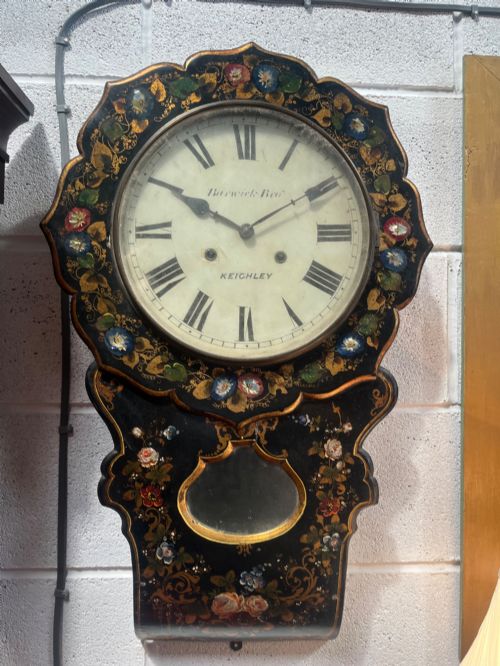
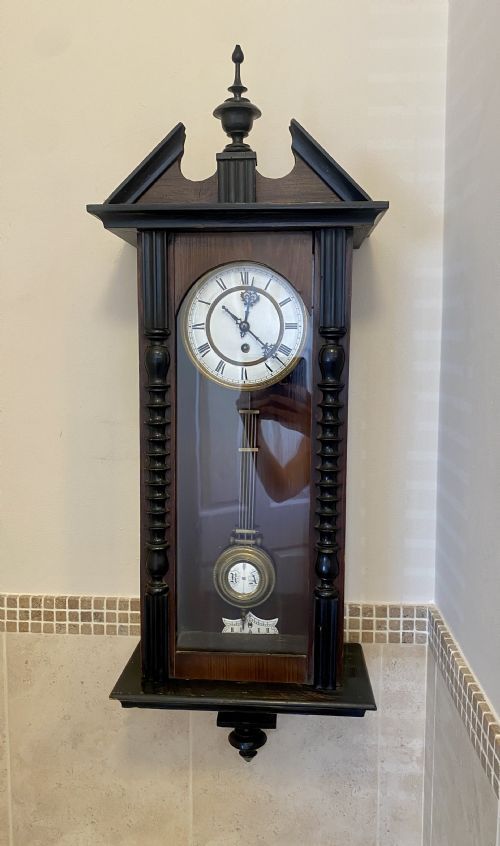
The selection ranges from school clocks and carved oak aneroid barometers to Vienna wall clocks and gilt metal cartel designs. French rosewood pieces and Art Deco oak examples sit alongside heavier industrial trade signs.
Origin points stretch across Britain, France, and Vienna, with nineteenth century items sharing space with 1920s and 1940s productions. Walnut, mahogany, and ebonised wood provide the primary casing materials for these domestic and commercial timekeepers.
How they were made
Cases utilise timber construction in walnut, mahogany, oak, rosewood, and ebonised wood, often shaped with carved details or smooth veneers. Glass protects enamel dials and delicate hands, while brass and gilt metal form bezels, cartel frames, and movement components.
Movements incorporate mechanical systems such as fusee mechanisms and chiming arrangements, alongside aneroid barometer assemblies. Painted decoration and giltwood finishes complete the decorative treatment on specific cartel and wall hanging formats.
Vintage Hanging Clock Retail Price Guide 2026
Typical asking prices for vintage hanging clock among the pieces listed under this phrase on Sellingantiques today, from the lower quarter to the upper quarter. They describe what is for sale here now, not the wider market.
Listings feature 19th Century, Victorian, Edwardian, and Art Deco periods, executed in walnut, oak, mahogany, glass, brass, and enamel.
What varies in quality
Quality separates through the crispness of timber carving, the depth of French polish or gilt finish, and the legibility of enamel dials. Refined Vienna regulators and carved oak barometer cases display greater attention to proportion than utilitarian school clocks.
The integrity of the movement and the original pairing of dial, case, and bezel define the standing of individual examples. Finer pieces retain intact glass bezels, distinct painted decoration, and signed movements from established makers.
Hyde & Sons Sleaford·Josef Herzog·Johann Baptist Beha·Perivale of England
The Vintage Hanging Clock Glossary
- Vienna wall clock
- A precision weight driven timepiece developed in Austria, noted for long wooden cases and visible swinging pendulums.
- Fusee mechanism
- A conical pulley system inside a clock that equalises the declining power of a mainspring as it unwinds.
- Aneroid barometer
- An instrument measuring atmospheric pressure without liquid, using a flexible metal box that expands or contracts.
- Cartel wall clock
- An ornate wall clock housed in an asymmetrical or scroll framed case made from gilt metal or carved wood.
- School clock
- A sturdy, plain dial wall clock designed for institutional visibility and reliable daily timekeeping.
Vintage Hanging Clock: Frequently Asked Questions
How do I wind a Vienna wall clock?
Vienna wall clocks usually require a key to wind the driving springs or pull the weight lines back to the top of the case. Care must be taken not to overwind the mechanism.
Pendulum clocks also need to be set on a level wall so the beat remains even and the clock does not stop.
Where should I hang a fusee clock?
Fusee wall clocks need a secure fixing directly into masonry or wall studs because the mahogany or walnut cases carry considerable weight. Place them away from damp areas and direct heat sources.
Ensure the wall is flat so the case hangs plumb and the pendulum swings freely without catching the backboard.
What is an aneroid barometer used for?
An aneroid barometer tracks changes in atmospheric pressure to help forecast short term weather shifts. The pointer moves across a graduated enamel dial marked with terms like stormy, rain, change, fair, and very dry.
Many vintage wall combinations mount the barometer alongside a clock and thermometer in a shared wooden case.
How do I date a Victorian wall clock?
Dating relies on case styles, wood types like walnut or mahogany, and the specific lettering on enamel or painted dials. School clocks and Vienna regulators often carry characteristic Victorian proportions and fusee movements.
Maker signatures on the dial or movement backplate provide the most reliable chronological markers.