



Vintage Glass Wall Appliques
These vintage glass wall appliques bring striking period illumination and decorative elegance to a room.
Vintage Glass Wall Appliques
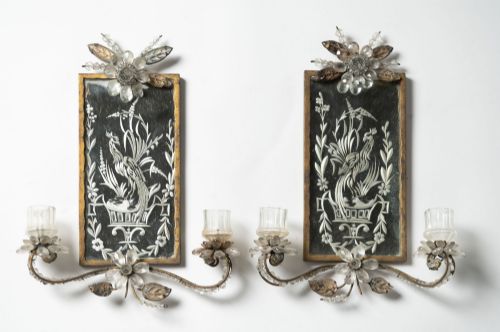
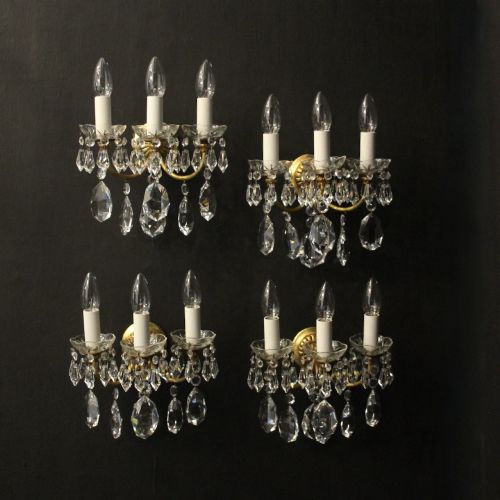
Vintage glass wall appliques comprise wall-mounted lighting fixtures designed to hold bulbs or candles while casting light across a space. The selection spans distinct eras including the Edwardian period, the 1920s, and the 1930s, alongside nineteenth-century examples.
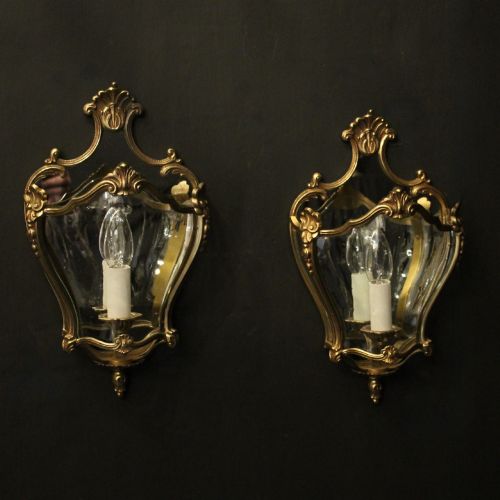
The forms encompass wall lights, wall sconces, half lanterns, and wall chandeliers, frequently presented in pairs or matching sets. These pieces originate from diverse stylistic traditions such as French Rococo, Art Deco, and Neoclassical designs.
Buyers seeking vintage glass wall appliques encounter pieces that integrate brass, bronze, crystal, and frosted glass. Many items reflect European craftsmanship, notably French and Italian workshops.
How they were made
Maker construction combines cast or gilt metals with shaped glass elements, utilising brass, bronze, and silver alongside cut crystal and frosted glass. Metal components are cast, chased, and gilded, providing secure structural backplates and arms for the glass shades.
Glass components are mouth-blown, pressed, or hand-cut, yielding decorative drops, beads, and shades that diffuse or refract light. Specialised moulded shades by known glasshouses are fitted into metal mounts to complete the fixture.
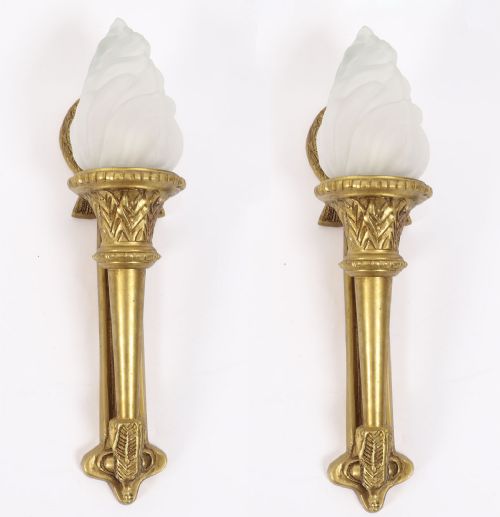
Some torch-form sconces were designed to make your hallway look like an eighteenth-century Parisian theatre.
What varies in quality
The refinement of the cast metalwork and the clarity of the glass dictate the standing of a piece within its period. Crisp chasing on bronze or ormolu mounts and deep, sharp facet cutting in crystal signal superior manufacturing standards.
The integrity of the design and the presence of original components, such as specialised glass shades, distinguish higher-grade examples. Pieces retaining matching sets of drops and unified patination across the metal structure command greater appreciation.
Maison Baguès·F. & C. Osler·Dugué·Lalique
The Vintage Glass Wall Appliques Glossary
- Ormolu
- Gilded bronze used for decorative mounts on furniture and lighting fixtures. This technique involves applying a mercury and gold amalgam to a bronze base.
- Sconce
- A wall-mounted lighting fixture designed to carry one or more lamps or candles. These fixtures project outward to illuminate hallways and rooms.
- Applique
- A decorative wall-mounted light fitting or architectural ornament. The term often describes French wall lights featuring metal backplates and glass drops.
- Frosted glass
- Glass treated to scatter light and produce a translucent surface rather than a transparent one. Acid etching or sandblasting creates this matte finish.
- Half lantern
- A wall-mounted lantern flat on one side to sit flush against a vertical surface. They combine enclosed glass panels with a protective metal frame.
Vintage Glass Wall Appliques: Frequently Asked Questions
How do I clean vintage glass wall appliques?
Remove delicate glass shades and crystal drops before cleaning to prevent accidental damage to the metal mounts. Wash glass gently in warm soapy water and dry thoroughly with a lint-free cloth.
Dust metal backplates with a soft brush rather than using harsh chemical polishes that can strip the historic finish or original gilding. Take care around vintage wiring and electrical components during maintenance.
Can these wall lights be rewired for modern homes?
Many vintage fixtures are successfully updated with modern wiring to meet current electrical standards and safety requirements. Professional electricians can replace perished internal cables while preserving the external period appearance.
Retaining the original sockets and backplate fixings ensures the historical character remains undisturbed during the rewiring process. Discuss your installation needs with a qualified specialist before mounting.
How high should wall sconces be hung?
Wall sconces are typically mounted so the centre of the light fixture sits at eye level, roughly one and a half metres from the floor. This placement prevents glare and distributes illumination effectively across the wall surface.
Adjust the height slightly depending on the scale of the room and the height of the ceiling. Pairing multiple sconces requires consistent alignment to maintain visual balance in a hallway or living space.
What is the difference between art deco and neoclassical styles?
Art Deco lighting from the 1920s and 1930s favours geometric lines, stylised motifs, and chrome or frosted glass. These pieces embrace modern industrial materials and streamlined silhouettes.
Neoclassical designs draw inspiration from classical antiquity, featuring symmetrical forms, urns, flaming torches, and ornate ormolu mounts. They reflect a formal elegance rooted in eighteenth-century aesthetic traditions.