

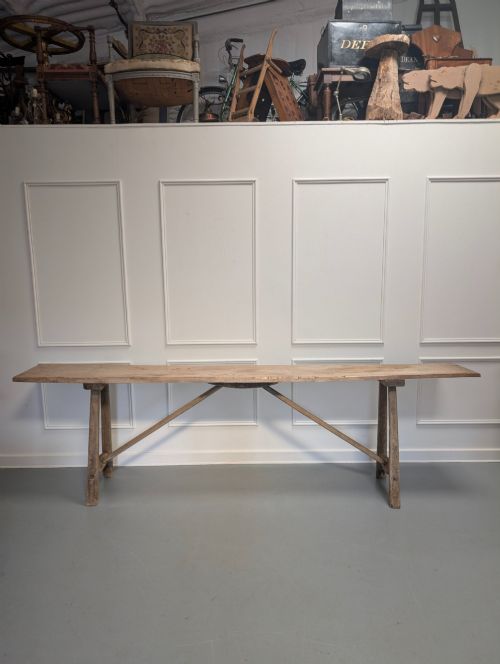
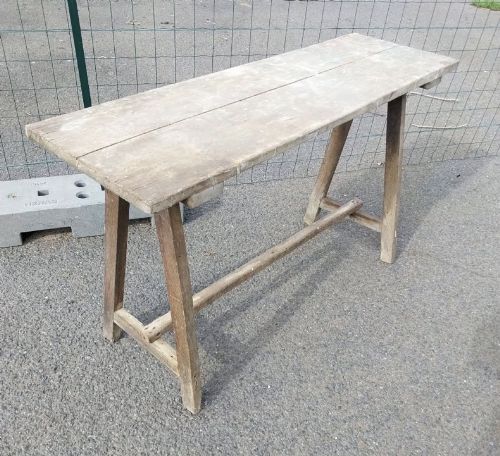




Vintage French Work Bench
A vintage french work bench brings heavy timber and raw utility into a room, offering practical surface space rooted in continental trade.
Vintage French Work Bench
When searching for a vintage french work bench, buyers encounter robust joinery pieces spanning the nineteenth and twentieth centuries. These sturdy tables originate from workshops, potting sheds, and craft spaces across France.
The selection ranges from primitive pine and beech carpenters' benches equipped with vises to scrubbed sycamore trestles and zinc-topped potting tables. Each piece reflects the honest daily labour of artisans who built them to withstand decades of heavy trade.
How they were made
Constructed primarily from dense hardwoods like oak, beech, elm, and pine, these surfaces rely on traditional mortise and tenon joinery. Heavy timber frames provide the mass needed to absorb the pounding of hand tools.
Many examples incorporate cast iron and wrought iron components, including functional wooden vises, metal screws, and strap work. Original painted finishes and weathered patinas frequently remain on the timber and metal elements alike.
Vintage French Work Bench Retail Price Guide 2026
Typical asking prices for vintage french work bench among the pieces listed under this phrase on Sellingantiques today, from the lower quarter to the upper quarter. They describe what is for sale here now, not the wider market.
Listings feature eighteenth, nineteenth, and twentieth-century French work benches constructed from pine, beech, oak, and elm timber.
What varies in quality
The distinction between ordinary and exceptional pieces rests upon the integrity of the timber and the retention of original working mechanisms. Benches retaining their complete wooden vises and structural hardware command stronger interest among collectors.
Proportion and wood selection also define the tier of a piece, with dense grain structures and pleasing patinas marking out superior examples. Heavily altered frames sit at the lower end, while untouched workshop surfaces remain highly desirable.
Trussant & Cie
The Vintage French Work Bench Glossary
- Workbench
- A heavy utilitarian table fitted with a vise and used for manual trades, carpentry, or crafting.
- Vise
- A mechanical screw device attached to the edge of a bench used to clamp materials securely in place.
- Patina
- The surface sheen and colour acquired by wood and metal through decades of handling, use, and age.
- Trestle
- A support structure consisting of a horizontal beam fixed to two splayed legs, commonly found on long tables.
Vintage French Work Bench: Frequently Asked Questions
What was a vintage french work bench used for?
These heavy tables served as practical stations for carpenters, watchmakers, cobblers, and florists across France. Craftsmen relied on the sturdy timber tops and integrated vises to shape, assemble, and repair goods.
Today, buyers repurpose them as kitchen islands, sideboards, or console tables in living spaces and hallways. Their utilitarian design allows them to function as durable display surfaces in modern homes.
How do I care for the surface?
Maintenance involves protecting the dry, historic timber from excessive moisture while preserving the accumulated patina. Gentle cleaning with a soft cloth removes dust without stripping the aged finish.
Applying a light wax occasionally helps nourish dry pine or oak without altering the authentic surface character. Avoid harsh chemical cleaners that might damage centuries of accumulated wear.
How do I date a bench?
Dating relies on examining the construction methods, tool marks, and hardware types used in the frame. Hand-cut joinery and forged iron components generally point towards nineteenth-century origins.
Later pieces from the early twentieth century often incorporate machine-cut timber and standardised metal fittings. Comparing the wood species and wear patterns against known period styles helps narrow the decade.