



Vintage French Ladies Desk
A vintage french ladies desk is a compact and elegant writing surface designed for private correspondence, combining decorative flair with practical utility.

Vintage French Ladies Desk
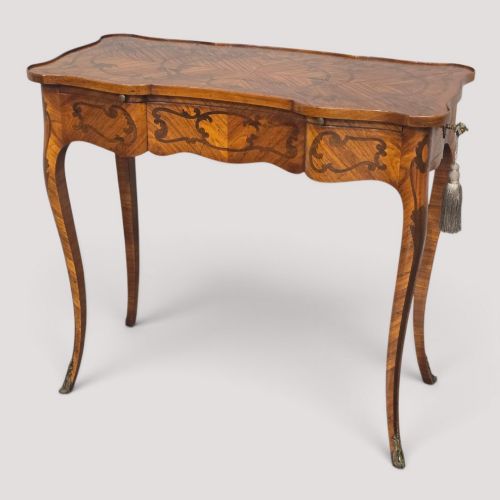
Buyers seeking a vintage french ladies desk encounter a variety of compact writing furniture spanning the nineteenth century and the early twentieth century. Forms include the traditional bureau de dame, writing tables, and bonheurs de jour that suit smaller residential spaces.
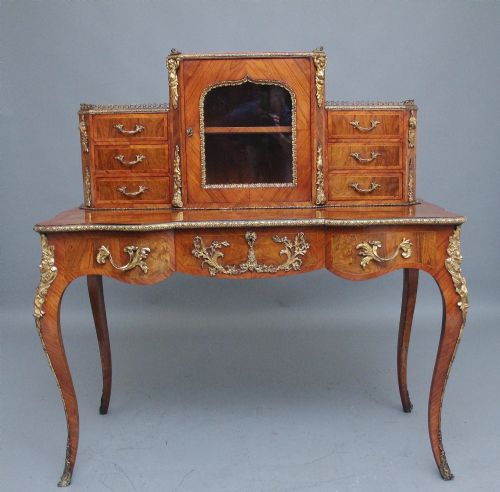
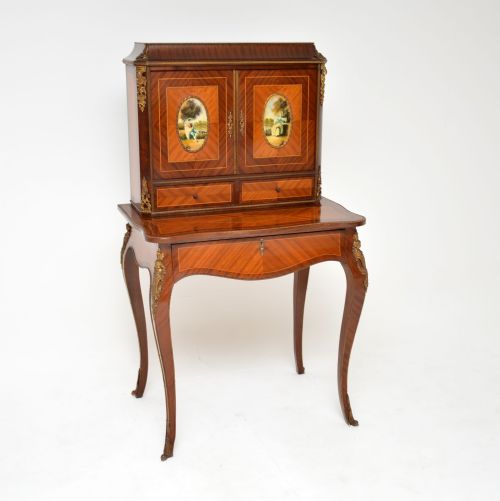
Louis XV revival designs and Louis XV style pieces appear frequently alongside Victorian interpretations and Art Deco examples. These desks typically offer integrated drawers, writing surfaces, and sometimes upper compartments for stationery storage.
Mahogany, walnut, kingwood, and rosewood form the primary wood selections for these pieces. Marquetry and inlaid details frequently decorate the surfaces, accompanied by gilt bronze or ormolu mounts.
Materials and construction
Cabinetmakers utilised hardwoods such as mahogany and walnut as foundational carcases, often veneered with decorative timbers including kingwood, rosewood, and satinwood. Marquetry patterns demonstrate precision cutting and fitting of contrasting wood veneers into intricate floral or geometric designs.
Ormolu and cast brass mounts provide structural accent and edge protection, shaped through metal casting and fire gilding. Glass panels and painted ceramic plaques sometimes appear as supplementary decorative elements set into the woodwork.
Vintage French Ladies Desk Retail Price Guide 2026
Typical asking prices for vintage french ladies desk among the pieces listed under this phrase on Sellingantiques today, from the lower quarter to the upper quarter. They describe what is for sale here now, not the wider market.
Materials recorded across the selection include mahogany, walnut, kingwood, rosewood, ormolu, brass, glass, and bronze.
Evaluating craftsmanship and detail
Quality depends upon the precision of the veneer work and the crispness of the cast metal mounts. Finer examples display harmonious grain matching across curved surfaces and tightly fitted joinery in the drawer construction.
The sophistication of the marquetry and the weight of the ormolu distinguish standard production from superior craftsmanship. Original surface patination and intact mounts contribute to the integrity of the piece.
Geo Maxim
The Vintage French Ladies Desk Glossary
- Bureau de dame
- A small ladies writing desk, often featuring a sloping lid or a fitted interior with small drawers. This form was developed in eighteenth-century France and revived in later periods.
- Bonheur de jour
- A light day-time writing desk featuring a small set of drawers or shelves on the upper surface. These desks emerged in the mid-eighteenth century and saw continued production in revival styles.
- Ormolu
- Gilded bronze mounts applied to furniture for decoration and edge reinforcement. The technique involves applying a mercury and gold amalgam to cast bronze.
- Marquetry
- The art of applying thin pieces of wood veneer to a structure to form decorative patterns. Craftsmen use contrasting timbers to create pictorial or geometric designs.
- Bureau plat
- A flat-topped writing table without a superstructure, usually fitted with drawers along the frieze. These tables often feature leather inset writing surfaces.
Vintage French Ladies Desk: Frequently Asked Questions
What is a bureau de dame?
A bureau de dame is a small ladies desk designed for correspondence and private writing. These pieces typically incorporate compartments and small drawers.
They offer a compact writing space suited for domestic interiors where full-sized library desks are impractical.
Where were these desks used?
These desks served in private chambers, boudoirs, and reception rooms for writing letters and managing personal accounts. Their modest proportions allowed placement against walls or freestanding in rooms.
They combine decorative presence with practical compartments for stationery and writing instruments.
What woods were commonly used?
Cabinetmakers employed mahogany, walnut, kingwood, and rosewood as primary structural and decorative timbers. Exotic veneers were selected for their grain patterns and colour.
Satinwood and marquetry elements frequently provided contrast against darker background woods.