


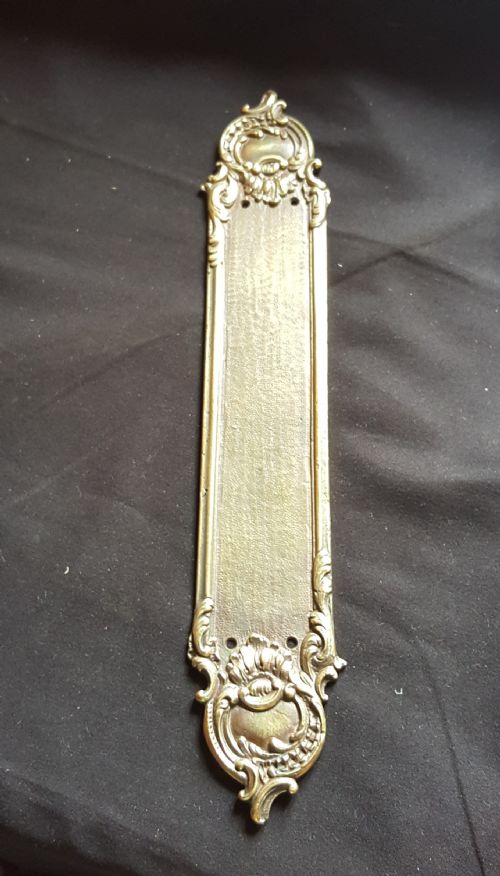
Vintage Door Push Plates
These vintage door push plates protect timber surfaces while defining period interior schemes through diverse cast metals and decorative styles.
Vintage Door Push Plates
Vintage door push plates, also listed as finger plates, protect high-traffic doors from finger marks around the handle or lock.
The selection here spans the nineteenth century through the nineteen-thirties, taking in Georgian, Regency, Victorian, Edwardian, and Art Deco designs.
How they were made
Foundry work dominates the production, utilising cast brass and cast bronze to achieve relief ornamentation across Art Nouveau and Arts and Crafts examples.
Makers employed applied enamel work and glass panels alongside traditional metal casting to create durable architectural hardware.
Wood appears occasionally as a backing or primary material, whilst copper alloy provides the foundation for many period pieces.
Vintage Door Push Plates Retail Price Guide 2026
Typical asking prices for vintage door push plates among the pieces listed under this phrase on Sellingantiques today, from the lower quarter to the upper quarter. They describe what is for sale here now, not the wider market.
A stray military aviation plate lets you slam the door with the backing of the Royal Flying Corps.
What varies in quality
Quality rests upon the crispness of the casting and the depth of the relief work, which distinguishes mass production from finer workshop output.
Substantial weight in the metal and the integrity of applied finishes, such as early enamel, mark out the better examples in any stylistic group.
The Vintage Door Push Plates Glossary
- Finger plate
- A protective plate fixed to a door beside the handle to prevent staining from hands. These items see heavy domestic and commercial use.
- Cast bronze
- An alloy of copper and tin poured into a mould to create rigid hardware. This material offers durability and takes fine detail.
- Art Deco
- A design style from the nineteen-twenties and nineteen-thirties characterised by geometric lines and streamlined forms. Pieces from this era often feature stylised symmetry.
- Arts and Crafts
- A movement prioritising visible handcraftsmanship and simple functional design. Hardware from this tradition displays honest construction methods.
Vintage Door Push Plates: Frequently Asked Questions
How do I clean tarnished brass push plates?
Use a soft cloth and mild soapy water to remove surface dirt without stripping the historic patina.
Avoid harsh chemical polishes that destroy the aged surface character collected over decades of use.
Can these fit standard modern doors?
Most vintage plates match standard proportions, though screw hole placements often require careful alignment.
Check the dimensions listed for each individual piece before attempting installation on existing doors.
Were push plates used in all rooms?
They appeared primarily on high-use doors such as drawing rooms, pantries, and commercial building entrances.
Private bedrooms less frequently received these protective metal fittings during the nineteenth and early twentieth centuries.
How do I date a push plate style?
Look to the decorative motifs, connecting the flowing organic lines to Art Nouveau or the sharp geometry to Art Deco.
Manufacturing techniques like sand casting also provide clues regarding the production era.