
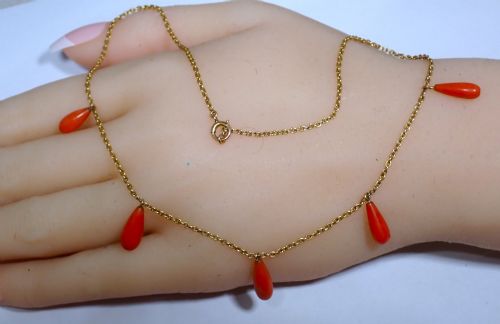


Vintage Coral Necklace
A vintage coral necklace brings together organic warmth and metalwork, offering a striking piece of wearable history from the Victorian era onwards.
Vintage Coral Necklace
A vintage coral necklace spans multiple decades, encompassing styles from the Victorian period through to the mid-century modern era. Buyers encounter various forms on this page, ranging from single and triple-stranded beaded designs to pendants and festoon necklaces.
The materials paired with coral in these listings include gold, silver, pearl, onyx, amethyst and moonstone. Lengths vary significantly, from shorter Edwardian examples to long Mediterranean red coral strands measuring over sixty inches.
Materials and construction methods
Construction relies heavily on organic materials such as natural coral, pink coral, and red coral, often shaped into graduated beads, rods, sticks, or branches. These elements are meticulously threaded onto silk thread or mounted securely in metal settings.
Metals such as silver, 9ct gold, 15ct yellow gold, and 18ct gold provide structural support through clasps, chains, and pendant mountings. Artisans of the Arts and Crafts and Art Deco movements combined these components using traditional bezel and chain-link techniques.
Listings feature periods spanning from the Victorian era, Edwardian period, and Arts and Crafts movement through to Art Deco and Mid-Century Modern.
Assessing quality and craftsmanship
Quality rests in the uniformity, colour saturation, and natural state of the coral material, distinguishing un-dyed and natural pieces from lesser alternatives. The integrity of the bead-drilling and the strength of the silk thread or chain links also dictate the durability of the strand.
The Vintage Coral Necklace Glossary
- Graduated bead
- Beads that increase in size progressively from the clasp to the centre of the necklace. This technique requires careful sorting of natural coral material.
- Festoon necklace
- A decorative chain or necklace featuring draped swags of material, often accented with gemstones like amethyst and moonstone. This style was prominent during the Arts and Crafts movement.
- Cabochon
- A gemstone or coral piece shaped and polished rather than faceted. This method preserves the organic depth of natural coral.
- Cameo
- A subject carved in relief upon a contrasting background, frequently seen in Victorian pendants mounted in gold. This technique highlights detailed sculptural artistry.
- Un-dyed coral
- Coral in its natural, unaltered colour state, highly valued by collectors for authenticity. It displays organic variations in tone without artificial enhancement.
Vintage Coral Necklace: Frequently Asked Questions
How do I care for my coral necklace?
Coral is an organic material that is sensitive to acids, cosmetics, and harsh chemicals. Wipe it gently with a soft, damp cloth after wearing and store it flat away from other jewellery.
Avoid submerging stringed necklaces in water for prolonged periods, as moisture can weaken silk thread over time.
Are these coral beads natural?
The listings include natural, un-dyed red coral, pink coral, and salmon coral pieces sourced from various historical periods. Each piece maintains its inherent organic characteristics.
Examining the surface under magnification reveals natural growth patterns unique to genuine marine coral.
What is the difference between Victorian and mid-century pieces?
Victorian and Edwardian pieces often feature intricate metalwork, hand-carved cameos, or traditional festoon layouts with gemstones like amethyst and moonstone. They reflect the ornate tastes of the nineteenth and early twentieth centuries.
Mid-century modern designs lean towards cleaner lines, bolder geometric settings, and unadorned strands that emphasise the pure form of the coral material.
How are long coral necklaces typically worn?
Long strands, such as those measuring over fifty inches, offer versatility through double or triple layering around the neck. They can also be knotted in traditional styles.
Shorter lengths rest close to the collarbone, pairing well with period clasps positioned at the back or front as a decorative feature.