



Vintage Copper Framed Mirror
A vintage copper framed mirror brings warmth and hand-worked texture to a room, drawing the eye with its metallic sheen.
Vintage Copper Framed Mirror
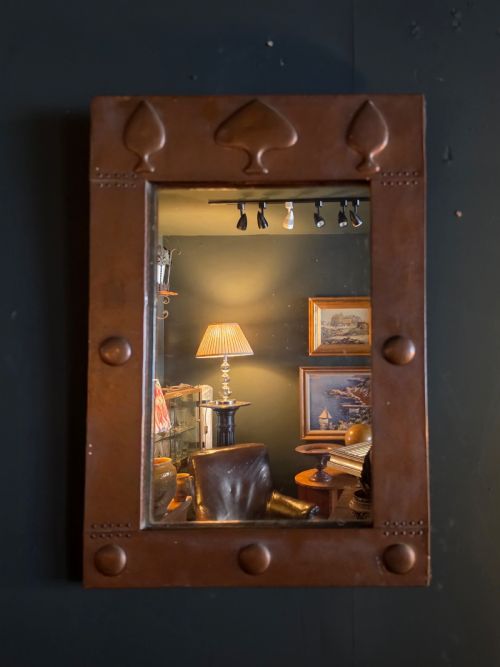
A vintage copper framed mirror is a wall mirror defined by its metalwork, most frequently produced during the Arts and Crafts movement around nineteen hundred. These pieces range from simple oval and rectangular wall mirrors to examples enriched with repoussé work, hammered surfaces, or inset ceramic cabochons.
The versions most commonly met on this page date from the late nineteenth century through to the nineteen twenties and nineteen thirties. Makers adopted styles spanning Arts and Crafts, Art Nouveau, and Art Deco, working in copper alongside brass, wood, and ceramic elements.
How they were made
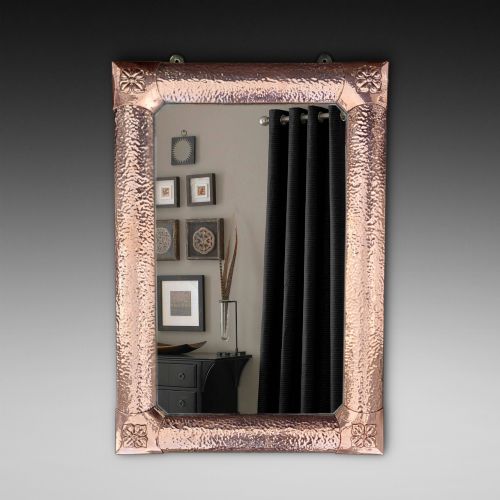
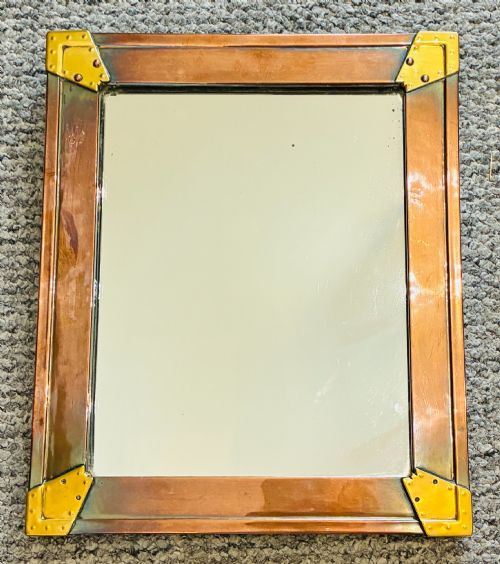
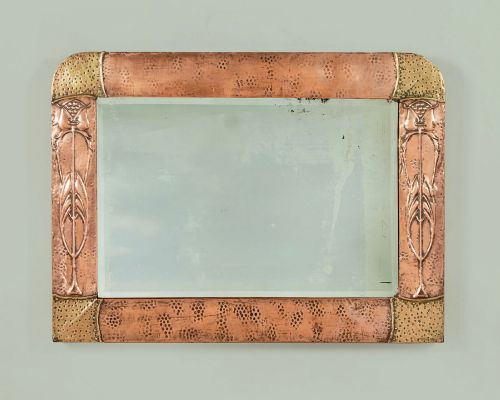
Makers shaped the copper frames by hand, employing techniques such as repoussé and beating to raise patterns from the metal sheet. Frames frequently incorporated bevelled glass secured within wooden backings, sometimes combining copper with brass elements or ceramic inserts.
Artisans hammered the metal surfaces to create textured finishes that caught the light, showing the direct intervention of the maker's hand. Surface details like stylised tree designs or geometric panels demonstrate the decorative vocabulary of the period.
Listings span periods from eighteen ninety through to nineteen thirty, encompassing Arts and Crafts, Art Nouveau, and Art Deco styles.
What varies in quality
Quality rests upon the depth and definition of the hand-worked metal and the sophistication of the design. Examples featuring repoussé work, riveted construction, or inset ceramic cabochons display a higher level of craftsmanship than plain metal borders.
The integration of materials also sets pieces apart, such as the combination of copper with bevelled glass, brass accents, or Ruskin ceramic inserts. Attributed pieces associated with established firms show superior attention to proportion and detail.
Liberty and Company·Liberty and Co
The Vintage Copper Framed Mirror Glossary
- Repoussé
- A metalworking technique where the metal is hammered from the reverse side to form a raised design in relief. This method creates tactile, three-dimensional decorative surfaces on the frame.
- Arts and Crafts
- A design movement originating in the late nineteenth century that valued traditional craftsmanship, hand-working, and simple forms. It rejected mass production in favour of visible maker participation.
- Art Nouveau
- A style characterised by organic, flowing lines inspired by natural forms such as plants and trees. It appears frequently in the curved motifs of these metal frames.
- Cabochon
- A polished, convex gem or ceramic piece without facets, often set centrally into the metal frame. Ruskin pottery inserts are a notable example of this decorative feature.
- Bevelled glass
- Glass mirror plates with edges cut and polished at an angle to create a framed optical border. This technique adds depth and catches light differently than flat mirror glass.
Vintage Copper Framed Mirror: Frequently Asked Questions
What periods do these mirrors come from?
These mirrors primarily date from the late nineteenth century around eighteen ninety through to the nineteen thirties. The majority originate from the nineteen hundreds during the height of the Arts and Crafts movement.
Later examples extend into the Art Deco period of the nineteen thirties, introducing different geometric styles and blue glass panels alongside the copper work.
How do I hang a heavy copper mirror?
These wall mirrors utilise substantial wooden backings behind the metal frames to support the weight of the glass. Secure wall fixings matched to the weight of the piece are essential for safe suspension.
Take care to distribute the load evenly using appropriate picture wire or sturdy wall brackets fixed directly into wall studs or masonry.
How do I clean a vintage copper frame?
Copper develops a natural patina over decades, which many collectors prefer to leave undisturbed. Gentle dusting with a dry cloth is usually sufficient for routine maintenance.
Avoid abrasive cleaners or harsh chemical polishes that strip away the historical surface character and the subtle tones achieved by the original makers.
Are these mirrors marked by makers?
Makers and retailers sometimes stamped their metalwork, though many period pieces remain unsigned or carry only design registrations. Attribution relies on stylistic markers, construction methods, and characteristic motifs associated with specific workshops.
Pieces linked to makers such as Liberty and Company often display distinct design traits, including stylised foliage and careful repoussé detailing.