






Vintage Coloured Wine Glasses
Vintage coloured wine glasses bring rich hues and tactile weight to the table, spanning Georgian, Victorian, and Edwardian periods in vibrant glass and cut crystal.
Vintage Coloured Wine Glasses
Vintage coloured wine glasses comprise drinking vessels produced across the Georgian, Victorian, and Edwardian eras, encompassing forms such as wine glasses, goblets, rummers, and hock glasses. Buyers exploring vintage coloured wine glasses encounter both individual pairs and matched sets of six or fifteen, executed in rich shades including cranberry, emerald green, aqua, turquoise, and amethyst.
The selection ranges from early hand-blown English lead glass and colour-twist stems to ornate Venetian revival pieces and Bohemian overlay glass. English Bristol green sets and Victorian cranberry glassware dominate the selection, offering distinct colour saturation and period silhouettes.
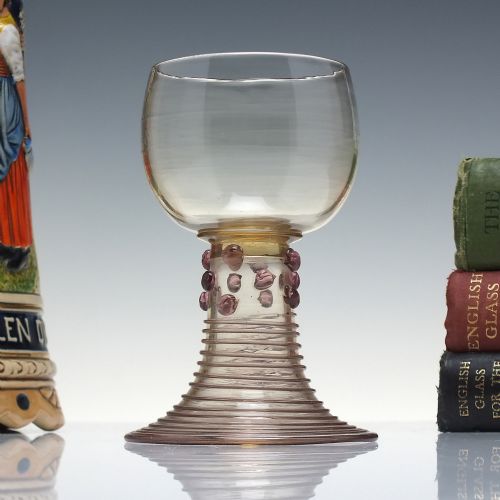
Makers and regional workshops utilised varied production methods, yielding everything from simple blown bowls to deeply cut crystal and multi-coloured glass combinations like amethyst bowls paired with amber stems.
What varies in quality
Quality in vintage coloured wine glasses rests on the depth and consistency of the glass colour, the crispness of any cut crystal facets, and the symmetry achieved by hand-blowing. Superior pieces exhibit even wall thickness, stable pontil marks or polished bases, and perfectly matched tones across full sets.
The complexity of the form dictates distinction, separating standard blown vessels from elaborate pieces featuring layered overlay glass, engraved details, or specialised stem treatments like colour twists and bobbin formations.
Vintage Coloured Wine Glasses Retail Price Guide 2026
Typical asking prices for vintage coloured wine glasses among the pieces listed under this phrase on Sellingantiques today, from the lower quarter to the upper quarter. They describe what is for sale here now, not the wider market.
The Vintage Coloured Wine Glasses Glossary
- Cranberry Glass
- A rich red-pink glass coloured with gold chloride, highly popular during the Victorian period for tableware and stemware. It appears frequently in sets of wine glasses.
- Lead Glass
- Glass containing lead oxide, which increases the weight, clarity, and refractive index of the material. This composition allows for sharper wheel-cutting.
- Overlay Glass
- A technique where a vessel is cased in one or more layers of coloured glass over a clear or contrasting body. Artisans cut through the outer layers to create striking patterns.
- Colour Twist
- A decorative stem feature containing fine threads of coloured glass twisted within a clear stem. It is often found on Georgian drinking vessels.
- Roemer
- A traditional Germanic or European drinking vessel featuring a large spherical bowl resting on a cylindrical stem decorated with applied prunts. Examples can combine contrasting bowl and stem colours.
Vintage Coloured Wine Glasses: Frequently Asked Questions
Are vintage coloured wine glasses safe to use?
Most antique and vintage glass is safe for serving drinks, provided the surface shows no signs of active degradation or severe interior clouding. Inspect the rim and base for any structural chips before use.
Because these are historic items made with traditional methods, hand washing ensures they remain in stable condition for occasional dining.
How can I tell Georgian glass from Victorian glass?
Georgian pieces often feature simpler hand-blown forms, lighter lead weight, and occasionally air or colour twists in the stems. They date from the 18th and early 19th centuries.
Victorian glass tends toward heavier proportions, intense cranberry or aqua hues, and diverse decorative techniques including extensive overlay and cut crystal.
Can I mix different coloured wine glass sets together?
Mixing various shades like emerald green, cranberry, and amethyst creates a vibrant, eclectic table setting that echoes historic dining practices. Many surviving pieces were produced in small pairs or partial sets rather than massive uniform collections.
Matching heights or similar period silhouettes helps unify a mixed arrangement of coloured glassware on the dining table.