
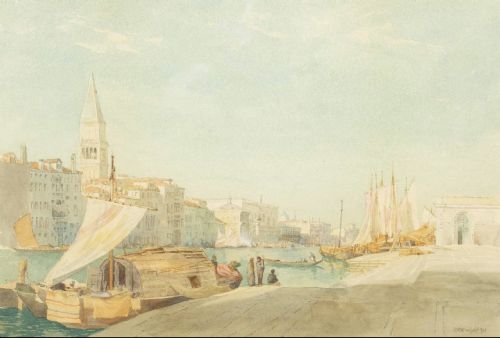


Vintage Canal Landscape Art
Vintage canal landscape art captures the moody stillness of water and urban towpaths, drawing collectors who appreciate historic waterways on canvas and paper.
Vintage Canal Landscape Art
Vintage canal landscape art spans nineteenth-century waterways, Edwardian scenes, and mid-century impressions, capturing European rivers, barges, and bustling Venetian canals. Buyers looking for vintage canal landscape art will encounter oil paintings, watercolours, and framed works stretching from the Victorian era through the mid-twentieth century.
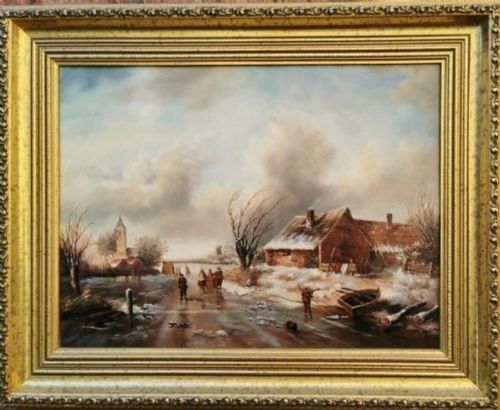
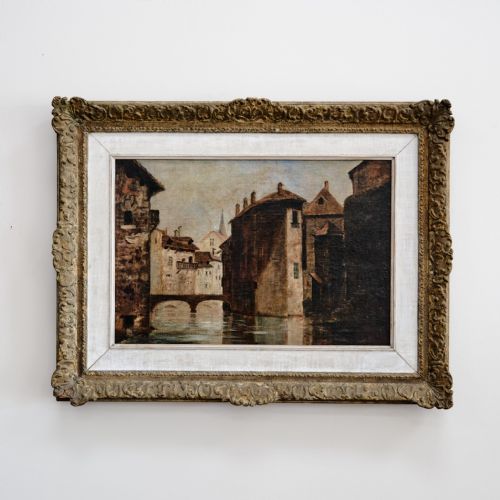
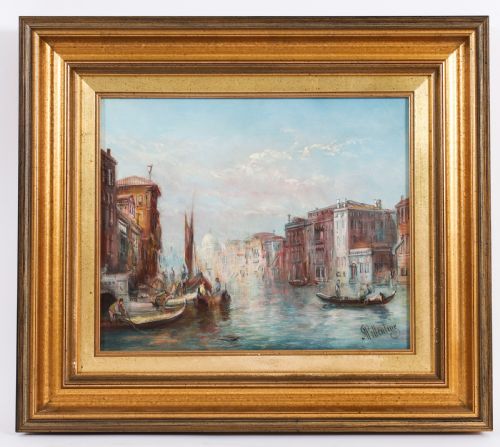
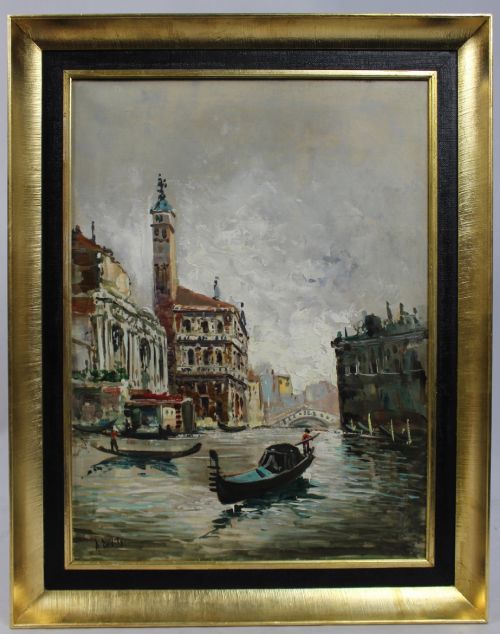
The selections on this page lean heavily towards continental views, particularly Dutch winter waterways and Venetian scenes featuring gondolas and historic palazzos. English and French riverscapes also appear frequently, rendered in styles ranging from detailed academic oils to looser impressionist watercolours.
How they were made
Painters of these waterways worked primarily in oil on canvas or applied watercolour to paper, often framing the finished pieces in gesso and giltwood. Oil pigments allowed for rich, layered depictions of water reflections and winter skies, while watercolours captured the bright, luminous atmosphere of Venetian canals.
Support materials shifted across the decades from traditional stretched canvas and heavy paper boards to mid-century alternatives, while frames ranged from ornate Victorian gilt moulding to simpler twentieth-century wooden surrounds.
Canvas and paper are the primary supports recorded across these nineteenth and twentieth-century urban waterscapes.
What varies in quality
The strength of a piece rests on the artist's handling of light upon water and the convincing perspective of architectural elements like bridges and canal facades. Stronger works demonstrate confident brushwork and tonal harmony, whereas weaker examples rely on rigid lines and flat, uninspired colour mixing.
Provenance and signature legibility also influence standing, as named artists working within established continental schools command greater attention than anonymous student copies or mass-produced decorative townscapes.
Alfred Pollentine·Antonio DeVity·Fred Lawson·Hein Hoppmann·Claude Jousset·Antoine Bouvard Senior·E. Perez Senet·Herbert Royle·Frank Wasley·David Law·William Knox·Wilfred Knox·Ludwig Hermann·John D. Walker·William Dommersen·Charles Clement Calderon
The Vintage Canal Landscape Art Glossary
- Oil on canvas
- Pigment suspended in drying oil applied to a stretched woven fabric support. This traditional medium allowed artists to build rich textures and deep tones for water and sky.
- Watercolour
- A paint consisting of colour suspended in a water-soluble binder, traditionally applied to paper. It offers translucent washes that suit bright, atmospheric canal scenes.
- Giltwood
- Wood carved and surfaced with a thin layer of gold leaf or gilt paint. It is commonly found on traditional frames enclosing nineteenth-century oil paintings.
- Impressionism
- A nineteenth-century painting style characterised by relatively small, thin yet visible brush strokes and an emphasis on accurate depiction of light. Artists applied this approach to capture the shifting reflections on urban waterways.
- Gouache
- An opaque water-based paint that dries to a matte finish. It often appears alongside pastel and ink to add solid highlights to works on paper.
Vintage Canal Landscape Art: Frequently Asked Questions
How do I date a canal painting?
Examine the canvas preparation, stretcher bars, and framing materials alongside any visible artist signatures or exhibition labels on the reverse.
Stylistic clues such as costume details on figures near the towpath or the architectural state of depicted bridges also help narrow down the decade of creation.
Where should I hang a canal watercolour?
Watercolours are sensitive to prolonged direct sunlight, so position them on interior walls away from harsh south-facing windows to preserve the pigments.
Pairing them with neutral wall colours helps highlight the delicate washes and paper textures characteristic of nineteenth and early twentieth-century works.
How do I tell oil paintings from watercolours?
Oil paintings feature a textured, tactile surface where thick brush marks catch the light and sit proud of the woven canvas support.
Watercolours present a flat, smooth finish beneath glass where the pigment sinks directly into the absorbent paper fibres.
What is the Dutch School style?
The Dutch School encompasses painting traditions focused on atmospheric landscapes, frozen canals, and low horizons beneath expansive grey skies.
Works in this tradition emphasise subtle tonal shifts in greys, blues, and muted earth tones to capture northern European winter light.