

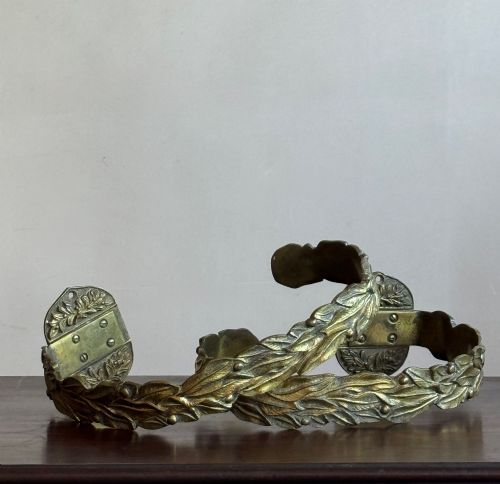


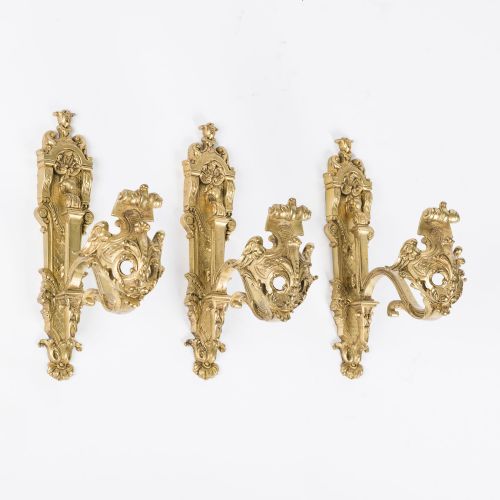

Vintage Brass Tiebacks
These vintage brass tiebacks hold drapery with the weight and detail of eighteenth and nineteenth-century rooms.
Vintage Brass Tiebacks
Vintage brass tiebacks secure heavy curtains to the window frame while adding distinct metalwork to the wall. When searching for vintage brass tiebacks, buyers encounter hardware designed to hold back fabric drapery cleanly and securely.
Most examples found on this page date from the Georgian and Victorian periods, alongside French Rococo Revival and Baroque interpretations. The selection spans simple brass hooks to elaborate ormolu and enamel designs originating from the eighteenth and nineteenth centuries.
How they were made
Metalwork for these pieces relies heavily on cast brass, ormolu, and gilded bronze formed into robust wall hooks and curtain ties. Molten or hammered metal takes the shape of lions, scrolling acanthus leaves, and decorative plates designed to bear the weight of heavy fabrics.
Fine examples incorporate applied enamel or surface gilding to catch the light beside a window. Skilled founders cast and chased the metal by hand, leaving crisp tool marks and tactile surfaces on the backplates.
Vintage Brass Tiebacks Retail Price Guide 2026
Typical asking prices for vintage brass tiebacks among the pieces listed under this phrase on Sellingantiques today, from the lower quarter to the upper quarter. They describe what is for sale here now, not the wider market.
What varies in quality
The distinction between ordinary utility hardware and superior work lies in the sharpness of the casting and the depth of the chased detail. Heavier gauge metal and crisp relief work on lion heads or floral scrolls indicate skilled workshop production rather than mass output.
Surface finish also separates the tiers, with thick fire gilding or preserved ormolu retaining a warm glow compared to thin, worn plating. Original mounting plates and matched pairs maintain greater integrity than mismatched replacements.
The Vintage Brass Tiebacks Glossary
- Ormolu
- Gilded bronze or brass produced by applying a mercury-gilding paste to cast metal and firing it to leave a rich gold finish. This technique creates a deep, warm lustre found on finer French decorative hardware.
- Tieback
- A device mounted to the wall beside a window to hold drapery open. These take the form of projecting hooks or shaped arms.
- Rococo Revival
- A nineteenth-century design movement mimicking the asymmetrical scrolls, shells, and natural curves of the mid-eighteenth century. Pieces in this style feature lively, organic contours.
- Gilt Brass
- Brass treated with a thin layer of gold or gold-coloured wash to imitate solid gold or richer bronze. It brightens the metal surface.
- Baroque
- An ornate historical style defined by dramatic movement, bold relief, and grand architectural forms. Hardware from this tradition displays strong visual weight.
Vintage Brass Tiebacks: Frequently Asked Questions
How do I mount vintage brass tiebacks?
Most tiebacks feature a central screw hole through the backplate or hook shank to secure directly into wall studs or masonry using appropriate anchors.
Because drapery creates steady outward tension, sturdy fixing ensures the hardware supports the weight of heavy curtains without pulling loose.
Are these tiebacks sold as pairs?
Many listings offer matching pairs intended for framing both sides of a single window symmetrically. Single hooks and larger sets of four also appear depending on the specific batch.
Checking the title and description confirms whether the hardware is matched for a standard two-curtain setup.
How should I clean vintage brass hardware?
Dusting with a dry microfibre cloth removes everyday buildup without disturbing the underlying metal or historic surface patination.
Harsh metal polishes strip away original gilding and ormolu, so gentle maintenance preserves both the finish and the value of the piece.
How do I date an antique brass tieback?
Stylistic clues such as Rococo asymmetry, Georgian lion motifs, or Victorian casting methods help narrow the period of manufacture.
Heavier hand-chased ormolu typically points to eighteenth-century origins or high-end nineteenth-century revivals.