


Vintage Bowfront Side Cabinet
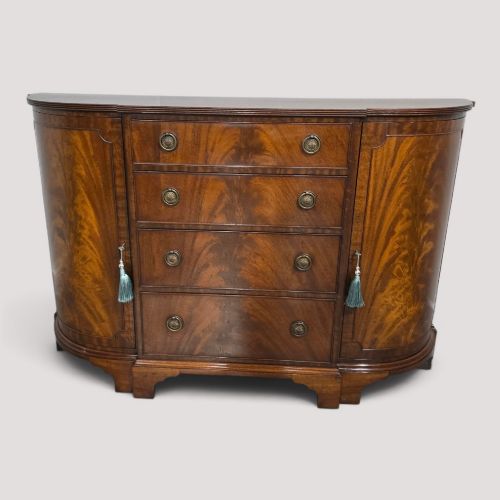
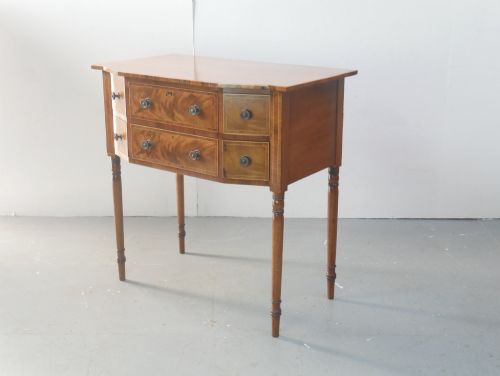
These vintage bowfront side cabinet pieces bring curved elegance and practical storage to a room, offering the exact proportions that collectors prize.
Vintage Bowfront Side Cabinet
A vintage bowfront side cabinet presents a curved projecting front that softens the corners of a room while offering practical storage. These pieces appear across multiple eras, ranging from Georgian and Regency origins through to Victorian and Edwardian interpretations.
The selection on this page relies heavily on mahogany, satinwood, and burr walnut, taking forms that span from compact bedside lockers to grand dining room sideboards and cocktail cabinets. Buyers most frequently encounter Edwardian and 1900s mahogany examples, alongside smaller Georgian and Victorian variations.
Revival styles dominate the later pieces, with cabinetmakers drawing on Sheraton, Chippendale, and Queen Anne designs. This blending of historic shapes with early twentieth-century manufacture creates functional furniture suited to contemporary spaces.
Separating the ordinary from the exceptional
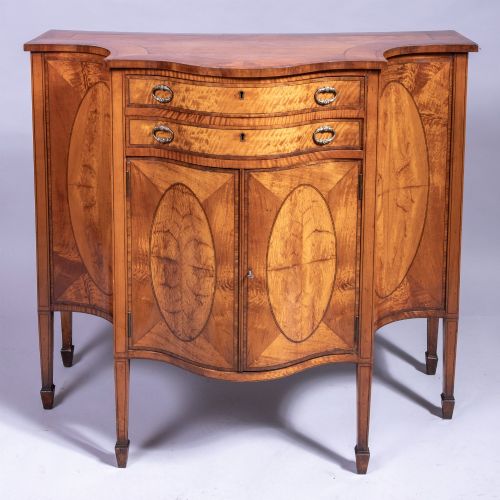
Quality rests in the selection of the wood and the precision of the curved drawer fronts. Finer examples display matched flame veneers or intricate marquetry that flows continuously across the doors and drawers.
The integrity of the internal fittings and the crispness of the carved details or inlay set superior pieces apart. A well-executed revival cabinet shows careful attention to historical proportions rather than a rushed commercial finish.
The listings feature mahogany as the dominant timber, accompanied by satinwood and burr walnut across pieces spanning from the 18th century to 1930.
The Vintage Bowfront Side Cabinet Glossary
- Bowfront
- A convex curved front that projects outward from the centre. This shape gained popularity in the Georgian period and returned during later revival eras.
- Flame mahogany
- A veneer cut from the branch junction of a mahogany tree, producing a distinctive flickering flame pattern. Cabinetmakers placed these leaves symmetrically for decorative effect.
- Marquetry
- The art of forming decorative patterns using thin pieces of wood veneer of different colours and grains. Artisans inlaid these directly into the surface of the cabinet.
- Demi-lune
- Half-moon shaped in plan, featuring a flat back to sit against a wall and a curved front. These often appear as console or side cabinets.
- Serpentine
- A front shape curving outward in the centre and inward at the sides, creating a wave-like profile. This form requires advanced joinery to execute cleanly.
Vintage Bowfront Side Cabinet: Frequently Asked Questions
Where should I place a bowfront cabinet?
These cabinets work well in hallways, dining rooms, or living spaces where a curved profile softens linear architectural lines. Their shallow sides make them practical for narrower rooms without sacrificing interior storage.
Larger sideboard versions anchor a dining room wall, while smaller bedside lockers or demi-lune tables fit neatly into corners or beside seating.
How do I date a mahogany cabinet?
Examining the secondary timbers inside the drawers and the style of the construction helps narrow down the period. Earlier pieces from the eighteenth and early nineteenth centuries often show hand-cut dovetails and native woods like oak or pine inside.
Revival pieces from 1900 and the Edwardian era generally display machine-sawn elements and lighter internal linings, even when mimicking older Georgian styles.
Are these cabinets difficult to maintain?
Routine dusting with a dry cloth and occasional application of appropriate furniture wax keeps the polish nourished. Avoiding direct sunlight prevents the mahogany or walnut veneers from fading over time.
Care should be taken with moisture and heat, using coasters and mats to protect the polished top surface from rings and marks.
What is the difference between a side cabinet and a sideboard?
Sideboards traditionally served dining rooms for storing silver and serving food, often featuring greater length and lower proportions. Side cabinets are generally taller and more versatile, designed for general storage across various rooms.
Both forms utilise the bowfront shape, but side cabinets frequently include glass doors for display or compact cupboard interiors.