
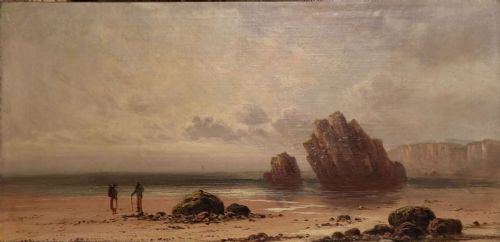



Vintage Beach Scene Artwork
Vintage beach scene artwork captures the enduring pull of the shore through coastal landscapes, maritime watercolours and modernist oils.
Vintage Beach Scene Artwork
Vintage beach scene artwork comprises coastal views, harbour paintings and seaside watercolours executed across the nineteenth and twentieth centuries. These works record shorelines, fishing boats and figures beside the sea through diverse regional lenses such as the Newlyn school, British Impressionism and the Scottish School.
The selections available here range from detailed nineteenth century realism to twentieth century modernist interpretations in oil and watercolour. Buyers encounter framed watercolours in hand enamelled polychrome surrounds alongside substantial oil paintings on canvas depicting rocky shores and tidal inlets.
Materials and methods
Artists relied primarily on oil paint applied to canvas or wood panels, and watercolours worked on paper. These mediums allowed painters to capture the shifting light and atmospheric conditions of coastal environments.
Framing often involved traditional gilt, ebonised or hand enamelled wooden surrounds designed to complement the palette of the marine subject.
Materials utilised across these listings include oil paint, watercolour, canvas, wood, paper, gold leaf and glass.
Distinctions in quality
Quality rests upon the artist's handling of light, brushwork confidence and the structural integrity of the support material. Superior examples demonstrate a secure command of tone and perspective that successfully conveys the openness of coastal air and water.
The distinction between standard decorative works and finer pieces lies in the directness of observation and the artist's ability to render movement within waves, clouds and figures on the shore.
William Banks Fortescue·George Hamilton Constantine·Sir William Russell Flint·Owen Bowen·GM de L Aubiniere·Daniel Sherrin·Yves Brayer·Thomas Bush Hardy·Henri Cadiou·Alfred Egerton Cooper·Harry John Pearson
The Vintage Beach Scene Artwork Glossary
- Oil on canvas
- Pigments bound in drying oil applied to a woven fabric stretched across a wooden frame. This medium allowed artists to build rich textures and deep tones suitable for dramatic marine weather.
- Watercolour
- A paint consisting of colourants suspended in a water soluble binder, traditionally applied to paper. It produces translucent washes that evoke the luminous quality of coastal skies.
- Impressionism
- A nineteenth century painting style characterised by relatively small, thin yet visible brush strokes and an emphasis on accurate depiction of light. Practitioners sought to capture transient atmospheric moments on the beach.
- Newlyn school
- An art colony based in Cornwall during the late nineteenth and early twentieth centuries focusing on plein air painting. Artists recorded local fishing communities and coastal life with naturalistic depth.
Vintage Beach Scene Artwork: Frequently Asked Questions
What periods do these beach artworks cover?
The works span from the nineteenth century through the Victorian era and into the mid twentieth century. They reflect shifting artistic movements from traditional realism to early modernist interpretations.
Changes in palette and technique across these decades offer a clear timeline of how artists viewed the British and European coastline.
How were these maritime paintings displayed originally?
Most works were framed in timber mouldings, often finished with gold leaf, ebonisation or hand enamelled decoration. These surrounds protected the edges of the canvas or paper while isolating the scene from interior walls.
Original frames provide context regarding how Victorian and twentieth century interiors accommodated coastal art.
Where do these coastal scenes originate?
The collection includes views from British locations such as Cornwall, Whitby, Devon and the Scottish Borders alongside continental European shores in France and Spain. Regional art schools heavily influenced the specific treatment of local light and topography.
Geographic diversity allows collectors to focus on particular coastal communities or broader European marine traditions.
How do I care for vintage watercolours?
Paper and watercolour mediums require protection from direct sunlight to prevent fading of pigments. Glazing with appropriate conservation glass helps shield the delicate surface from ultraviolet light and atmospheric moisture.
Stable indoor humidity levels ensure the paper support remains flat within its historic frame.