
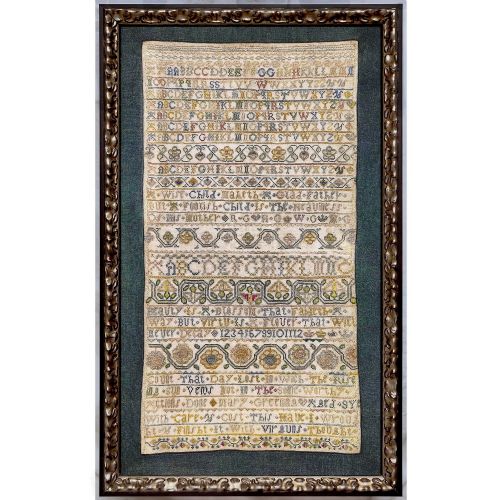


Vintage Alphabet Sampler
A vintage alphabet sampler brings centuries of quiet domestic skill straight to your wall, offering a tangible link to hand-stitched education and patience.
Vintage Alphabet Sampler
A vintage alphabet sampler represents a traditional needlework exercise, often worked by young girls learning stitches and lettering. These textiles appear primarily as framed wall art spanning the 18th century, Georgian, and Victorian periods.
The most common forms on this page include framed needlework samplers and embroidered panels created by makers such as Mary Greening, Ann Hodson, and Margaret Ann Blackow. Pieces range from miniature works to larger compositions, sometimes incorporating dates, ages, and school names like the Oswestry National School.
Materials vary across these examples, featuring linen grounds worked with thread, wool, or silk thread. Many survive housed behind glass within wooden frames, including maple wood settings that complement their age.
Materials and technique
Makers constructed these works using woven linen as the foundational fabric, upon which they applied various stitches using thread, wool, or silk thread. This meticulous handwork required immense patience and steady execution to form clean letters and pictorial motifs.
Framing forms an essential part of their preservation, with period examples frequently utilising wood, such as maple wood, alongside glass to protect the delicate textiles from environmental damage.
Listings feature textile art from the 18th century, Georgian, and Victorian periods, utilising linen, silk thread, and maple wood.
Judging quality and execution
Quality rests heavily on the regularity and complexity of the needlework, where tightly executed stitches and clear letter formation elevate a piece above simpler exercises. The inclusion of detailed biographical information, such as the maker's name, age, and a specific date, adds considerable documentary interest.
Condition and originality also dictate standing, particularly the survival of the original linen ground and the preservation of the early thread colours. The presence of period framing, such as original wood or maple wood surrounds under glass, enhances the integrity of the piece.
Mary Greening·Ann Hodson·Margaret Ann Blackow·Ann B Gilies·Rachel·Emma and Hannah Barnes
The Vintage Alphabet Sampler Glossary
- Sampler
- A piece of needlework produced as a demonstration or test of skill in various stitches. These typically feature alphabets, numerals, and decorative motifs.
- Band sampler
- An early format of needlework where rows of distinct stitch patterns run horizontally across a long strip of linen. These predate the more pictorial balanced layouts of later eras.
- Needlepoint
- A type of canvas work where yarn or thread is stitched through a stiff open-weave backing. It creates a dense, durable surface completely covering the ground fabric.
- Tapestry sampler
- A pictorial needlework panel executed to practise figurative or landscape elements alongside lettering. These often record the maker's school or home location.
Vintage Alphabet Sampler: Frequently Asked Questions
What is a vintage alphabet sampler?
A vintage alphabet sampler is a historic piece of textile art created to practise and display embroidery skills, usually featuring alphabets and numerals.
These works were traditionally stitched by young girls learning needlework during the 18th and 19th centuries.
How old are these alphabet samplers?
The pieces listed span from the late 17th century through the Georgian and Victorian eras up to the late 19th century.
Many examples include specific dates stitched directly into the linen by the original young maker.
How should I hang a sampler?
Samplers require careful placement away from direct sunlight to protect the fragile linen grounds and delicate threads from fading.
Most pieces survive housed behind glass within wooden frames, which helps shield the textile from dust and atmospheric moisture.
What materials were used?
The foundational ground is typically woven linen, worked with thread, wool, or silk thread by hand.
Frames are commonly made from wood, including maple wood, enclosing the textile alongside protective glass.