
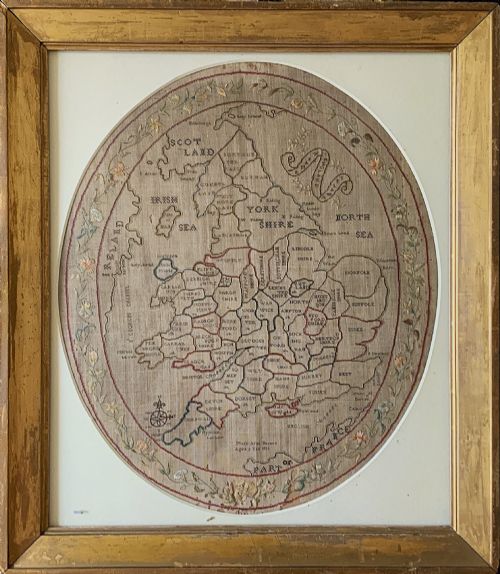


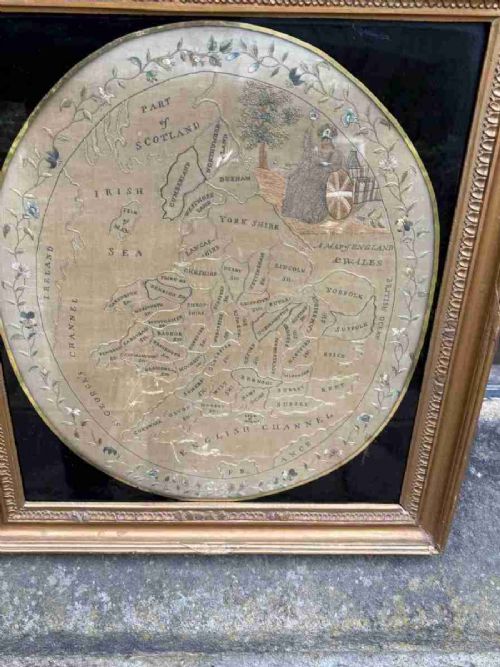


Gilt Framed Needlework Sampler
These gilt framed needlework sampler pieces are historic textile works preserved behind glass in gilded frames, offering a tangible link to domestic education of past centuries.
Gilt Framed Needlework Sampler
A gilt framed needlework sampler is a historic textile created to demonstrate stitching proficiency, cartographic knowledge, or pictorial skill. These works range from early educational exercises to detailed topographical maps.
The versions most likely to meet a buyer on this page date from the 18th century, the Georgian era, and the Victorian period. Examples include schoolgirl exercises, cartography of England and Wales, and figurative needlework.
Makers recorded in these pieces include young stitchers such as Mary Banion, Mary Mason, Rachel of Oswestry National School, and Mary Pinfold. Their work captures centuries of needlecraft tradition framed in wood, giltwood, or rosewood.
How they were made
Makers constructed these works using linen as the foundational fabric for the textile art. Silk thread and standard thread formed the stitches that mapped regions or illustrated scenes.
Carpenters housed the completed textile art in wooden enclosures, frequently applying a gilt finish to create gilt frames or giltwood borders. Glazing protected the delicate silk and linen fibres from environmental wear.
Listings feature items from the 18th century, Georgian, Regency, William IV, and Victorian periods, utilising linen, silk thread, wood, and glass.
What varies in quality
Quality in a gilt framed needlework sampler rests upon the complexity of the subject matter and the precision of the stitchwork. Elaborate cartographic representations of England and Wales demand greater skill than basic alphabetic drills.
The condition of the textile materials and the preservation of the original gilt wood or rosewood frame influence the character of the piece. Intricate schoolgirl signatures and dated school inscriptions add documentary depth to the object.
Mary Banion·Mary Mason·Mary Pinfold
The Gilt Framed Needlework Sampler Glossary
- Sampler
- A piece of textile art worked to demonstrate various stitches or educational subjects. These often record the maker's name, age, and location.
- Giltwood
- Wood treated with gold leaf or a golden coating to form decorative frames. This material surrounds the textile to provide structural support and visual enhancement.
- Needlepoint
- Stitches worked through an open-weave ground fabric to create pictorial or cartographic designs. This technique defines much of the historical needlework seen here.
- Tapestry
- A heavier form of hand-woven or stitched textile art. Victorian examples often depict figurative scenes such as animals.
Gilt Framed Needlework Sampler: Frequently Asked Questions
What is a map sampler?
A map sampler is a specific type of textile art where the maker stitches geographical details, such as a map of England and Wales, onto linen. These pieces served as both geography lessons and demonstrations of needle skill.
Young girls executed these works in school settings, recording their names and ages alongside the cartography.
How old are these samplers?
The pieces listed span the 18th century, the Georgian era, the Regency period, and the Victorian age. Dates range from specific years like 1800 and 1831 to broader period designations.
Each piece reflects the prevailing educational and decorative standards of its respective century.
What materials make up the frames?
Makers housed these textiles in wooden frames finished with gilding, creating gilt wood and giltwood borders. Rosewood also appears as a primary framing material for Victorian tapestry examples.
Glass fronts generally protect the delicate silk thread and linen beneath from dust and handling.
Who made these needlework pieces?
Young students typically stitched these samplers as part of their education in schools and domestic settings. Inscribed names like Mary Pinfold and Rachel from Oswestry National School identify the original makers.
These inscriptions often note the maker's age, providing a personal record of the child's labour.