



19th Century Tapestry Sampler
A 19th century tapestry sampler carries the careful stitches of young makers, recording names, dates and pastoral scenes framed for the wall.
19th Century Tapestry Sampler
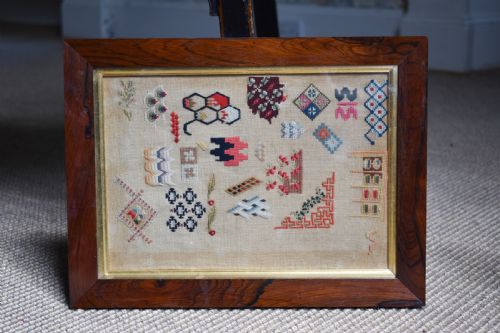
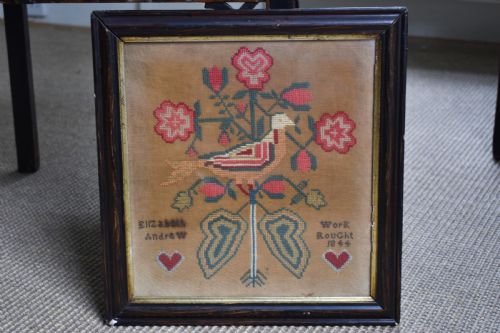
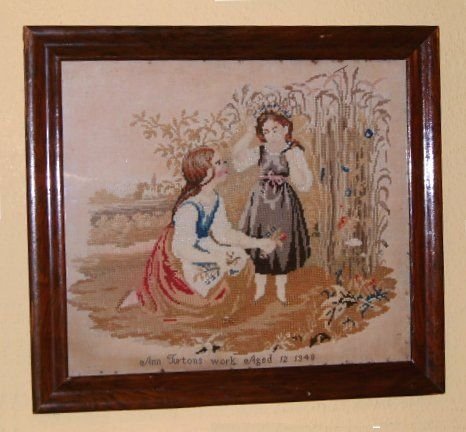
A 19th century tapestry sampler represents textile art created by needleworkers of the Georgian and Victorian eras, often recording a maker's name, age, and a specific date. These works frequently appear as needlework samplers or framed wall art, with several examples mounted behind glass in rosewood frames.
The pieces on this page span the 19th century, incorporating Regency and William IV periods alongside strict Victorian and Georgian items. Makers like Jane Wettmore, Ann Hodson, Mary Mason, Mary Street, Rachel, and Rebecca Cleminson anchor these works in specific schools and homes.
Beyond standard wall art, the form extends to functional items such as needlework sampler firescreens and gros point panels depicting figures like a girl feeding a swan or a horse. Canvas serves as the foundation for wool work, silk thread, and embroidery stitches.
Materials and construction
Makers stitched wool work, silk thread, and embroidery onto canvas and linen grounds using various needlework techniques. Gros point and petit point provide the detailed texture seen in mid-century panels and pictorial scenes.
Finished textiles frequently found protection inside wood frames, particularly rosewood, often paired with glass to preserve the delicate fibres. Functional pieces incorporated wood structures, such as firescreens built to stand near a hearth.
Listings feature linen, wool, silk thread, canvas, and wood, encompassing rosewood frames and glass.
Variations in quality
The standard of execution depends on the precision of the stitching and the complexity of the design, moving from basic alphabets and numerals to elaborate pictorial compositions like figures, birds, and animals. Gradations in skill are evident in the regularity of the wool or silk thread and the ambition of the imagery.
Framing and original context also elevate a piece, with period rosewood surrounds and glass preservation indicating higher historical care. Dated works that record the maker's age, location, or school provide clearer provenance than unsigned examples.
Jane Wettmore·Ann Hodson·Mary Mason·Mary Street·Rebecca Cleminson
The 19th Century Tapestry Sampler Glossary
- Sampler
- A piece of needlework produced to demonstrate proficiency in various stitches, often featuring alphabets, numbers, and motifs. These exercises developed skills and served as keepsakes.
- Gros point
- A coarse counted-thread embroidery stitch worked on canvas, producing a durable and textured surface. It frequently forms the background or main body of 19th-century wool work.
- Firescreen
- A freestanding wooden piece designed to shield a person's face from the radiant heat of an open fireplace. Many incorporated framed needlework panels as decorative inserts.
19th Century Tapestry Sampler: Frequently Asked Questions
What is a 19th century tapestry sampler?
A 19th century tapestry sampler is a piece of historical needlework created on canvas or linen, often featuring alphabets, decorative motifs, or pictorial scenes stitched by young makers.
These textiles frequently record the maker's name, age, and date, providing a direct link to domestic education and craft during the Georgian and Victorian periods.
How were these samplers displayed?
Makers and later owners mounted these textiles as wall art, placing them behind glass within wood frames, particularly rosewood.
Some needlework designs were also incorporated into functional household furnishings, such as freestanding firescreens placed near a hearth.
What materials are used in these pieces?
Surviving examples utilise a foundation of canvas or linen stretched to receive stitches made from wool work and silk thread.
Frames are typically constructed from wood, with polished rosewood being a notable material choice that protected the textiles behind glass.
How can you tell the age of a sampler?
Age is often determined by inscribed dates, maker details, and stylistic conventions associated with the Georgian, Regency, William IV, or Victorian periods.
Materials such as rosewood frames and specific stitching techniques like gros point and petit point also help anchor the work within the 19th century.