


Victorian Walnut Letter Box
These Victorian walnut letter box pieces are practical desk accessories designed to organise correspondence with nineteenth-century elegance.
Victorian Walnut Letter Box
A victorian walnut letter box serves as a functional desktop cabinet for holding correspondence, envelopes, and paper. The pieces found here span the nineteenth century, including specific dates from the eighteen-fifties through to the eighteen-nineties.
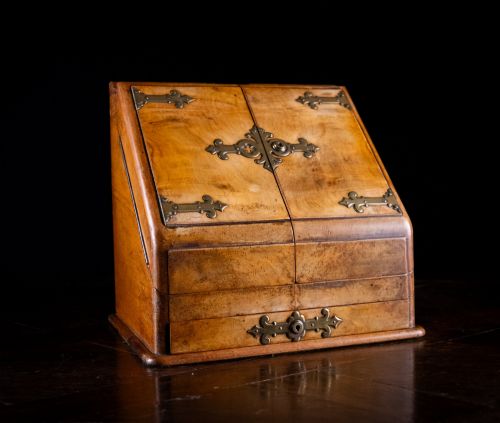
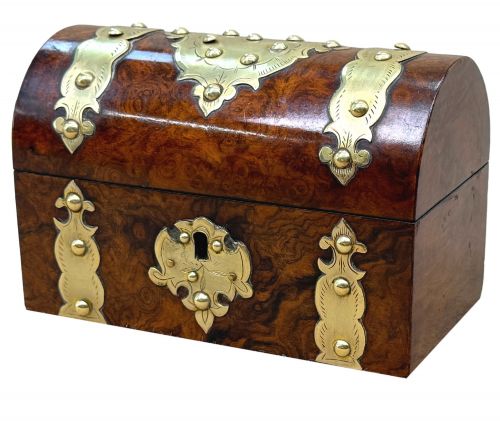
Most examples take the form of stationery boxes or correspondence chests designed to sit securely upon a writing desk. Variations include dome-top profiles, drop-front cabinets, and architectural Victorian Gothic Revival designs.
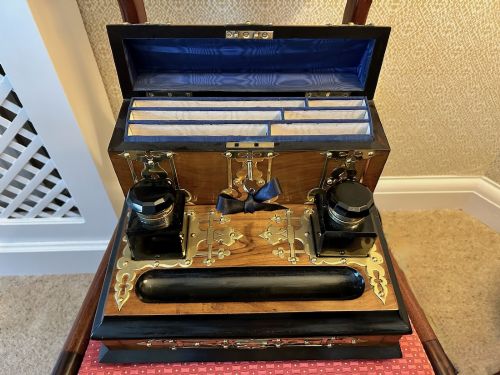
Makers utilised rich timbers to create these desk accessories, frequently selecting burr walnut veneers for their swirling grain patterns. Many items incorporate fitted interiors lined with silk, along with bone handles and compartments for stamps and pens.
Materials and construction methods
The primary construction relies on solid walnut and mixed hardwood veneers, often enhanced by highly figured burr walnut panels. Cabinetmakers applied these timbers carefully over structural carcases to create rich, varied surface patterns.
Metalwork played a crucial structural and decorative role, with heavy brass mounts, straps, and hinges reinforcing the corners and edges. Tunbridge ware mosaic inlays and fine boxwood stringing frequently decorated the exterior surfaces of finer examples.
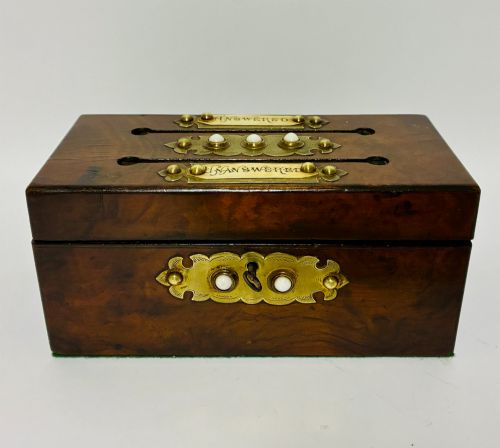
Interiors often feature delicate details such as bone escutcheons, hand-painted porcelain plaques, and fitted glass inkwells or compartments. Silk linings add a refined texture to the inner writing compartments and letter slots.
Some nineteenth-century letter boxes secreted tiny compartments designed specifically for holding postage stamps safely away from moisture.
Distinctions in craftsmanship
Quality rests in the selection of the timber and the precision of the cabinetmaking. Finely figured burr walnut displays deep, complex grain patterns that elevate the visual weight of the box.
The execution of decorative elements such as brass mounts, Tunbridge ware mosaic banding, and hand-painted porcelain determines the standing of an individual piece. Superior examples integrate these materials harmoniously without crowding the walnut carcase.
Structural integrity within the interior fitments, including intact silk linings and original bone or brass hardware, separates standard desk accessories from more ambitious nineteenth-century commissions.
Edmund Nye
The Victorian Walnut Letter Box Glossary
- Burr walnut
- A prized timber harvested from growth excrescences on walnut trees, yielding highly figured and swirling grain patterns. Cabinetmakers sliced this wood into thin veneers for decorative surfaces.
- Tunbridge ware
- A meticulous form of woodwork originating in Kent, featuring tiny mosaic tiles assembled from various natural coloured woods to form geometric or pictorial patterns. These mosaics frequently bordered the lids of letter boxes.
- Stationery box
- A desk accessory built with internal partitions and slots specifically sized for holding writing paper, envelopes, and correspondence. They evolved during the nineteenth century to keep desks tidy.
- Gothic Revival
- An architectural and decorative style popular during the Victorian era that drew inspiration from medieval forms. Pieces in this style often feature pointed arches, heavy brass strapwork, and ecclesiastical motifs.
- Escutcheon
- A protective plate surrounding a keyhole, usually fashioned from brass or bone on these cabinets. It prevents the surrounding walnut timber from sustaining damage when the key is inserted.
Victorian Walnut Letter Box: Frequently Asked Questions
What is a Victorian walnut letter box?
A Victorian walnut letter box is a desk accessory created during the nineteenth century to store envelopes, stationery, and incoming post. These wooden boxes keep desks organised while showcasing the rich grain of walnut timber.
Most examples feature hinged lids or drop fronts, often reinforced with brass mounts and fitted with internal compartments for stamps and writing paper.
How were these boxes used on desks?
Owners placed them upon writing tables and partner desks to sort daily correspondence and keep writing materials close at hand. The partitioned interiors allowed users to separate blank paper from received letters.
Many designs included dedicated slots on the exterior or lid specifically intended for posting or receiving letters before collection.
What materials are typical for these pieces?
The primary material is walnut, frequently utilised as highly figured burr walnut veneer over a secondary wood carcase. Cabinetmakers embellished these surfaces with brass hinges, mounts, and lock escutcheons.
Additional materials found on finer pieces include boxwood stringing, Tunbridge ware mosaic banding, bone handles, and delicate silk linings within the compartments.