


Victorian Walnut Chaise Longue
A victorian walnut chaise longue offers an elegant place to recline, combining rich timber frames with sweeping nineteenth-century upholstery.
Victorian Walnut Chaise Longue
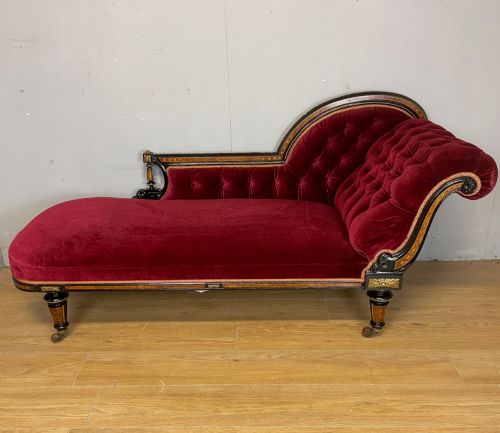
A victorian walnut chaise longue brings together nineteenth-century comfort and architectural timber framing, most often appearing as a single-ended daybed or a double-ended settee designed for reclining in a salon or drawing-room. These pieces span the nineteenth century, with Victorian examples dominating the selection alongside occasional Edwardian variations and earlier Regency influences.
Makers and workshops varied the silhouettes significantly, producing scroll ends, carved shell backs, and conversation seats alongside standard daybeds. The timber framework provides a warm brown tone that contrasts with contemporary upholstery, Hessian, or velvet finishes.
Materials and Construction
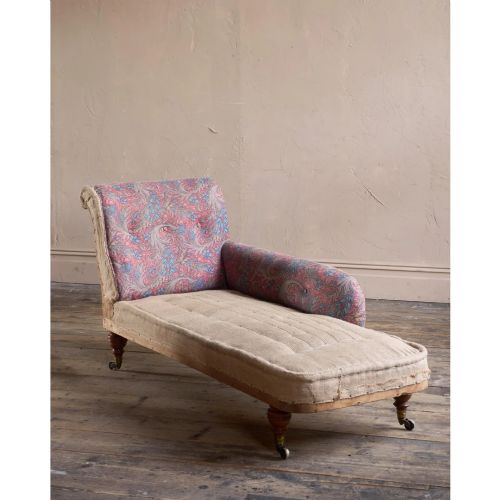
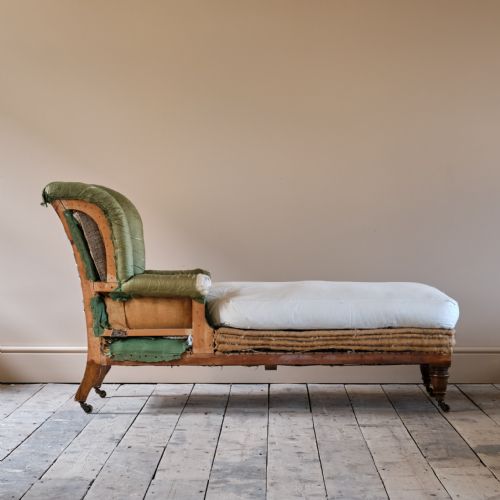
Cabinet makers utilised solid walnut for the structural frames, often carving elaborate ornamentation into the wood or mounting ormolu decoration upon ebonised panels. These frames support traditional upholstery systems built upon Hessian foundations and finished with fabric, velvet, or leather coverings.
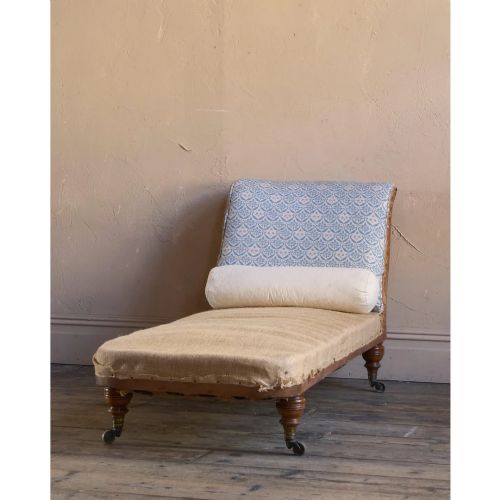
Brass castors frequently support the legs, allowing easy movement across carpeted drawing rooms. Joinery techniques from the period rely on sturdy tenons and concealed fastenings to bear the weight of reclining figures.
Some nineteenth-century conversation seats allowed two people to sit facing opposite directions while maintaining a polite, if slightly tangled, proximity.
Judging Quality and Craftsmanship
The crispness of the hand-carved walnut woodwork distinguishes standard workshop output from exceptional commissions. Deeply undercut foliage and sculptural scrollwork indicate a higher grade of artisan labour.
The integrity of the internal stuffing and the choice of surface fabric dictate the comfort and authenticity of the piece. Premium examples retain supportive underlying webbing and well-preserved timber patination.
Howard and Sons
The Victorian Walnut Chaise Longue Glossary
- Chaise Longue
- A long upholstered chair for reclining, literally translating from French as long chair. These seating forms became central to Victorian domestic comfort.
- Walnut
- A dense, dark brown timber favoured by nineteenth-century cabinet makers for its rich grain and suitability for carving. It replaced mahogany as the fashionable wood for many parlour suites.
- Ormolu
- Gilded bronze mounts applied to furniture woodwork for decorative accent. This technique adds metallic contrast to dark timber frames.
- Hessian
- A coarse woven fabric made from jute fibres, utilised as the foundational sacking beneath upholstery stuffing. It provides the tensile base for traditional sprung seats.
- Double End Settee
- A couch form featuring scrolled headrests at both extremities rather than a single raised end. This symmetrical design allows a user to recline facing either direction.
Victorian Walnut Chaise Longue: Frequently Asked Questions
How do I style a chaise longue today?
Place the piece freestanding in a spacious drawing room or bedroom where its sweeping silhouette remains visible from all angles. Allow sufficient floor clearance around the frame to let the timber details stand out.
Pair the upholstery with neutral cushions or a simple throw that complements the dark walnut frame without concealing the carved woodwork.
Were these pieces used for sleeping?
Victorian daybeds and couches served primarily for daytime resting, reading, or receiving visitors in a semi-reclined posture. They were not intended to replace a conventional bed for nighttime slumber.
The raised scroll end supported the head while the long body accommodated the torso and legs during afternoon repose.
How do I identify a Victorian period piece?
Look for dense walnut framing, hand-carved ornamentation, and traditional joinery methods consistent with nineteenth-century cabinet making. The presence of original brass castors beneath the legs also points toward this era.
Compare the timber finish and upholstery construction with established examples from the mid to late nineteenth century to confirm the date.
Can I replace the fabric?
Many nineteenth-century daybeds undergo reupholstery to suit modern interiors while preserving the antique timber frame underneath. Traditional materials such as Hessian and horsehair stuffing can be renewed by a skilled restorer.
Selecting a fabric that respects the period aesthetic ensures the piece maintains its historical character after conservation work.