






Victorian Wall Weather Gauge
These Victorian wall weather gauges combine precision engineering and domestic utility, offering a direct link to nineteenth-century meteorological observation.
Victorian Wall Weather Gauge
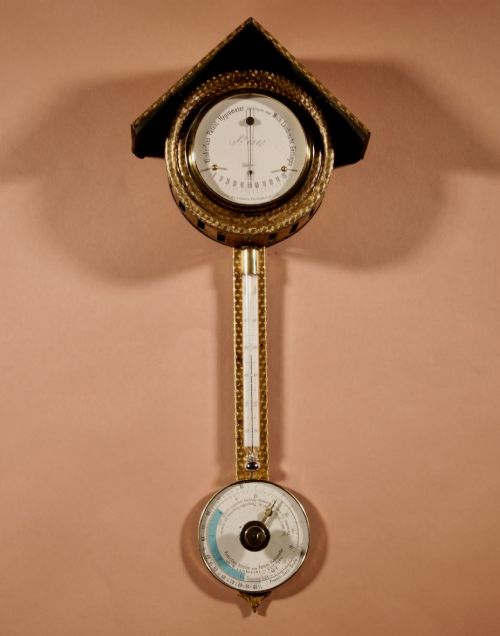
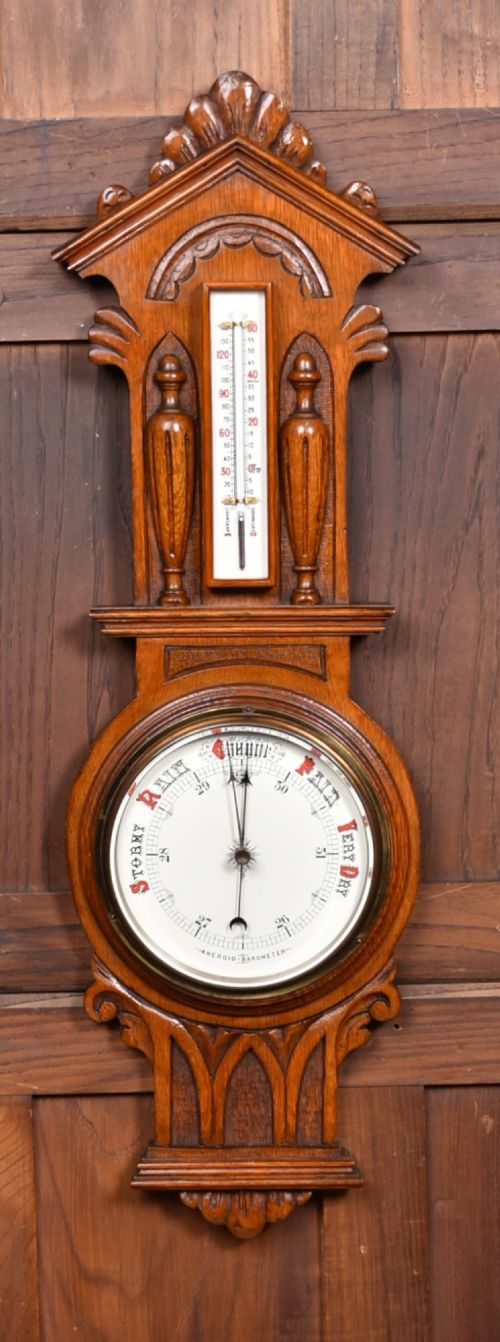
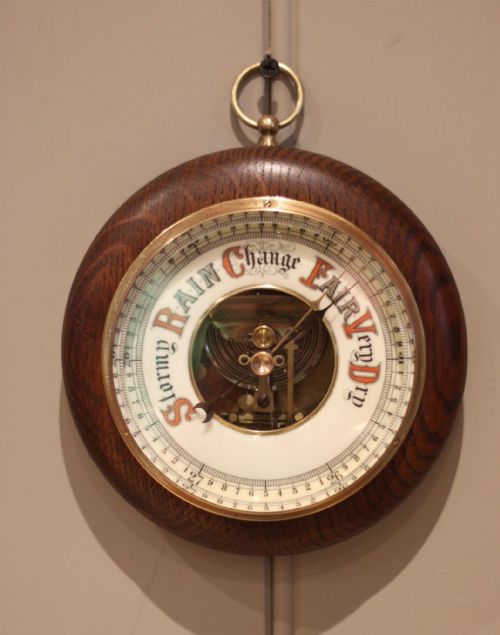
A Victorian wall weather gauge encompasses various scientific instruments designed to measure atmospheric pressure, temperature, and humidity for interior display. Buyers searching for a Victorian wall weather gauge typically encounter aneroid barometers, stick barometers, and complex weather stations housed in timber cases.
The domestic forms range from compact carved oak banjo barometers to large dial instruments mounted in mahogany, rosewood, and walnut. Maritime examples, including RNLI type aneroid barometers and ships barometers, sit alongside elaborate Black Forest carvings and specialised hygrometers.
Materials and construction
Instrument makers utilised durable hardwoods such as oak, mahogany, walnut, rosewood, and beech to fashion the wall cases, frequently employing intricate carving or inlay techniques. Brass frames, bezels, and skeletal movements house the internal mechanics, paired with glass dials and enamel or porcelain indicators.
Specialised scientific components incorporate steel springs, hair hygrometer strands, and mercury columns within stick barometers to record atmospheric changes accurately. Enamelled and ceramic dials present clear legible scales for barometric pressure and temperature readings.
Victorian Wall Weather Gauge Retail Price Guide 2026
Typical asking prices for victorian wall weather gauge among the pieces listed under this phrase on Sellingantiques today, from the lower quarter to the upper quarter. They describe what is for sale here now, not the wider market.
The documented periods span the Victorian era, the Edwardian period, and the wider nineteenth century.
Evaluating craftsmanship and execution
Quality reveals itself in the precision of the dial engraving, the legibility of the maker inscriptions, and the fidelity of the timber carving. Superior examples feature robust mechanical movements housed within finely figured wood veneers or deeply carved Black Forest housings.
The reputation of the maker and the complexity of the instrument dictate the standing of a piece within the field. Multi-function weather stations and signed scientific instruments demonstrate higher levels of nineteenth-century technical ambition than standard domestic banjo barometers.
Wilh. Lambrecht·Poulenc Freres·Elliott Brothers·Short & Mason·Negretti & Zambra·James H Kelly·Blake & Son·Dollond of London
The Victorian Wall Weather Gauge Glossary
- Aneroid barometer
- An instrument that measures atmospheric pressure by the expansion and contraction of a flexible metal disc in a sealed capsule, operating without liquid. This design allowed barometers to be mounted securely on walls in various orientations.
- Stick barometer
- A tall, narrow instrument containing an open column of mercury that rises and falls with atmospheric pressure variations. These vertical wall pieces often include attached Fahrenheit thermometers.
- Hygrometer
- A device used for measuring the humidity or moisture content of the air. Hair hygrometers utilise human or animal hair to detect these atmospheric changes.
- Banjo barometer
- A domestic wall barometer shaped like a banjo, featuring a circular dial at the top for pressure readings and a longer lower trunk often containing a thermometer or humidity gauge.
- Weather station
- A combined domestic instrument incorporating multiple gauges, such as an aneroid barometer, thermometer, and hygrometer, mounted on a single board or within a unified case.
Victorian Wall Weather Gauge: Frequently Asked Questions
How do I mount a wall barometer safely?
Secure the instrument to a solid wall using fixings appropriate for the weight of the timber case and internal brass mechanism. Ensure the fixing point supports the hanging bracket firmly without placing strain on the outer frame.
Keep the barometer away from direct heat sources and exterior doors to prevent sudden temperature shifts that might affect the mechanical readings.
What is the difference between a stick barometer and an aneroid barometer?
A stick barometer relies on a vertical column of mercury to register atmospheric changes through direct fluid movement. These tall instruments require careful handling and vertical mounting.
An aneroid barometer uses an internal sealed metal vacuum chamber that expands or contracts with pressure changes, turning a pointer on a dial face. This compact design made aneroid models popular for diverse domestic wall settings.
How do I read a nineteenth century weather station?
Observe the main dial to check the barometric pressure reading indicated by the pointer, noting whether the needle points toward rain, change, or fair weather. Many instruments include a secondary manual pointer to track movement over time.
Read the accompanying thermometer and hygrometer scales positioned alongside the main dial to gather complete atmospheric data for the room or exterior environment.
Are these antique barometers still accurate?
Many nineteenth-century barometers retain functional movements and respond reliably to current atmospheric pressure changes when calibrated correctly. Mechanical sensitivity depends on the condition of the internal linkages and springs.
Minor adjustments can often be made using the setting screw located at the back or through the dial face to align the instrument with local barometric readings.