


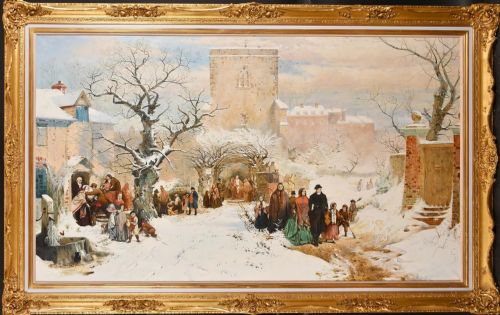


Victorian Village Scene Artwork
Victorian village scene artwork captures rural community life through oil and watercolour, offering a direct window into nineteenth-century domestic and agrarian routines.
Victorian Village Scene Artwork
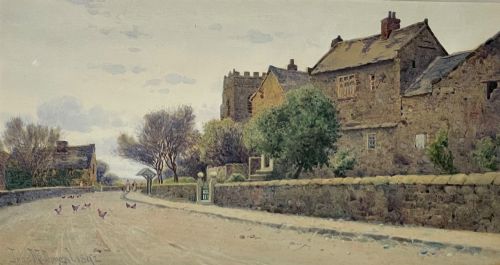
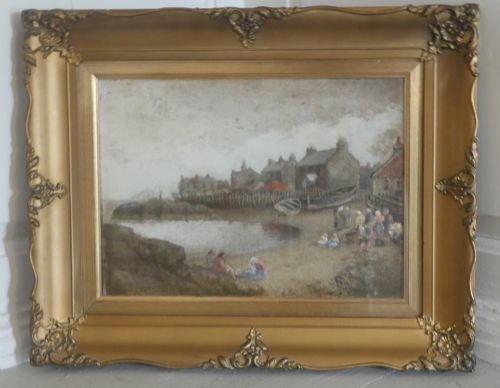
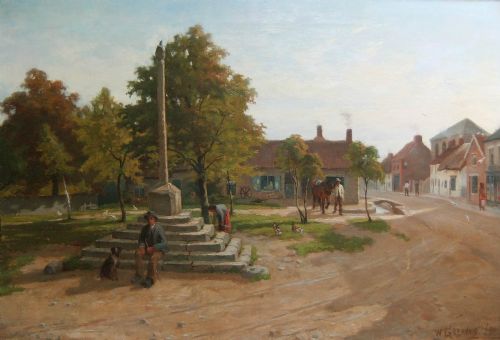
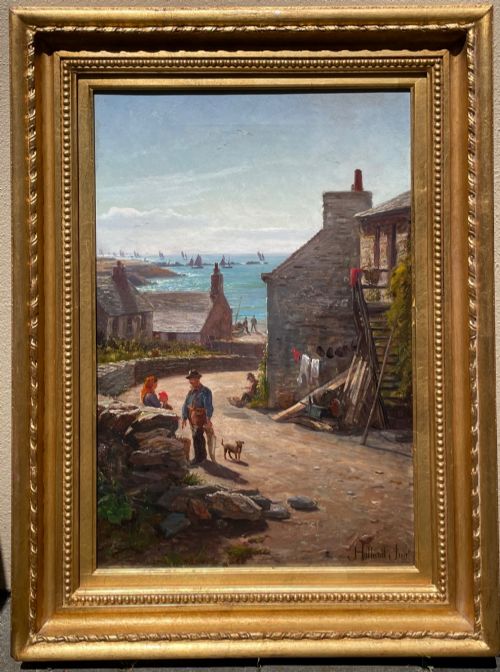
Victorian village scene artwork encompasses paintings and watercolours depicting community life, coastal harbours, rural inns, and country lanes across the nineteenth century and into the early twentieth century. These works record the physical appearance of British and European settlements, documenting architecture, local figures, and everyday rural activities.
The selection on this page relies heavily on nineteenth-century oil paintings on canvas and panel, alongside detailed watercolours on paper. Artists working in this genre recorded specific locations ranging from Yorkshire and Wales to Cornish coasts and French villages, often framing these rural observations within gilt frames.
Materials and methods
Artists built these compositions using oil paint on canvas or wooden panel, and pigment applied to paper in watercolour. Canvases frequently received layers of oil paint to create depth in landscapes, while watercolours relied on translucent washes over pencil preparatory sketches.
Framing forms an integral part of the physical object, with gilt frames providing the traditional border for oil paintings from the period. Many works retain their original mounting materials, supporting the paper or canvas within period wooden structures.
One cheerful canvas records a young foal caught in the act of stealing fruit from a basket.
Assessing quality and execution
Quality rests in the handling of light, atmospheric perspective, and the naturalistic arrangement of human and animal figures within the landscape. Stronger examples demonstrate confident brushwork or precise watercolour technique that brings architectural details and human interaction to life without stiffness.
The depth of the composition and the specific recording of local topography distinguish superior works from generic topographical production. Artists who successfully integrated genre details, such as children fishing or travellers by village inns, achieved a more engaging narrative balance.
John McDougal·Edward Mills·William Greaves·John Holland·Charles Vickers·Helena Maguire·George Gregory·Robert Hollands Walker·David Woodlock·Henry Sykes·Robert McGregor·John Ritchie·Henry Charles Bryant·Georgina Lara·Carleton Grant·Eugene Battaille·Joseph Thors·John Holland Snr·John Baragwanath King
The Victorian Village Scene Artwork Glossary
- Genre art
- Painting that depicts scenes of everyday life and ordinary people. These works focus on domestic activities, village gatherings, and street scenes rather than historical or mythological subjects.
- Watercolour
- A painting method in which the paints are made of pigments suspended in a water-soluble vehicle. Paper serves as the primary support, allowing for luminous washes.
- Oil on canvas
- Pigments bound in a medium of drying oil applied to a stretched woven fabric support. This combination allows for rich colour saturation and blended tonal gradations.
- Gilt frame
- A wooden picture frame coated with a thin layer of gold leaf or metallic gilt paint. These frames enhance the visual weight and period context of nineteenth-century paintings.
Victorian Village Scene Artwork: Frequently Asked Questions
What subjects appear in Victorian village scene artwork?
These works depict rural settlements, coastal harbours, country inns, and riverbanks populated by local figures, children, and farm animals. Artists recorded specific regional localities across Britain and France.
Common motifs include village taverns, windmills, cottage lanes, and daily community activities observed during the nineteenth century.
How do oil paintings differ from watercolours in this selection?
Oil paintings utilise pigments bound in drying oil applied to canvas or wood panels, yielding rich textures and deep tonal ranges. Watercolours employ water-soluble pigments on paper, producing lighter, translucent effects.
Oils typically appear within heavy gilt frames, whereas watercolours require glass protection to preserve the paper support.
How are nineteenth-century rural scenes dated?
Dates rely on artist biographical records, stylistic indicators of nineteenth-century realism, and occasional inscriptions on the reverse of canvases or panels. Costumes worn by figures also provide chronological clues.
Many works carry specific year markers or reflect the active painting periods of listed artists.
How should I care for a nineteenth-century painting?
Keep works away from direct sunlight, high humidity, and rapid temperature fluctuations to protect canvas, wood, and paper supports. Avoid placing oil paintings near heat sources that might dry out the paint layer.
Dust gilt frames gently with a soft, dry brush and consult a professional conservator if cleaning the painted surface becomes necessary.