

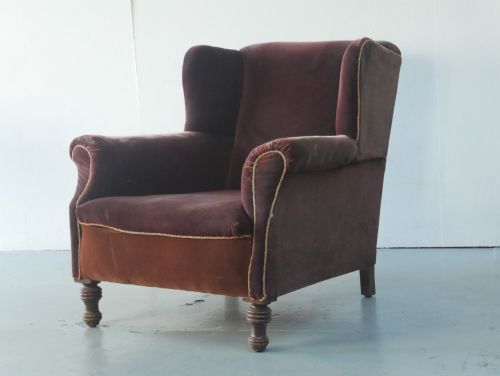
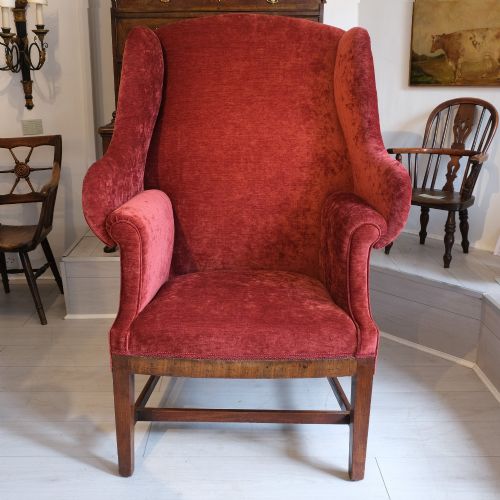
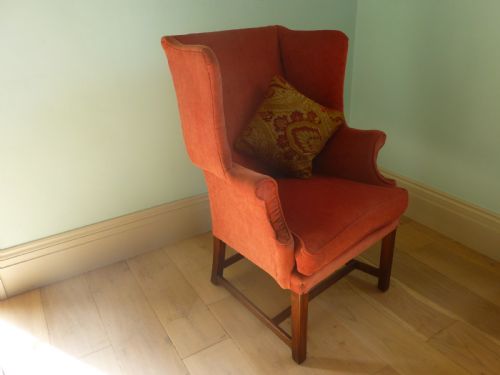


Victorian Velvet Wing Chair
These Victorian velvet wing chairs offer deep-sprung comfort and high-sided draught exclusion.
Victorian Velvet Wing Chair
A victorian velvet wing chair provides an enclosed seating experience designed to shield the sitter from draughts in large rooms. These armchairs typically feature prominent upholstered wings flanking the backrest to trap warmth around the head and shoulders.
Most examples encountered here originate from the nineteenth century, spanning periods from mid-nineteenth century incarnations to late nineteenth century productions. The forms vary from standard wing armchairs to low-slung lounging versions.
Makers such as Howard and Sons produced notable variations of the form, though many surviving pieces remain unattributed. Buyers will encounter both walnut and mahogany frames beneath the upholstery.
Materials and construction
Frames are constructed from hardwoods including walnut, mahogany, and general timber, providing the structural skeleton for the upholstery. Timber components are often visible on the legs, which may incorporate brass castors.
Upholstery methods rely on traditional stuffing and springing techniques encased in heavy textiles. Velvet, chenille twill, damask, and green or burnt orange pile fabrics form the visible exterior covering.
Victorian Velvet Wing Chair Retail Price Guide 2026
Typical asking prices for victorian velvet wing chair among the pieces listed under this phrase on Sellingantiques today, from the lower quarter to the upper quarter. They describe what is for sale here now, not the wider market.
The documented pieces span the nineteenth century, including specific attribution to Howard and Sons.
Assessing quality
Quality rests primarily in the integrity of the timber frame and the depth of the original springing beneath the fabric. Finer examples retain their structural rigidity without excessive wobble in the joints.
The choice and execution of the textile upholstery significantly influence the character of the piece. Superior examples display careful hand-tackwork and dense pile fabrics that wear evenly over decades.
Howard And Sons
The Victorian Velvet Wing Chair Glossary
- Wingback
- An armchair featuring projecting side panels attached to the backrest. These wings were originally designed to shield the face from fireside heat or room draughts.
- Chenille
- A type of tufted yarn that gives textile surfaces a velvety pile. It appears frequently on nineteenth-century upholstery.
- Damask
- A reversible figured fabric woven on a loom, utilised for formal upholstery. The pattern is formed through contrasting warps and wefts.
- Castor
- A small wheel fitted to the base of chair legs for ease of movement. Nineteenth-century versions are frequently brass.
Victorian Velvet Wing Chair: Frequently Asked Questions
What is a wing chair?
A wing chair is an upholstered armchair with high sides designed to block draughts.
The prominent wings also served to trap heat from an open fireplace around the sitter.
How do I date a Victorian armchair?
Dating relies on timber choice, leg style, and construction methods used in the frame.
Earlier nineteenth-century pieces often feature mahogany, whilst later nineteenth-century examples frequently employ walnut.
Are these chairs comfortable?
These armchairs are built for deep, upright seating rather than slouching.
The enclosed back and sprung upholstery provide firm support for long periods.
What fabrics are used?
Upholstery typically consists of velvet, chenille twill, or damask.
Green and burnt orange pile fabrics appear frequently among nineteenth-century examples.