



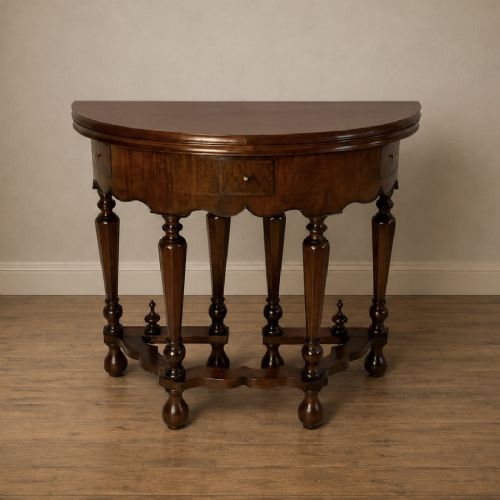
Victorian Turn Over Table
These Victorian turn over table designs provide a clever folding surface for card games and tea.
Victorian Turn Over Table
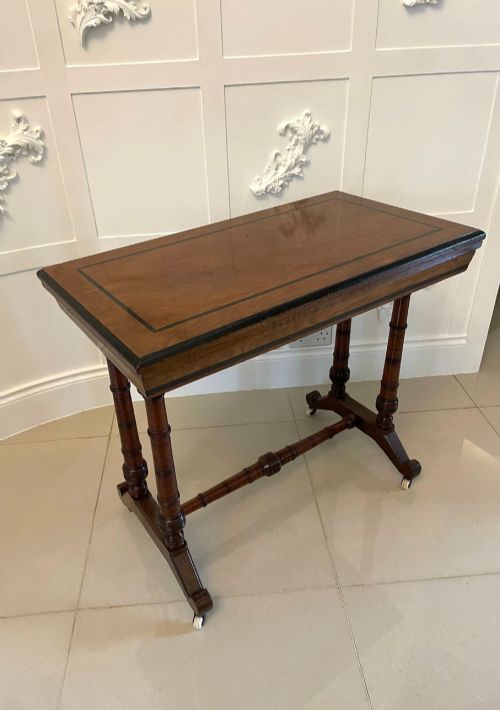
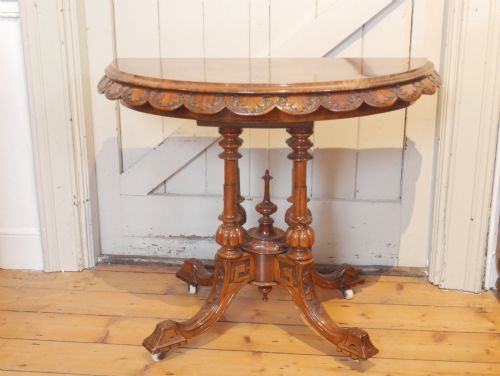
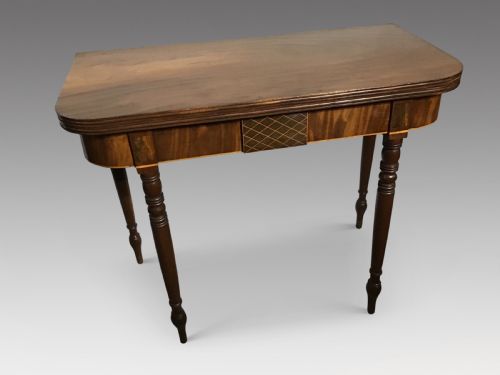
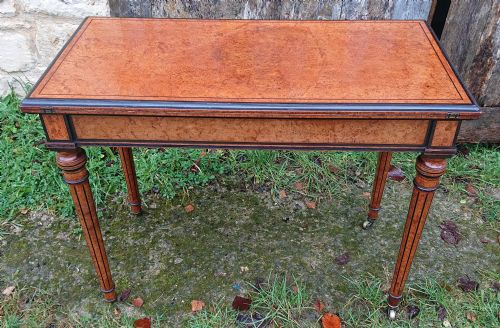
A victorian turn over table functions primarily as a card or games table, offering a folding top that expands from a compact side piece into a full display or playing surface. The selection spans walnut, mahogany, and rosewood examples originating through the nineteenth century, including specific styles like Arts and Crafts, Aesthetic Movement, and William IV.
Buyers will most frequently encounter walnut and burr walnut iterations featuring inlaid wood work or Tunbridge ware details, alongside earlier Georgian and Regency forms. These pieces often double as side tables when closed against a wall, making them practical for daily interior use.
Materials and construction methods
Timbers such as mahogany, walnut, and rosewood form the structural foundation, frequently enhanced with burr veneers and intricate wood inlay. Cabinet makers utilised brass hinges and metal supports to allow the top leaf to pivot and fold smoothly.
Surface decoration incorporates specialist techniques including Tunbridge ware micro-mosaics and ebony stringing, reflecting the Arts and Crafts and Aesthetic Movement preferences for detailed craftsmanship.
Victorian Turn Over Table Retail Price Guide 2026
Typical asking prices for victorian turn over table among the pieces listed under this phrase on Sellingantiques today, from the lower quarter to the upper quarter. They describe what is for sale here now, not the wider market.
The listings span multiple timber varieties including mahogany, walnut, rosewood, and oak, alongside inlaid decorative treatments.
Judging the quality
Quality rests upon the choice of timber veneer and the precision of the wood inlay, where figured burr walnut and complex geometric patterns elevate a piece above plain mahogany alternatives. The tightness of the hinge mechanism and the alignment of the folding leaves when open also separate superior cabinet work from standard production.
The sophistication of the decorative movement influences the standing of the table, with specialised attributes like Tunbridge ware panels or attributions to known makers marking out the finest examples from standard nineteenth century output.
Gregory and Co·W.F. Greenwood and Sons
The Victorian Turn Over Table Glossary
- Turn over table
- A table featuring a hinged top that folds over to double the surface area, commonly used for card games or tea.
- Burr walnut
- A prized wood grain obtained from walnut tree growths, yielding intricate swirling patterns highly sought after in Victorian furniture.
- Tunbridge ware
- A type of decorative woodwork characterised by tiny mosaic tiles forming pictorial or geometric designs, named after the town of production.
- Aesthetic Movement
- A late nineteenth century design style emphasising visual beauty and artistic detail over traditional historic revivalism.
Victorian Turn Over Table: Frequently Asked Questions
How do you open a victorian turn over table?
The hinged top section rotates on a pivot or swings on brass hinges to rest flat upon an expanded frame or pivoting support rail.
Care must be taken to support the weight evenly during the motion to protect the original wooden joints and hinges.
What were these tables used for historically?
These pieces served primarily as compact console or side tables during the day, expanding when guests arrived for card games or tea.
The green baize interiors typically found inside provided a suitable playing surface for card games popular in nineteenth century drawing rooms.
How do I identify a Victorian period table?
Nineteenth century pieces often display characteristic timber choices such as burr walnut, rosewood, and mahogany, alongside specific stylistic markers from the Arts and Crafts or Aesthetic Movement.
Construction details like hand-cut joints and brass hardware help distinguish authentic period pieces from later reproductions.
Will a card table fit in a modern living room?
Their dual-purpose design allows them to sit flush against a wall as a narrow side table when the top remains folded closed.
Opening the leaf requires clearance around the furniture, making them suitable as occasional centre tables for entertaining.