




Victorian Trumpet Box
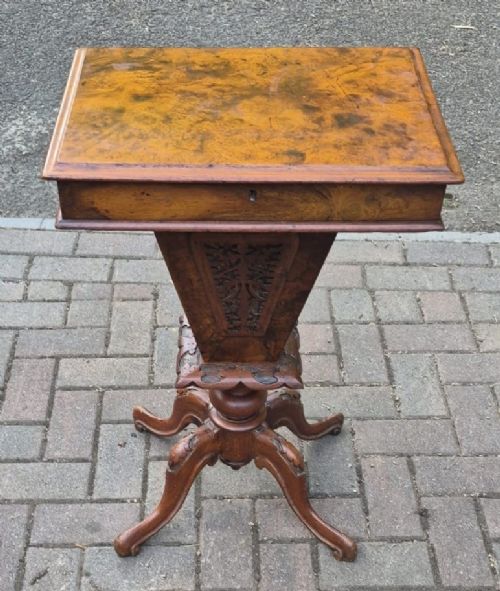
A victorian trumpet box is a flared, octagonal or circular sewing receptacle rising on a slender tripod base, designed for nineteenth-century needlework.
Victorian Trumpet Box
A victorian trumpet box serves primarily as a specialised repository for threads, needles, and fabric scraps, combining utilitarian storage with graceful drawing-room display. These pieces belong to the broader family of sewing tables, work tables, and occasional tables produced during the nineteenth century, particularly between 1850 and 1890.
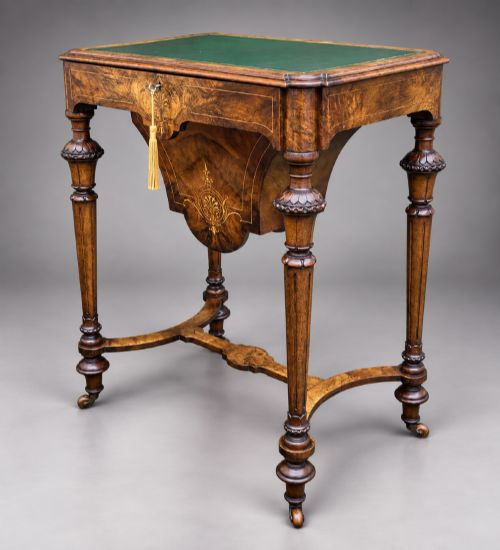
The defining physical characteristic is the cone-shaped or trumpet-shaped body that expands outward from a narrow base toward a hinged lid. Inside, makers fitted compartments and trays to organise sewing implements, sometimes incorporating chess boards or games tables into the lid exterior.
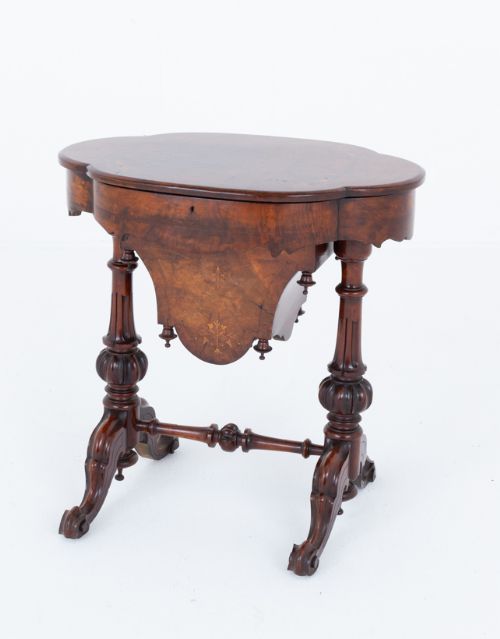
Burr walnut and rosewood dominate the selection, often accompanied by marquetry inlay, boxwood inlay, and carved wooden supports. Buyers encounter variations in form ranging from compact table-top workboxes to freestanding tripod pieces resting on carved pillar legs.
Materials and Construction Methods
Cabinetmakers constructed the distinctive flared body using tightly fitted vertical timber staves joined together to create the cone shape, similar to barrel-making. Walnut, burr walnut, and rosewood veneers provided the decorative exterior surfaces, selected for rich grain patterns and warm colour.
Intricate decoration relied on wood inlay, boxwood inlay, and marquetry techniques to ornament the lids and sides with floral motifs or geometric banding. Solid mahogany, walnut, or Irish yew formed the structural frames and turned tripod legs that support the tapered body.
The recorded material selection spans walnut, burr walnut, rosewood, mahogany, and Irish yew, alongside specialised marquetry and boxwood inlay.
Distinctions in Quality
The tier of quality depends heavily on the choice of timber veneer and the precision of the marquetry inlay. Selected burr walnut with lively, swirling grain patterns commands attention above plain timbers, while crisp, unblemished wood inlay indicates superior workshop execution.
Interior architecture further separates standard examples from exceptional pieces. Fitted compartments featuring lidded compartments, small bone or ivory pulls, and intact original silk-lined wells represent the higher standard of nineteenth-century cabinet work.
The Victorian Trumpet Box Glossary
- Trumpet box
- A cone-shaped sewing receptacle with a flared body resting on a tripod base. This form widens toward the top to house a fitted interior tray.
- Burr walnut
- A highly figured timber sliced from walnut tree growths or excrescences. Cabinetmakers prized this material for its swirling grain patterns.
- Marquetry
- The art of applying decorative veneer pieces of different woods to a structure. This technique creates pictorial or geometric patterns on tabletops and lids.
- Tripod base
- A three-legged support structure commonly found beneath nineteenth-century occasional furniture. It provides stable elevation for tapered bodies.
- Work table
- A multi-functional piece of furniture designed for needlework and domestic crafts. These tables often include internal compartments and drop leaves.
Victorian Trumpet Box: Frequently Asked Questions
What is a trumpet box used for?
These pieces served nineteenth-century women as portable or freestanding repositories for sewing gear, embroidery threads, and small notions. The flared upper section held a lift-out tray above a deep storage well.
Beyond practical needlework storage, the decorative exterior allowed the piece to sit permanently in a Victorian parlour as an elegant occasional table.
How do I identify the timber?
Burr walnut displays dense, swirling grain patterns filled with small knot clusters and rich golden-brown tones. Rosewood offers a heavier weight and darker reddish-brown colour with distinct black grain streaks.
Mahogany provides a straighter, reddish grain, while Irish yew exhibits pale contrasting tones with fine natural figuring.
Are the interiors usually fitted?
Most examples contain a shallow lift-out wooden tray divided into small compartments for reels and pins. Beneath this tray lies a deep well designed for scraps of fabric and wool.
Some interiors retain remnants of original pleated silk or paper linings, though many have been cleanly stripped over the decades.
Where should I place it at home?
The compact footprint makes these pieces suitable beside a living room armchair, sofa, or in a hallway as an occasional display surface. The tripod base requires minimal floor space while offering stable support.
Keep the timber away from direct heat sources and strong sunlight to protect the fragile veneers and polished finishes.
How do I date these pieces?
Dating relies on stylistic markers and recorded production periods spanning from 1850 to 1890. Mid-century examples often feature simpler rosewood or mahogany construction without extensive marquetry.
High Victorian pieces from the 1870s and 1880s frequently showcase elaborate burr walnut veneers, boxwood inlay, and carved tripod columns.