

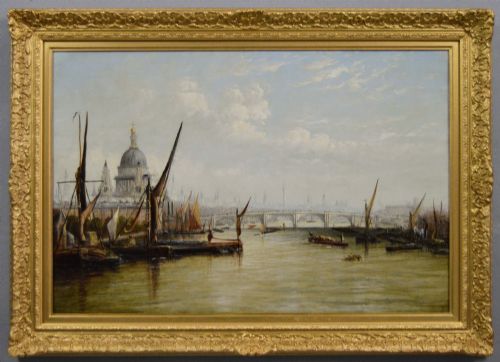


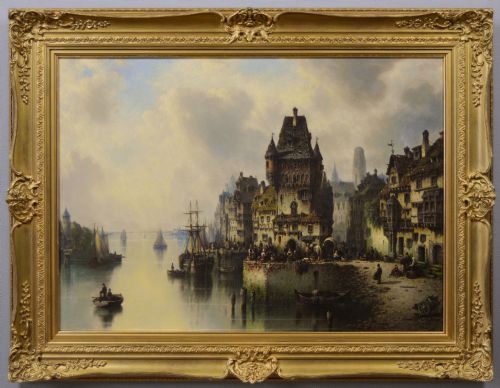


Victorian Townscape Oil Painting
These Victorian townscape oil paintings capture bustling city streets, Venetian canals and historic bridges through the rich medium of nineteenth-century canvas and board.
Victorian Townscape Oil Painting
A Victorian townscape oil painting brings the bustling street scenes, quiet canals and historic architecture of the nineteenth century directly into view. These works range from local English views in Reigate and Evesham to grand continental vistas across Venice, Cannes and Dutch waterways.
The pieces appearing on this page span several decades of the nineteenth and early twentieth centuries, capturing evolving approaches to realism and landscape art. Buyers meet both expansive canvases depicting famous landmarks like St Pauls and intimate oil on board studies of everyday street life.
Many of these works focus on architectural precision, framing cathedrals, bridges and harbours with meticulous brushwork. Others lean into atmospheric depictions of marine settings and river traffic, reflecting the varied interests of nineteenth-century artists.
Materials and construction
Artists of this period predominantly applied oil paint onto prepared canvas or wooden board, utilising the rich medium to build depth and texture. The pigments capture light on water and stone with a permanence that defines the era's pictorial tradition.
Many works retain their period frames, constructed from wood and gesso with gold leaf or giltwood finishes. These heavy mouldings often incorporate composition ornament to frame the view.
Victorian Townscape Oil Painting Retail Price Guide 2026
Typical asking prices for victorian townscape oil painting among the pieces listed under this phrase on Sellingantiques today, from the lower quarter to the upper quarter. They describe what is for sale here now, not the wider market.
Listings feature works spanning the 1860s to the early 1910s, utilising oil on canvas and oil on board within giltwood and gesso frames.
Judging quality in nineteenth-century townscapes
The distinction between standard works and finer examples lies in the artist's handling of light, perspective and architectural detail. Superior pieces demonstrate confident brushwork that brings movement to figures and water while maintaining structural accuracy in buildings.
The preservation of the original surface and the harmony between the painting and its period frame also influence the overall standing of the work. Well-maintained canvases and boards retain vibrant pigments without excessive overpainting.
Francis Moltino·Cornelis Christian Dommersen·Alfred Pollentine·Edward Henry Holder·Jane Vivian·Ludwig Hermann·George Willis Pryce·Arthur Joseph Meadows·Henry Schafer·David Cox Senior
The Victorian Townscape Oil Painting Glossary
- Oil on canvas
- Pigments bound in drying oil applied to a stretched woven fabric support. This traditional method allows for subtle blending and rich surface texture.
- Oil on board
- Pigments applied directly to a rigid wooden panel or pasteboard. This smaller format was frequently used for direct plein air studies.
- Giltwood
- Wood carved and covered with a thin layer of gold leaf or metallic powder. It provides a luminous border to traditional paintings.
- Gesso
- A plaster mix applied to wood frames to create a smooth surface for gilding. It allows for crisp moulded decorative details.
- Composition
- A mouldable mixture of whiting, linseed oil and resin used to create ornamental details on frames. It hardens to resemble carved wood.
Victorian Townscape Oil Painting: Frequently Asked Questions
What subjects appear in these paintings?
The works depict recognizable city streets, canals, bridges and harbours across England, France, Italy and the Netherlands. Scenes range from bustling Venetian waterways to quiet English riverside towns.
Artists frequently recorded notable landmarks such as the Doge's Palace, St Pauls and various European cathedrals alongside daily street life.
How should I display an oil painting?
These works require placement away from direct sunlight and excessive humidity to protect the canvas, board and giltwood frame. Stable indoor temperatures prevent warping in the wooden supports and cracking in the oil paint.
Ensure the painting hangs securely using appropriate fixings suited to the weight of both the artwork and its heavy period frame.
Are these works signed by the artists?
Many nineteenth-century townscapes bear the signature or monogram of the painter, often positioned discreetly in a lower corner. Attribution is also supported by historical records, stylistic analysis and period documentation.
Works lacking a visible signature are typically attributed to a specific school or period based on technique and subject matter.
What is the difference between canvas and board?
Canvas involves woven fabric stretched over a wooden frame, allowing for larger compositions and a slightly flexible painting surface. Board provides a rigid, solid support typically utilised for smaller studies and street scenes.
Both mediums were standard practice during the nineteenth century, chosen by artists depending on the scale and location of their work.