
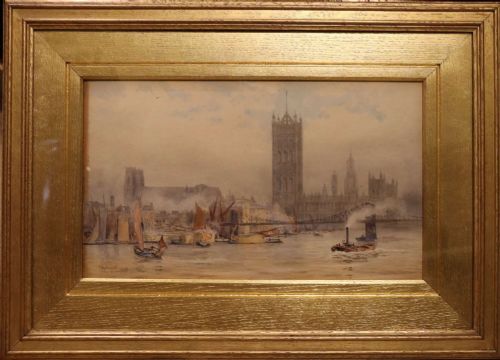


Victorian Thames Watercolour
A Victorian Thames watercolour captures the river and its reaches in fluid pigment, offering a glimpse of London and the valley as artists recorded them over a century ago.
Victorian Thames Watercolour
A Victorian Thames watercolour depicts familiar riverside scenes, from the maritime bustle of the Pool of London to quiet locks near Marlow and Wargrave. These works record historic bridges, chapels, and parliament buildings as artists observed them along the water.
The selections on this page span the nineteenth century into the twentieth century, bringing together topographical views and atmospheric river landscapes. Works range from expansive cityscapes featuring St Paul's Cathedral to intimate depictions of children fishing at dusk in Thameside villages.
Makers working within the British School and British Impressionism styles dominate these listings, applying watercolour pigment to paper with varied degrees of finish. Buyers encounter both exhibited exhibition pieces and focused topographical studies by named hands.
Materials and Technique
Artists painted these watercolours using finely ground pigment suspended in water, applied directly to heavy paper supports to capture transient effects of light on the river. Many works incorporate delicate ink lines to define architectural details of bridges, barges, and London skylines.
Surviving examples are preserved behind glass and framed in gilt wood or giltwood mouldings that protect the delicate paper surface from atmospheric moisture. The combination of transparent wash and opaque pigment allowed painters to render both luminous skies and the reflective surface of the Thames.
Dated examples across the inventory span from the late nineteenth century through the Edwardian era into the mid-twentieth century.
Distinctions in Quality
Quality rests in the artist's handling of atmosphere and light, distinguishing a spirited topographical record from a stiff or formulaic transcription of a riverside view. Masterful brushwork captures the damp haze of Smokey London or the fading dusk light over a Berkshire lock with economy and precision.
The strength of the composition and the preservation of the original pigment vibrancy shape the standing of each sheet. Works that retain their full tonal range without excessive fading offer a direct encounter with the nineteenth-century landscape.
H. Medlycott·Alfred Young Nutt·Henry John Kinnaird·Robert Winchester Fraser·Frederick G. Coulridge·A. G. Hayward·Walter Duncan·Henry Sykes·Frank Wasley·Carleton Grant·Frances E. Nesbitt·William A. Macdonald·Herbert John Finn·Frank William Scarbrough
The Victorian Thames Watercolour Glossary
- Watercolour
- A painting method where fine pigment is mixed with water and applied to paper. This medium allows for transparent washes that mimic the shifting light and moisture of the Thames.
- Topographical
- Representing a specific actual place with accuracy and detail. These watercolours often document historic London landmarks and rural Berkshire reaches as they appeared decades ago.
- Giltwood
- Wood carved and covered with a thin layer of gold leaf or gilt. Frames of this material frequently accompany nineteenth-century works.
- British School
- A loose categorization for artists trained and working within British artistic traditions. Many Thames watercolours originate from painters aligned with these regional methods and Impressionist tendencies.
Victorian Thames Watercolour: Frequently Asked Questions
How do I hang a watercolour?
Hang watercolours away from direct sunlight to prevent the pigments from fading over time. Maintaining stable indoor humidity also protects the paper and the surrounding gilt wood frame.
Ensure the piece is glazed with protective glass and hung securely on an interior wall. Proper placement preserves both the paper support and the delicate washes.
What subjects appear most often?
Common subjects include the Houses of Parliament, Westminster Bridge, and city views featuring St Paul's Cathedral. Rural stretches near Windsor, Marlow, and Wargrave also feature prominently.
Artists frequently recorded locks, barges, and daily river life along the Thames valley. These varied viewpoints document both urban commerce and quiet rural backwaters.
How do I identify the period?
Dating relies on recorded artist active dates, stylistic cues of the British School, and occasional manuscript inscriptions on the mount or reverse. Victorian works often show a detailed topographical approach or early impressionistic brushwork.
Comparing costume, vessel types, and London architecture helps narrow the decade of execution. Many sheets carry signatures or dates added by the artist at the completion of the work.
Are these works original?
The listings consist of original hand-painted works on paper rather than later reproductions or prints. Each sheet displays the distinct brush marks and pigment texture characteristic of direct painting.
Artists applied watercolour pigment and ink by hand to capture transient atmospheric conditions. Examining the surface under magnification reveals the authentic touch of the painter.