




Paper Watercolour London Landscape
These paper watercolour london landscape works capture the capital through a century of changing light, offering an authentic glimpse of the city's historic streets and river views.
Paper Watercolour London Landscape
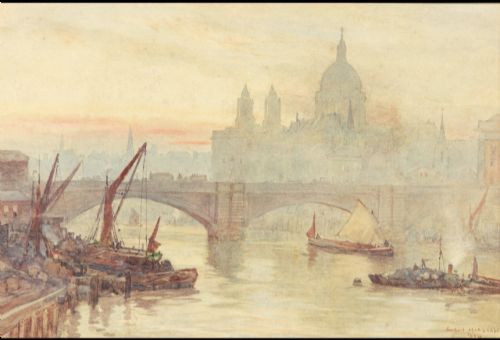
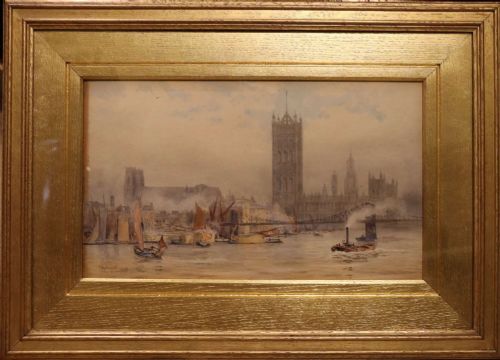
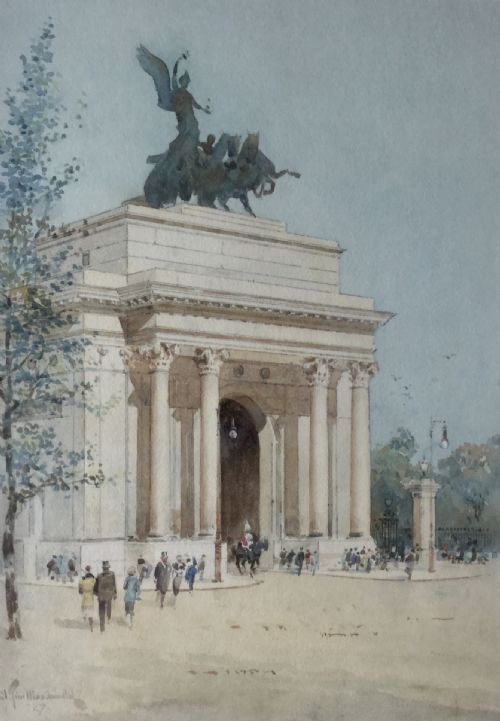
A paper watercolour london landscape depicts familiar capital scenes such as the River Thames, St Paul's Cathedral, and Whitehall, executed on a paper support. These works range from the nineteenth century through the Edwardian era into the mid-twentieth century.
Buyers will encounter varied artistic approaches, from Victorian fine art watercolours to British Impressionism and Edwardian maritime views. The subjects span major city landmarks, including the Houses of Parliament, Leicester Square, and Kew Gardens.
The format relies on water-soluble pigments applied to paper, occasionally complemented by ink lines to define architectural details and river craft. Works are typically framed in gilt wood behind glass to protect the delicate medium.
Materials and execution
Watercolour paint combined with water creates translucent washes applied directly to paper supports, allowing artists to build luminosity layer by layer. Ink is frequently utilised alongside pigment to add precision to architectural structures and street furniture.
Framing materials such as gilt wood and protective glass preserve these works from atmospheric damage while enhancing the visual depth of the painted surface.
The listings on this site feature paper watercolours spanning the nineteenth century, Edwardian era, and mid-twentieth century.
Distinguishing quality
Quality rests on the confidence of the brushwork and the artist's ability to capture atmospheric conditions such as smog, river mist, or spring sunlight over London parks. Stronger examples demonstrate precise spatial composition and spirited handling of light upon water and stone.
The prominence of the maker and the historical significance of the specific London viewpoint elevate an individual piece, alongside the preservation of the original paper surface and pigment vibrancy.
H. Medlycott·Charles James Lauder·Rowland Henry Hill·David Small·Jack Merriott·Walter Duncan·Frank W. Scarborough·Beatrice Parsons·Frances E Nesbitt·J. Tim Macdonald
The Paper Watercolour London Landscape Glossary
- Watercolour
- A painting method in which the paints are made of pigments suspended in a water-soluble vehicle. This medium allows for transparent washes and delicate tonal gradations.
- Gilt wood
- Wood that has been treated with gold leaf or a gold-coloured finish. It provides a traditional decorative border for framing fine art.
- British Impressionism
- A painting style influenced by the French movement, focusing on light and everyday subjects. Artists working in this manner prioritize loose brushwork over rigid academic precision.
- Gouache
- An opaque watercolour paint consisting of pigment, water, and a binding agent such as gum. It is sometimes used by artists to add highlights and solid opaque areas to a watercolour painting.
Paper Watercolour London Landscape: Frequently Asked Questions
How should I hang a watercolour?
Keep watercolours away from direct sunlight to prevent the pigments from fading over time. Indirect light in a stable environment preserves the paper and colour.
Ensure the room humidity remains moderate to protect both the paper support and the gilt wood frame from warping or moisture damage.
What periods do these paintings cover?
The works span from the nineteenth century through the Edwardian period and into the mid-twentieth century. Styles evolve from Victorian fine art toward British Impressionism and mid-century interpretations.
Artists during these eras recorded the changing face of London, from traditional river scenes to urban parks and landmarks.
Are these works original paintings?
Every piece is an original painting created by hand using watercolour paint and ink on paper. Artists applied their pigments directly to the support, making each composition unique.
Signatures or attribution notes within the titles identify the individual hands behind these historic London views.
How do I identify a Victorian watercolour?
Victorian watercolours often display detailed attention to architectural forms and atmospheric narrative, capturing specific London locations like Kew Gardens or Whitehall. The handling reflects the academic or fine art standards of the nineteenth century.
Comparing the signature and stylistic traits with known practitioners of the period helps confirm the era of production.